
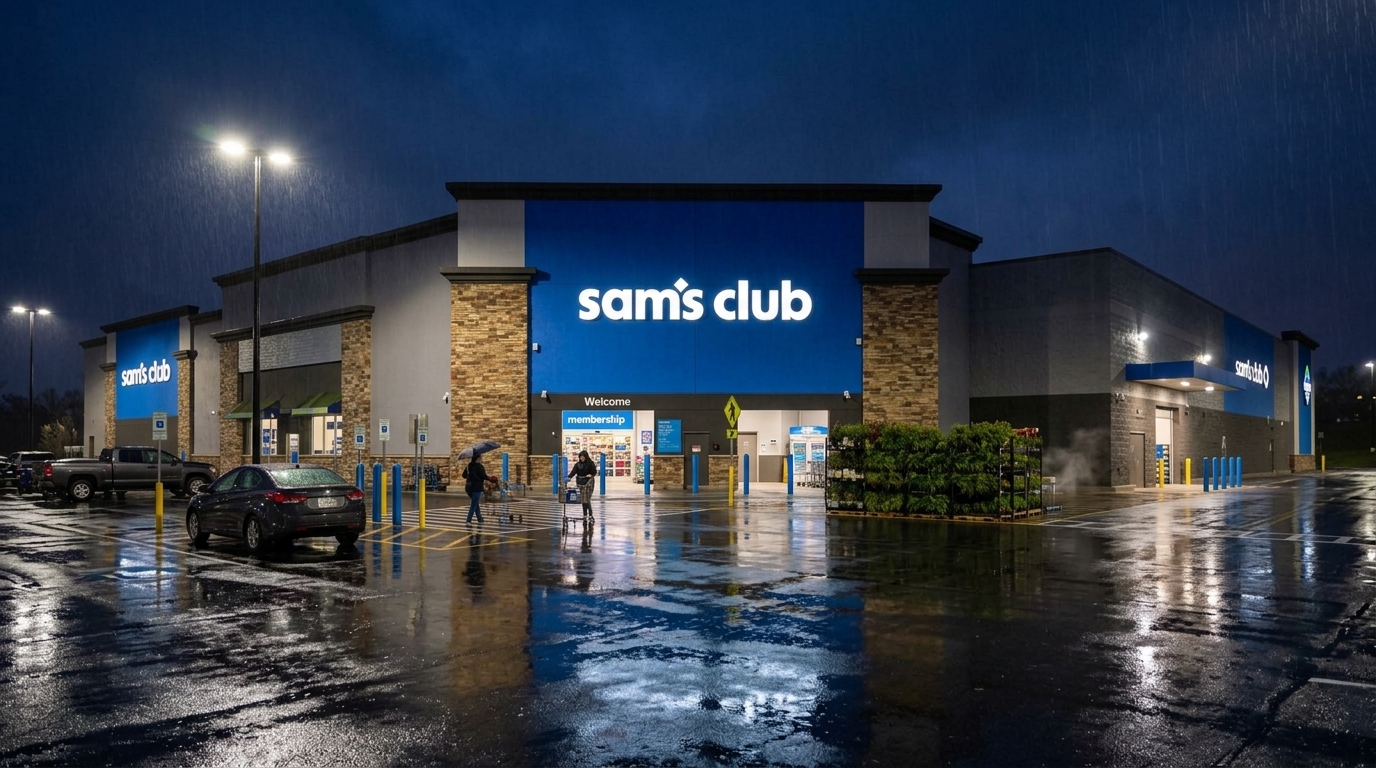
Sam’s West, Inc. (doing business as Sam’s Club) is a subsidiary of Walmart that operates a chain of membership-only warehouse club retail stores. Founded in 1983 as Sam’s Wholesale Club, it was named after Walmart founder Sam Walton. As of January 31, 2025, Sam’s Club ranked second in sales volume among warehouse clubs with $90.2 billion in sales, ahead of BJ’s Wholesale Club but behind its main rival Costco. The chain competes through a lean model of limited product selection, high inventory turnover, and membership-based access. Sam’s Club is a membership warehouse club, a limited-item business model that offers members quality products at an exceptional value, with merchants stocking the right products and purchasing them in large quantities, and passing on the savings to members.
As of May 18, 2026, Sam’s Club operated 602 membership warehouse clubs in the United States across 44 states and Puerto Rico, with no locations in Alaska, Massachusetts, Oregon, Rhode Island, Washington, or Vermont. Outside of the United States, Sam’s Club operates 173 locations in Mexico and 48 locations in China. In 2024, Sam’s Club and Walmart merged their supply chain teams completely, bringing both companies even closer together.
Retail Formats and Where It Operates
Sam’s Club sells most of its merchandise in bulk and directly off pallets, with clubs arranged like warehouses and merchandise stocked in steel bins. The standard club format ranges between 130,000 and 160,000 square feet. The first next-generation location reopened in Grapevine, Texas, in 2024, followed by the chain’s first new build in Tempe, Arizona, in 2025, with the chain aiming to add 15 new stores per year going forward. Tempe has about 7,000 square feet of fulfillment space and Grapevine has almost 6,000, while the average company-wide is around 1,500 square feet.
Sam’s Club added fuel stations, with pumps available only to members and the price for fuel found only inside the club, not advertised on the street. Sam’s Club offers car wash services at gas stations in 41 locations. The chain operates cafe locations and has expanded prepared-foods offerings in recent years.
Company Background
In 1983, Sam Walton opened the first Sam’s Club in Midwest City, Oklahoma. Just four years later, Sam’s boasted one million members, proving the club warehouse model was quite popular, and not just with small business owners. Sam’s Club expanded beyond the U.S. opening its first location in Mexico City in 1991 followed by China in 1996.
In 1987, Wal-Mart Stores purchased West Monroe, Louisiana-based SuperSaver Wholesale Warehouse Club; the purchase expanded the Sam’s Wholesale Club chain by 24 locations. In 1990, Sam’s Wholesale Club was renamed Sam’s Club, dropping off “Wholesale”. In 1993, Walmart acquired PACE Membership Warehouse from K-mart and converted a majority of PACE locations into Sam’s Club stores.
On January 11, 2018, Walmart announced that 63 Sam’s Club locations in cities including Memphis, Houston, Seattle, and others would be closing, with ten of the stores becoming e-commerce distribution centers. In January 2010, it was announced that ten clubs would be closing, including four in California, while at the same time, Sam’s opened six new clubs at various locations in the United States.
Between 2007 and 2009, there was speculation of a possible sale or spinoff of Sam’s Club from Walmart, and on February 26, 2009, Walmart Canada announced that it would be closing all six of its Canadian Sam’s Club locations as part of a decision to shift focus towards other superstores.
Ownership, Structure and Financial History
Sam’s Club is a subsidiary of Walmart. Sam’s Club operates quasi-independently with a CEO and other executive-level staff that make some decisions. The division shares resources with Walmart, including technology, data, and suppliers for house-brand products. On November 15, 2019, Kathryn McLay succeeded Furner as CEO of Sam’s Club. She became CEO of Walmart International in 2023 and was succeeded as Sam’s Club CEO by Christopher Nicholas. Latriece Watkins, currently Walmart U.S.’ EVP and chief merchandising officer, will assume the role of president and CEO at Sam’s Club U.S., effective February 1, 2026.
The warehouse club model relies on thin product markups and membership fees as primary revenue drivers. Mark-up on Sam’s Club items is just over wholesale, so goods at these stores are deeply discounted over other vendors. Starting May 1, 2026, Sam’s Club membership costs $60 per year instead of $50 for basic membership and $120 for its plus membership, instead of $110. Plus members see the annual cap on 2% Sam’s Cash rewards grow from $500 to $750.
Product Range and Store Brands
Launched in 1998 to provide members with quality alternatives to branded products, the brand underwent consolidation in 2017 when Sam’s Club unified its 20 proprietary brands under the Member’s Mark name. In 2022, Sam’s Club relaunched Member’s Mark as a purpose-driven, regenerative brand under the theme “Made with Our Member and Planet in Mind,” introducing a new logo and design while emphasizing quality, trend-right innovation, and sustainability.
Sam’s Club decided to remove over 40 ingredients, including certified synthetic colors, artificial flavors, aspartame, and high-fructose corn syrup from Member’s Mark products without compromising taste or value, and all Member’s Mark food and beverage products now meet its Made Without Commitment standards.
Sam’s Club has announced the availability of three new proprietary brands found exclusively at Club locations nationwide: Simply Right, Artisan Fresh and Daily Chef, with the products under the three brands previously available under the Member’s Mark brand. Simply Right is a health and wellness line, Artisan Fresh includes all natural and premium prepared foods, and Daily Chef includes a wide array of everyday foods such as easy-peel shrimp and organic coffee.
Products sold include jewelry, designer goods, sunglasses, crystal, and collectibles, electronics, floral, apparel, food, and meats. Sam’s Club sells more than 100 million slices of pizza a year at its cafe.
People and Workplace
Rosalind Brewer was named as the new CEO for Sam’s Club, a change that came into effect on February 1, 2012. She became the first woman to hold the CEO position at Sam’s Club.
Sam’s Club unveiled a reimagined approach to its workforce compensation, announcing a new plan that accelerates pay for nearly 100,000 frontline associates and provides a roadmap for them to plan and pursue more predictable, longer-term financial futures. Sam’s Club raised workers’ minimum wage from $15 to $16 an hour starting in November 2024, and will also raise wages for its nearly 100,000 employees, ranging from 3% to 6% depending on worker tenure. With the upcoming increase on November 2, Sam’s Club’s hourly wage rose nearly 30% in the last five years.
Since 2019, Sam’s Club has made more than a dozen unique wage investments from starting pay increases to annual stock grants that have benefited hourly and salaried associates across every level and area of the club. Implementation of block schedules for full-time associates provides associates better work-life balance with consistent weekly schedules.
Market Position and Competition
Sam’s Club operates in an intensely competitive warehouse club segment dominated by Costco and complemented by BJ’s Wholesale Club. As of January 31, 2025, Sam’s Club ranked second in sales volume among warehouse clubs with $90.2 billion in sales, ahead of BJ’s Wholesale Club but behind its main rival Costco. The chain differentiates itself through technology adoption and omnichannel capabilities.
In 2016, Sam’s Club rolled out a mobile application that allowed users to scan items while they shop and pay for them, skipping the checkout line, and by December 2016, the app could be used at all locations in the United States, though in 2019, the dedicated scanning app was deprecated and its features incorporated into the main Sam’s Club app.
Notable Developments and Outlook
In April 2025, Sam’s Club announced the nationwide implementation of its AI-powered receipt verification technology across all 600 US locations. As of January 2024, Sam’s Club used artificial intelligence-based receipt-checking technology at 10 stores that required customers to move through a portal to verify purchases, with plans to put the technology in all stores by the end of 2024.
Sam’s Club announced the launch of an enhanced version of its Express delivery service, enabling members to receive thousands of in-club items from checkout to doorstep in as little as an hour with no minimum purchase and pricing consistent with in-club shopping, with members now choosing between two Express delivery options: an expedited one-hour or less service priced at $10 for Plus members and $22 for Club members, or the traditional three-hour or less service at $5 for Plus members and $17 for Club members.
In 2023, Kathryn McLay announced plans for the company to build 30 stores. More cities are confirmed for 2026, with the chain aiming to add 15 new stores per year going forward. At Walmart’s 2025 Investment Community Meeting, former president and CEO Chris Nicholas outlined a strategy to double membership and more than double sales and profit over the next eight to 10 years.
Leave a Reply