
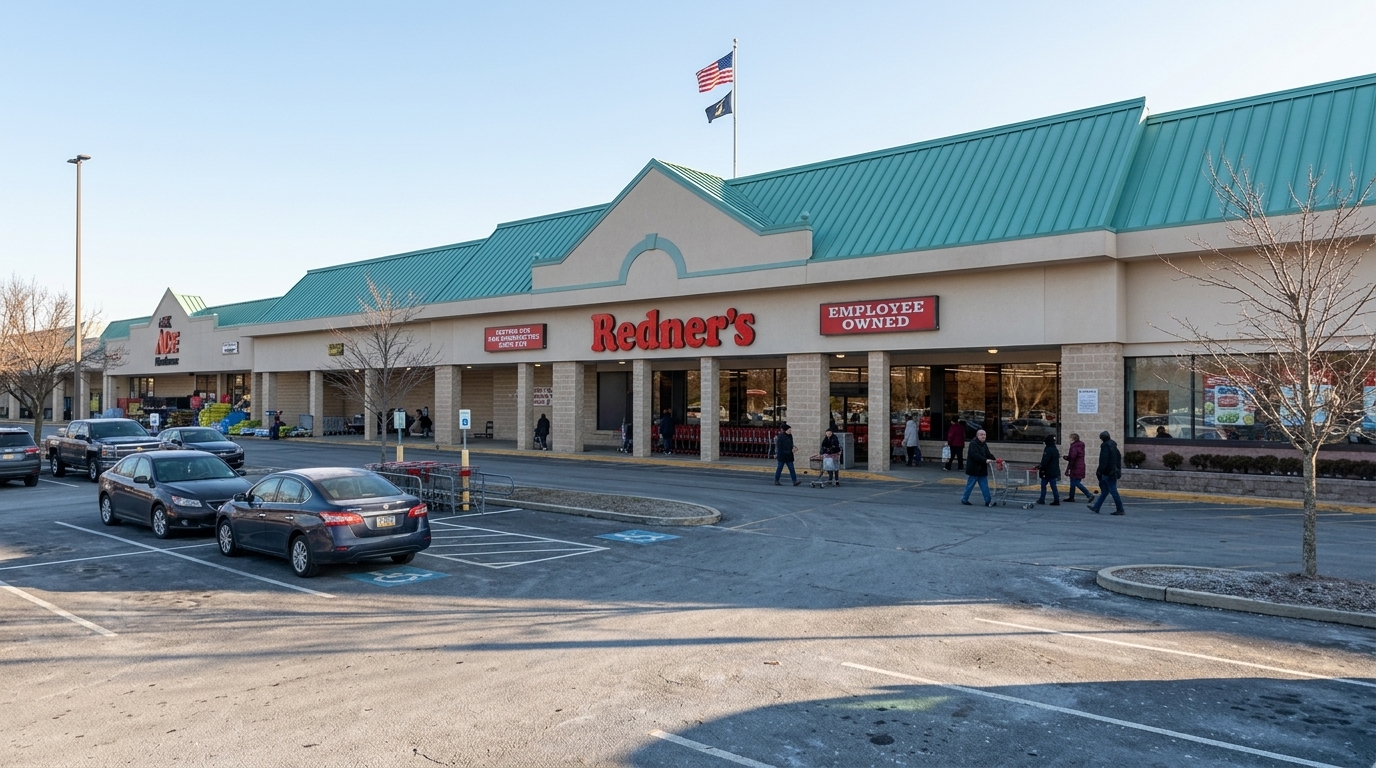
Redner’s Markets is a privately held, employee-owned American supermarket chain headquartered in Reading, Pennsylvania, wholly owned by present and past employees and members of the Redner family. The company operates primarily in the Mid-Atlantic region, competing on a combination of aggressive everyday low pricing, efficient warehouse-style operations, and a strong commitment to employee ownership that distinguishes it from both national chains and conventional regional grocers. Redner’s operates stores throughout Pennsylvania, Delaware, and Maryland, with a distribution warehouse located in Maidencreek Township, Pennsylvania.
Redner’s operations are organized into three divisions: Redner’s Warehouse Market, Redner’s Fresh Market and Redner’s Quick Shoppe. The warehouse format, which accounts for the bulk of the chain’s footprint, emphasizes high-volume bulk sales and cost efficiency, while the newer Fresh Market banner targets urban and affluent suburban customers seeking upscale merchandising and experiential shopping. The Quick Shoppe division provides fuel and convenience shopping across the region. Historically, Redner’s pioneered workforce innovations rare in grocery retail, including early adoption of employee stock ownership and in-store features such as salad bars and pharmacy departments.
Retail Formats and Where It Operates
Redner’s Warehouse Markets are warehouse-style markets without the need of a store club membership fee, with most locations ranging from 40,000 and 59,000 square feet in store size. These stores stock general merchandise and a full-service supermarket, selling products such as meat and poultry, baked goods, delicatessen, frozen foods, dairy products, garden produce, and fresh seafood.
Redner’s Fresh Markets are more conventional supermarkets and are slightly smaller than the size of a Redner’s Warehouse Market, offering beer & wine café, full-service food and grocery, and beauty aids/non-foods. The first location opened in the fall of 2019 in Reading, with two more locations (one in Audubon and one in Bel Air, Maryland) opening soon after. Additional Fresh Markets include Lewes, DE (opened November 2022), Langhorne, PA (converted from a Warehouse Market in fall 2023), and Collegeville, PA (converted from a Warehouse Market with a ribbon-cutting on May 2, 2024). The Wyomissing store at Berkshire Square, opened in April 2017, also remains operational.
Redner’s Quick Shoppe is a combined gas station and convenience store, with some locations offering Automatic Car Washes and Diesel. The chain also operates under convenience store banners including Quick Stop locations that serve as fuel and grab-and-go retail points across its operating region.
Company Background
Redner’s Markets was founded in March 1970, by Mary (1918–2007) and Earl Redner (1926–2017). Earl Redner was born in Bridgewater, Virginia, and began his career in the food industry in 1940 with the Grand Union Tea Co., spending the next 29 years working for Grand Union in various positions, including assistant store manager, district sales manager, division grocery sales manager and superintendent of stores in Washington, D.C., and was the youngest Grand Union employee to hold the title of manager, district manager and store superintendent until his departure in 1970. Earl and his wife Mary purchased two small floundering IGA supermarkets in the Reading area in 1970.
In 1975, the company formed an Employee Stock Ownership Plan (ESOP), making them the first supermarket in Pennsylvania to be employee owned. In 1979, Redner’s Markets transitioned from affiliation with the Independent Grocers Alliance (IGA) to operating as an independent chain under its own branding, a move that allowed greater control over merchandising and pricing strategies.
In March 1987 the company opened its first Warehouse Market location, and all its supermarkets were converted to the warehouse style by November 1987. This larger, cost-efficient model focused on bulk sales and low prices, tripling the business volume by 1990 through store enlargements and expanded selections.
In October 1990, Earl Redner retired and Richard and Gary W. Redner took over management of the company. From 1990 until the end of the decade, under Dick Redner’s leadership, the company grew impressively from nine stores to more than 30, utilizing its high-volume discount format to quickly gain market share in many new operating areas. Under Richard Redner’s direction, Redner’s entered new markets in the 2000s, opening its first Delaware store in Dover in 2008 and expanding into Maryland with locations such as Dundalk in 2012, thereby extending operations across three states.
Mary Redner died in 2007. Gary W. Redner was murdered in 2008 in a still unsolved homicide. Earl Redner, the founder of Redner’s Markets, died April 5, 2017, at age 91. Richard E. Redner, chairman of Redner’s Markets, died on April 25, 2024, two days after his 73rd birthday.
Ownership, Structure and Financial History
Redner’s is an employee-owned company that is wholly owned by present and past employees and members of the Redner family. In 2012, 48% was owned by Redner’s employees and 52% by the Redner family. The employee stock ownership structure has remained foundational to the company’s identity and operational philosophy for nearly five decades. The company formed its original employee stock ownership plan on December 21, 1975, and as of December 31, 2017, the ESOP owned approximately 48.1 percent of the Company.
The warehouse format enabled Redner’s to maintain thin margins while achieving strong absolute profit through high volume and efficient logistics. The distribution center in Maidencreek Township serves as the company’s operational nerve center, handling procurement, inventory management, and logistics across the region. In 2016, Redner’s installed Pennsylvania’s first high-volume grocery store food waste digester at its Maidencreek facility, converting supermarket waste into renewable energy and reducing landfill contributions.
Product Range and Store Brands
Redner’s Markets offers a comprehensive selection of grocery items across its stores, including staples in the grocery department such as canned goods, snacks, and household essentials, alongside a dedicated dairy section featuring milk, cheese, yogurt, and other refrigerated products sourced with an emphasis on local Pennsylvania suppliers to ensure freshness and support regional agriculture. The produce department highlights seasonal fruits and vegetables, often incorporating locally grown Pennsylvania options for quality and sustainability, while the meat department provides fresh cuts of beef, poultry, pork, and seafood, with full-service butchery available in many locations. The bakery department specializes in freshly baked breads, cakes, pastries, and custom orders, and the deli offers prepared foods, salads, cheeses, and meats for quick meals or platters.
A key aspect is the strong focus on private-label products, which allow Redner’s to offer high-quality alternatives at lower prices without relying heavily on national brands. Pharmacy departments operate across most locations, offering both prescription and over-the-counter medications at community pharmacy pricing and accepting most major insurance plans.
Fresh Markets feature dedicated spaces for ready-to-eat meals, such as Chef Tim’s signature offerings, allowing shoppers to explore innovative meal solutions without compromising on convenience or quality, with this emphasis on enhanced perishables and service-oriented sections setting Fresh Markets apart and providing a more curated selection than bulk-focused alternatives.
Redner’s Markets announced the launch of its new shopper app, replacing the disconnected digital shopping experience of the grocer’s previous app, which allows users to access their loyalty program rewards, find digital deals and place online orders. In 2026, Redner’s Markets launched a new mobile app powered by RSA’s unified commerce and engagement platform, bringing loyalty rewards, digital promotions, ecommerce ordering, and fuel rewards into a single shopper experience across its stores in Pennsylvania, Maryland, and Delaware. The app is the “cornerstone” of a larger digital strategy for the grocery company.
People and Workplace
Redner’s has long positioned itself as an employee-centric organization, with ownership structure and workplace benefits reflecting founder Earl Redner’s commitment to treating employees fairly. The retailer has been known for innovation, being the first grocer in the area to include salad bars in stores, install scanners, implement a recycling program, add in-store pharmacies, and become employee owned. The ESOP structure gives long-term employees a direct stake in company profitability and growth, creating alignment between workforce and shareholder interests unusual in retail grocery.
Under the ESOP mechanics, eligible employees receive stock allocations after completing one year of service while working more than 20 hours per week, with distributions tied to factors such as compensation levels, which reflect tenure and performance contributions, and this structure facilitates profit-sharing, where annual company contributions to the plan are allocated proportionally, directly linking employee efforts to ownership stakes and encouraging practices that drive efficiency and cost control.
Market Position and Competition
Redner’s operates in a competitive Mid-Atlantic market dominated by large national chains such as Weis Markets, Giant Food, and Wegmans, as well as discounters like Aldi and Lidl. The company’s positioning centers on warehouse-format efficiency and everyday low prices rather than premium service or specialty offerings in its core Warehouse Market division. The warehouse format allows the company to undercut traditional supermarket pricing while avoiding the club membership fees that characterize Costco-style operations.
The Fresh Market banner represents a strategic response to changing consumer preferences and competitive pressure from upscale regional chains, permitting Redner’s to serve affluent suburban and urban shoppers without compromising the warehouse division’s core value proposition. This two-banner approach reflects recognition that no single format can serve all customer segments in mature grocery markets.
E-commerce and digital engagement have emerged as critical competitive factors. Redner’s investment in a unified mobile app and digital commerce platform in 2026 underscores awareness that independent grocers must match national chains’ digital capabilities to retain market share. For independent grocers, mobile apps are described as “great equalizers,” empowering retailers to deliver a modern, seamless shopping experience that rivals what national chains offer, especially when it comes to customer convenience and loyalty.
Notable Developments and Outlook
In 2022, the company eclipsed $1 billion in annual sales. By 2024, Redner’s operated 44 grocery stores and approximately 24 Quick Shoppe convenience and fuel locations across eastern Pennsylvania, Delaware, and Maryland. In November 2025, Redner’s held a groundbreaking for its eighth Fresh Market location in Wilmington, Delaware—a 52,000-square-foot prototype store with in-store eateries, planned to open in 2026.
Leadership transitioned to the third generation following Richard Redner’s death in 2024. Ryan Redner, son of Richard, assumed the CEO role, while Gary M. Redner, a nephew and vice president, continues in operational leadership. In November 2024, Elaine Redner was appointed Chairwoman of the Board, providing strategic oversight while Ryan and Gary continue in their executive roles.
Strategic priorities center on digital infrastructure modernization, expansion of the Fresh Market format into new markets, and maintaining the warehouse division’s competitive advantage in price-sensitive segments. The deployment positions Redner’s to expand its digital engagement strategy in the coming months, including in-store kiosks planned for rollout later in 2026 and the use of advanced data insights and artificial intelligence to deliver more targeted promotions and personalized shopper experiences. Redner’s faces ongoing structural pressures from e-commerce, discount formats, and national chain scale, but its employee ownership structure, regional logistics network, and established brand loyalty provide defensible competitive advantages in its served markets.
Leave a Reply