
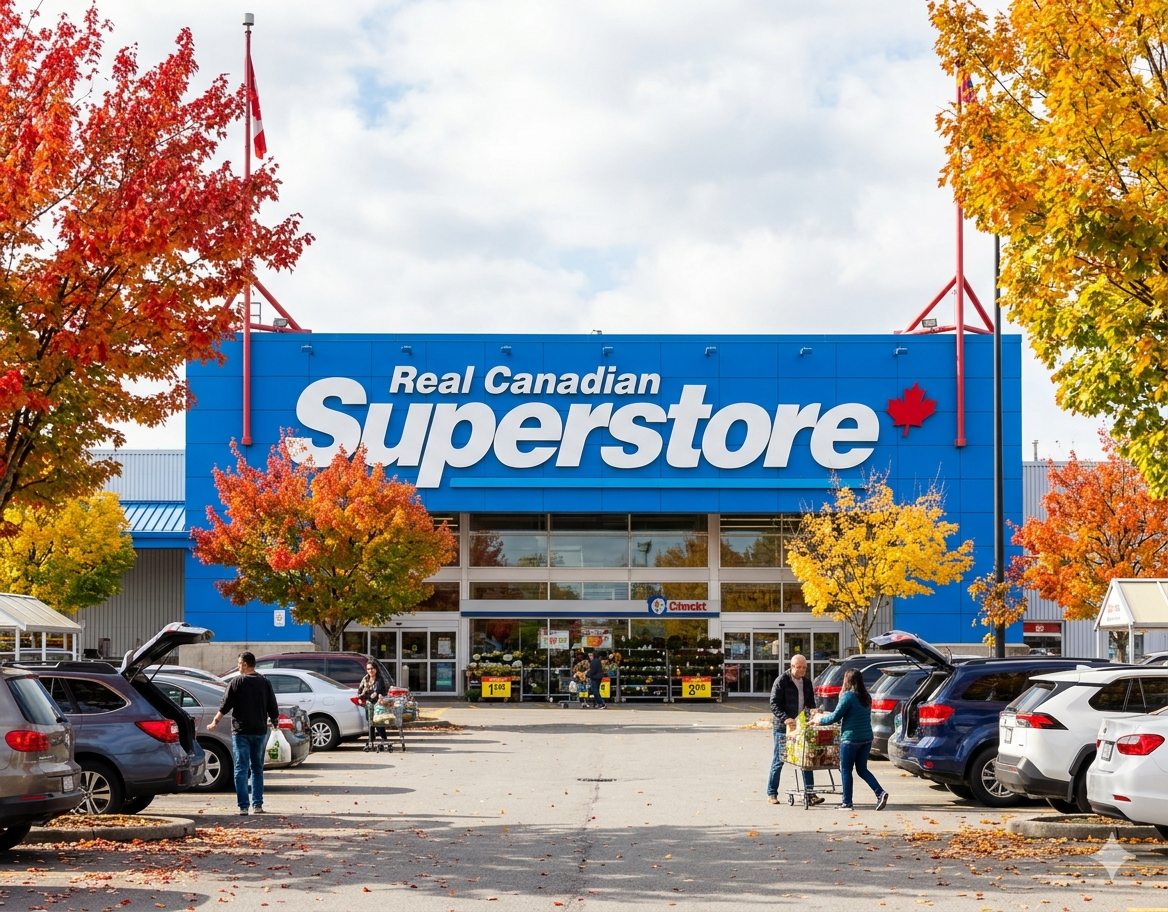
Real Canadian Superstore is one of Canada’s best-known big-box grocery banners, owned by Loblaw Companies Limited. It combines supermarket, general merchandise, and value-oriented retailing in a large-format store model that is especially strong in Western Canada and Ontario.
The chain is built around the one-stop shopping idea, with groceries as the core draw and a broader selection of household goods, seasonal products, and general merchandise than a traditional supermarket. That format has made it a familiar destination for families and value-focused shoppers who want to complete a larger shopping trip in one visit.
History
Real Canadian Superstore was launched in the late 1970s and early 1980s as Loblaw expanded into the superstore format in response to changing consumer expectations and rising competition from mass merchants. The banner later expanded into Ontario in the early 2000s as Loblaw used the format to compete more directly with Walmart and other large-format retailers.
Over time, the chain became a flagship example of the Canadian one-stop shop model. Its growth reflected the broader evolution of grocery retail, where stores increasingly combined food, home, and general merchandise under one roof.
Operations & Footprint
As of 2026, Real Canadian Superstore operates as a Loblaw banner and is headquartered within Loblaw’s corporate structure in Brampton, Ontario. The chain is known for large-format stores, often around or above 100,000 square feet, with a wide merchandising mix that extends beyond groceries.
The banner has long been associated with Western Canada, but it has also continued to expand selectively in Ontario. Industry coverage has pointed to continued growth plans in the province, showing that the format remains an important part of Loblaw’s retail strategy.
Products, Services & Merchandising
The chain’s core offer includes produce, meat, dairy, bakery, pantry staples, frozen foods, prepared foods, and household essentials. Compared with a conventional supermarket, Real Canadian Superstore also devotes significant space to general merchandise such as electronics, home goods, and apparel-related categories.
That wider assortment helps the banner compete on convenience and trip consolidation, especially for families and value-focused shoppers. It also makes the store relevant to customers who want to combine grocery shopping with bulk household purchasing in a single visit.
Work Environment & Employment
As a Loblaw banner, Real Canadian Superstore draws from the parent company’s large retail labor pool and typically employs workers across grocery, cashier, merchandising, warehouse, pharmacy-adjacent, and department-support roles. Store staffing needs are shaped by the format’s size and broad product mix, which generally require more operational coordination than a smaller neighborhood grocery store.
The work environment can vary by location, but the format is generally fast-paced and operationally complex because of its scale. Employment opportunities are broad, especially for workers seeking experience in retail operations, grocery management, and customer service.
Financial Profile
Real Canadian Superstore is not separately publicly traded; it is a banner within Loblaw Companies Limited, which is listed on the TSX under the symbol L. Loblaw reported 2024 revenue of $61.014 billion, adjusted diluted net earnings per common share of $8.55, and approximately $3.9 billion in e-commerce sales for the year.
For the banner specifically, sales are not usually reported as a standalone public figure in the same way a public company would report segment results. In practical terms, the Superstore format is financially important because it supports Loblaw’s food retail, general merchandise, and value-positioning strategy within the broader corporate portfolio.
Competitive Landscape
Real Canadian Superstore competes most directly with Walmart Canada, Costco, Sobeys, Metro, and other large-format and discount grocery chains. Its strength is the combination of grocery scale and non-food breadth, which makes it more of a one-stop supercenter than a pure supermarket.
That positioning gives it an advantage with large weekly baskets and household stock-up trips. At the same time, it faces pressure from discount formats, warehouse clubs, and consumers who are increasingly price-sensitive and willing to split trips across multiple retailers.
Current Status & Outlook
As of 2026, Real Canadian Superstore remains an important Loblaw growth banner, with continued interest in expansion and format investment, especially in Ontario. The chain’s large-format model still fits a market where shoppers want value, assortment, and convenience in one stop.
Its future will likely depend on how well it balances price perception, assortment, and operational efficiency in a competitive grocery market. The format remains relevant because it serves a clear customer need: a broad shopping trip with groceries and general merchandise under one roof.
Leave a Reply