
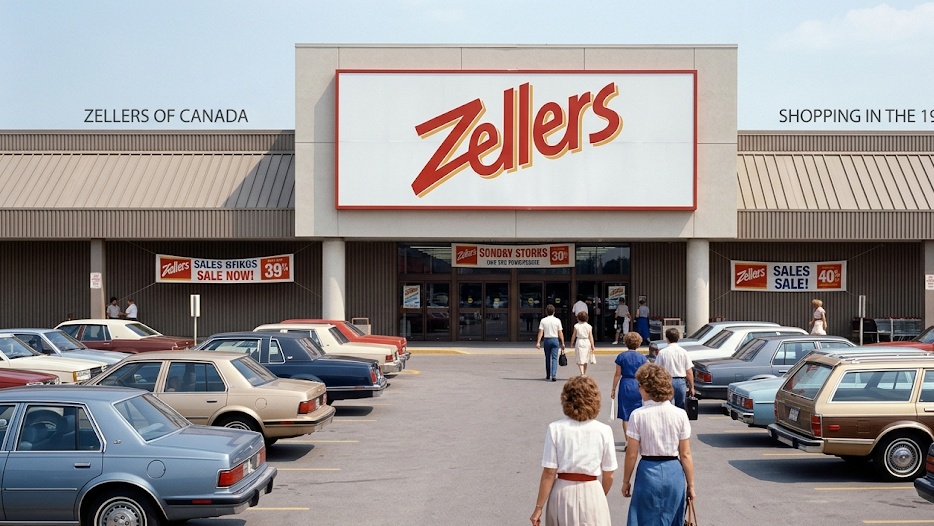
Zellers was originally founded on August 4, 1928, by Walter P. Zeller in London, Ontario, who established the company after working in retail at several major American department stores. The business closed two years later but was relaunched in 1931. After the initial failure, Zeller purchased fourteen Canadian locations of the bankrupt Schulte-United chain and relaunched Zellers as a discount retailer. For decades, the chain grew steadily across Canada and became a household name, known for affordable family shopping that combined clothing, household goods, toys, and food items under one roof.
Zellers sold clothing, groceries, stationery, toys, electronics, furniture, and home supplies, with all locations carrying basic groceries and some featuring an expanded grocery section called the Neighbourhood Market that included frozen and dairy aisles. The brand operated with the slogan “Where the lowest price is the law” and featured in-store restaurants initially called The Skillet in the 1960s and later rebranded as the Zellers Family Restaurant. The discount department store model proved durable, and the chain became a cultural anchor in Canadian retail for generations of shoppers.
History
Within 25 years, Zellers operated 60 stores and employed 3,000 people. In 1952, in a move to expand into Atlantic Canada, it acquired the Federal Stores chain of variety stores, adding more than 12 new Zellers locations. Throughout the 1950s and 1960s, the chain continued regional expansion under Zeller’s leadership. W.T. Grant, an American mass merchandise chain, acquired a 51 percent stake in 1959, but later withdrew entirely from Canada due to intense competition in the United States.
In 1976, Fields, a Vancouver-based clothing retailer, offered to purchase a 50.1 percent stake in Zellers, but Zellers’ shareholders reversed the takeover and instead purchased Fields and its hardware store division, Marshall Wells, adding 70 Fields stores and 162 franchised Marshall Wells stores to the company. Joseph Segal, Fields president and founder, was appointed president of Zellers. In 1978, Hudson’s Bay Company acquired Zellers, bringing the banner into one of Canada’s largest retail conglomerates.
After a series of acquisitions and expansions, Zellers peaked with 350 locations in 1999. In 1990, Hudson’s Bay Company acquired the 51 stores of the Towers/Bonimart chain from the Oshawa Group, and converted most of them to Zellers outlets. In 1993, Hudson’s Bay Company purchased the assets of the bankrupt Woodward’s chain, including 21 store locations, which were converted into Zellers and The Bay stores and greatly expanded the company’s presence in Western Canada. In 1998, Hudson’s Bay Company acquired Kmart’s Canadian division and merged it with the Zellers division to create a larger combined chain under the Zellers name.
During the 2000s, Zellers faced fierce competition and an inability to adapt during the early stages of the retail apocalypse, resulting in significant loss of ground. In January 2011, HBC announced that it would sell the lease agreements for up to 220 Zellers stores to the US chain Target. HBC initially retained 64 Zellers locations but announced in July 2012 that all of them would be closed by March 31, 2013. When the chain ceased, HBC converted three former stores into Zellers-branded liquidation outlets for Hudson’s Bay stores, however they all had closed by January 2020.
Operations & Footprint
Zellers operated predominantly across Canada in suburban and urban shopping malls and retail districts. By the 1990s, the chain had expanded to include acquisitions such as the Towers/Bonimart discount brand, which solidified its presence in major metropolitan regions. As of 2012, the remaining Zellers stores employed approximately 6,400 people, or roughly 100 per location, ranged in size from 48,000 to 128,000 square feet, and were mostly in small towns. The typical Zellers store operated as a full-service discount department store with multiple departments spread across a large footprint, though prototype stores in Winnipeg featured full grocery departments including fresh produce and baked goods, though such plans were dropped following Target Canada’s acquisition of many Zellers leases.
Zellers and Fields were kept as separate divisions of Hudson’s Bay Company, allowing the company to operate both the discount Zellers banner and the Fields fashion chain under distinct retail strategies. HBC acquired full ownership of Zellers and Fields in 1981 and Marshall Wells in 1982. The corporate structure kept Zellers positioned as a strategic discount division within the larger HBC portfolio, though this relationship shifted in later years as HBC’s parent companies pursued different strategic priorities.
Products, Services & Merchandising
Products sold at Zellers included clothing, groceries, stationery, toys, electronics, furniture, and home supplies. Some locations featured the Neighbourhood Market, an expanded grocery section with frozen and dairy aisles, while prototype stores in Winnipeg tested full grocery departments with fresh produce and baked goods. Zeddy, a teddy bear mascot, advertised Toyland, the toy section, and many stores had on-site restaurants, at first called The Skillet in the 1960s and later rebranded as the Zellers Family Restaurant.
The brand’s appeal rested on its value positioning and broad assortment. Zellers used the slogan “Where the lowest price is the law” throughout much of its operated history, establishing price leadership as its core competitive advantage. Loyalty was encouraged through the Club Z points program, which rewards customers for repeat purchases. The in-store restaurants added to the one-stop-shopping appeal, making Zellers a destination for family outings, particularly in suburban markets where the large stores served as neighborhood anchors.
Work Environment & Employment
Zellers employed staff across multiple functions: sales associates, stockers, cashiers, customer service personnel, and restaurant workers. As the chain declined, the remaining 64 stores employed approximately 100 people per location. The work environment reflected the broad nature of the discount department store model, with employees managing diverse merchandise categories and in-store services. No evidence of significant unionization efforts or major labor disputes appears in the historical record, though Zellers operated during decades of rising retail employment and competition for labor in suburban and mall-based retail settings. The closure in 2013 resulted in large-scale job losses across Canada.
Business Model & Financial History
Zellers operated on the thin-margin discount retail model, competing primarily on price and assortment breadth. The chain’s economics depended on high inventory turnover, efficient operations, and real estate leverage—owning or leasing prime mall locations that generated substantial traffic. In fiscal 2006, Zellers reported a loss of $107 million on sales of $4.2 billion across 291 stores, part of Hudson’s Bay Company’s (HBC) overall net loss of $175 million for the year. By 2010, Zellers’ annual sales remained stagnant at approximately $2.5 billion, compared to Walmart Canada’s $16 billion, highlighting a significant loss of market share to competitors.
In July 2008, the company was sold to NRDC Equity Partners, a private equity firm based in New York, for just over $1.1 billion, and the Canadian and US holdings were transferred to NRDC Equity Partners’ holding company, Hudson’s Bay Trading Company. After the deal with Target Corporation, HBC still carried a burden of half of the $226.4 million of Zellers lease obligations remaining through 2016. The financial strain of unwinding Zellers’ extensive lease portfolio forced HBC to either terminate liabilities at steep discounts or find new tenants—a process that consumed significant management attention and capital during the early 2010s as HBC prepared for its own public offering.
Competitive Landscape
Walmart’s expansion in Canada, starting with its 1994 acquisition of Woolco stores, allowed it to leverage economies of scale for lower prices and broader supply chains, while Zellers struggled to match these advantages. By the 2000s, Zellers faced compounding challenges: Walmart had established superior operational efficiency and scale, discount retailers like Dollarama had fragmented the value segment, and e-commerce was beginning to erode the retail mall model. Target exited its Canadian stores in early 2015 amid billions of dollars in losses, having failed to replicate its U.S. success in the market it inherited from Zellers.
The core vulnerability of the old Zellers model was its dependence on large-format stores in shopping malls at a time when both the mall model and big-box discount retail were under structural pressure. The brand’s broad assortment, once a strength, became costly to maintain at a time when specialized retailers and online channels were fragmenting the customer base. Zellers could not match Walmart’s supply-chain scale or Costco’s membership model, nor could it compete with pure-play fashion or home retailers on curation or expertise.
Recent Developments & Outlook
In 2023, the Zellers brand was formally reintroduced as a store-within-a-store concept inside Hudson’s Bay department stores. However, in 2025, HBC filed for bankruptcy and closed all Hudson’s Bay stores. On August 28, 2025, for the third time in its history, it was announced that Zellers would be relaunched again, this time under new ownership of Les Ailes de la Mode, with the first location opening in a former Hudson’s Bay store at Londonderry Mall in Edmonton, which ultimately opened on October 30, 2025.
Designed as a 30,000–50,000 square foot modern, smaller department store concept, Zellers will deliver a thoughtfully curated experience that blends heritage with contemporary design. The Benitah family, led by Isaac Benitah, controls several Canadian retail banners and brings decades of apparel and home retail experience to the Zellers revival, with Joey Benitah emerging as the public face of Zellers 3.0, emphasizing discipline, adaptability, and long-term viability. By Spring 2026, Zellers will begin announcing new locations across the country, with expansion plans over the next several years, and plans to occupy select vacant spaces formerly held by Hudson’s Bay stores, reimagined into smaller, more efficient retail footprints.
A new discount storefront is set to open near Toronto’s Yorkdale Mall on June 18th, and another at Windsor’s Tecumseh Mall in July. The Ontario stores will also introduce snack foods and toys; the owners initially wanted to leave toys out because they felt it would be too hard to compete with Walmart and Amazon, but changed their mind because a small selection of toys at the Edmonton location wound up being some of the store’s best sellers. Zeddy’s return will also mark the revival of Zellers’ long-standing commitment to giving back, with the brand developing a national partnership with pediatric oncology camps to support camps that serve children and families affected by childhood cancer.
The new Zellers positions itself as a value-focused, smaller-footprint alternative to sprawling discount department stores of the past, targeting a market gap between Walmart and specialty retailers. Success depends on whether the Benitah family can sustain the brand through disciplined execution, differentiated merchandise curation, and genuine value delivery. The phased rollout approach and emphasis on listening to customer feedback suggest a more cautious growth strategy than the original chain’s aggressive expansion, but also reflect the realities of a mature, competitive retail market where nostalgia alone cannot sustain operations. As of 2026, the brand is at an early stage of its third resurrection, with momentum and consumer goodwill but no certainty of long-term viability.
Leave a Reply