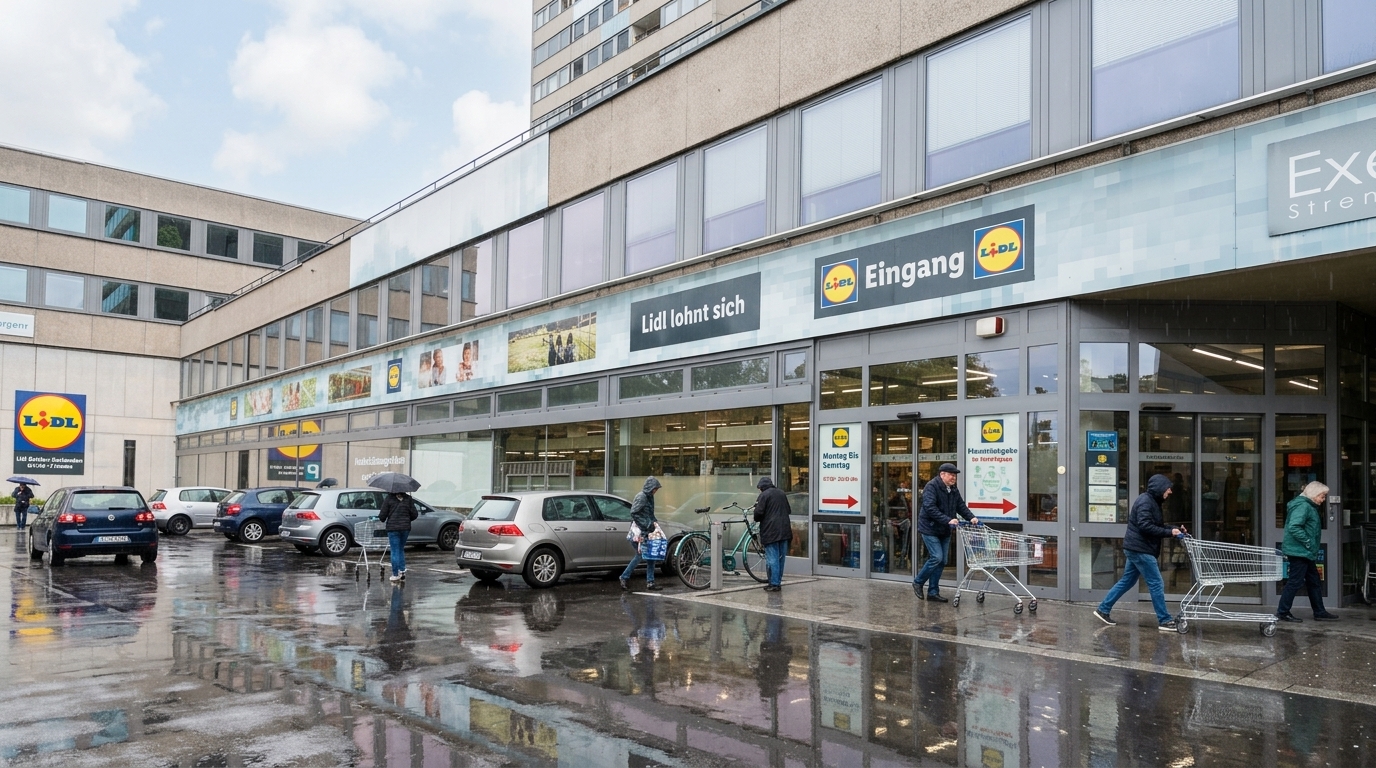
Lidl traces its origins to 1930, when Josef Schwarz became a partner in Südfrüchte Großhandlung Lidl & Co., a fruit wholesaler in Heilbronn, Germany, which he renamed Lidl & Schwarz KG. Under his son Dieter Schwarz, the company began focusing on discount markets and cash-and-carry wholesale operations in 1977. Dieter Schwarz adopted the discount store concept in 1973, opening the first Lidl store in Ludwigshafen, Germany, with an initial offering of 500 product lines. By 1977, the chain had grown to 33 stores, establishing a strong presence in Germany. Dieter became CEO in 1977 when Josef died and built Schwarz Group into Europe’s largest retail empire, with more than 500,000 employees.
Lidl expanded internationally in 1989 with the opening of its first store in Sarreguemines, France. In 2012, Lidl launched bakeries in their stores across Europe, consisting of small baking areas where bread and pastries were displayed for sale. Lidl entered the United Kingdom in September 1994. In June 2015, the company announced it would establish a United States headquarters in Arlington, Virginia. Lidl opened its first stores in the United States in Virginia Beach, Virginia, and other mid-Atlantic cities in June 2017. By the end of 2020, the company operated over 100 stores across the eastern U.S. As of 2024, there were 173 stores in the US.
In April 2022, Lidl postponed its expansion in Ukraine due to Russia’s invasion of the country. In 2025, Lidl committed to increase the proportion of sales of plant-based foods by 20 percent from a 2023 baseline by 2030.
Lidl set up in Norway over three years ago but never captured more than 2% of the market and announced in March 2008 that it would sell all its stores and entire operations to competitor Rema 1000 and cease all operations. Out of all the markets Lidl has entered, Norway remains the only one where the company has fully exited.
Operations & Footprint
Lidl operates around 12,600 stores and more than 230 logistics centres and warehouses in 31 countries. The largest international markets are France with 1,600 stores, followed by the United Kingdom with 1,005 and Poland with 892 locations. In its home market of Germany, the number of stores stood at 3,247 as of the end of 2024.
In the United States, the company initially focused on opening locations in East Coast states, between Pennsylvania and Georgia, and as far west as Ohio, opening its first stores in Virginia Beach and other mid-Atlantic cities in June 2017. In Virginia, which leads with 35 stores, Lidl demonstrates strong market penetration and an established footprint, while New York follows with 33 locations, signaling ongoing expansion. Its stores are mostly in Virginia and North and South Carolina.
The Schwarz Group is the parent company of Lidl, Kaufland and other brands. Schwarz Group is owned by a foundation, technically a limited liability company, but Dieter maintains full control and is the effective owner. Lidl operates as a private company without public equity ownership.
Lidl has major distribution centers in Mebane, North Carolina, and Spotsylvania County, Virginia. In July 2022, Lidl founded Tailwind Shipping Lines GmbH & Co. KG, headquartered in Hamburg, which operates a total of eleven container ships to transport goods from Asia to Europe. In June 2025, it was announced that Tailwind had ordered five medium-sized container ships with up to 8,400 TEU.
Products, Services & Merchandising
Like fellow German discounter Aldi, Lidl has a zero-waste, no-frills approach of displaying most products in their original delivery cartons, allowing customers to take the product directly from the carton. Approximately 90% of Lidl’s inventory consists of private-label brands, streamlining inventory management and reducing costs. Lidl does not produce anything itself, but the sister company “Schwarz Produktion” produces private labels exclusively for Lidl and Kaufland.
Lidl has explored ventures beyond traditional grocery retail, including travel services like ‘Lidl Voyages’ in France. The company also engages in e-commerce, with online revenue reported at €1.7 billion in fiscal year 2022. The introduction of in-store bakeries, a strategy initiated in 2012, enhances the customer experience and attracts more foot traffic.
The Lidl Plus app connects the digital world with physical retail and is now available in all European Lidl countries with stores. It combines basic information such as store finder, opening hours and digital leaflets, offers additional benefits like coupons and discounts, and makes shopping easier with digital receipts and the Lidl Pay function.
In 2021, Lidl planned to phase out the selling of cigarettes in all its Dutch stores by 2024 as part of the “smoke-free generation”.
Work Environment & Employment
Staffing is minimal, with stores typically having a team of between 17 and 25 depending on store size, and everyone from management to customer assistants multiskilled from working delivery at 5AM, jumping on the tills or baking and completing the promotional changeovers.
Lidl has faced significant criticism regarding workplace practices across multiple regions. The Times noted that Lidl managers work excessive hours and are obliged to sign out of the Working Time Directive when starting with the company, while The Guardian reported other allegations in the United Kingdom and abroad. In March 2008, the German magazine Stern published an exposé accusing Lidl of secretly inserting cameras into their stores throughout Germany and the Czech Republic to watch their workers. Lidl has been criticised in both the United Kingdom and Ireland for not allowing workers to join unions. From the outset, Lidl members in Slovenia faced an aggressive attack on the union by the company, with the aim of destroying workers’ trade union organisation through punitive transfers of union members to remote workplaces, threatening several of them and sacking the union president.
In April 2010, on the initiative of the European Center for Constitutional and Human Rights and the Clean Clothes Campaign, the Hamburg Consumer Protection Agency filed an unfair competition complaint against Lidl for claims made in the company’s advertisements about fair working conditions in their supplier chain. Lidl now acknowledges that abuses often occur when governments fail to protect workers and trade unions are absent or weak.
In 2023, an employment tribunal ruled that Lidl unfairly dismissed a senior construction consultant and discriminated against him because of his age after marking him down in a redundancy process for not having a degree.
Business Model & Financial History
The discount model aims to provide customers with basic necessities at the lowest possible price while maintaining high quality. The success of this supermarket type is due to four fundamental pillars: limited product range, increased supply of low-priced private label products, good value for money with high quality at reduced prices, and efficient supply-chain operations.
The Lidl business model emphasizes affordability, with the store maintaining a low profit margin so that customers can purchase goods at discount prices. The company’s emphasis on private labels, which constitute approximately 90% of its stock, allows for greater control over quality and cost, enabling prices around 30% lower than branded alternatives.
Lidl’s core operations are built around a lean retail model focused on efficiency and cost-effectiveness. Lidl’s commitment to cost control extends to its logistics, evidenced by the establishment of Tailwind Shipping Lines. This initiative, which added routes from Asia to Europe in June 2025, aims to further enhance control over its supply chain and mitigate rising freight costs. This integrated approach to operations and logistics is fundamental to how Lidl operates and underpins its competitive discount grocery model.
Schwarz Produktion produces private labels exclusively for Lidl and Kaufland. A sister company “MEG Weißenfels GmbH & Co. KG” operates five bottling plants in Germany and one in Great Britain. In September 2022, Papierfabrik Maxau with 440 employees was acquired from Stora Enso for €210 million. The company Erfurter Teigwaren GmbH (renamed Bon Pasta GmbH) in Erfurt was acquired in October 2022, producing 110,000 tons of durum wheat pasta annually.
Competitive Landscape
Lidl is the chief competitor of the German discount chain Aldi in several markets. In contrast to other expansion markets where Lidl and Aldi have not yet been able to gain on the respective market leaders, both are steadily improving their positions in Great Britain. According to Kantar, Lidl’s market share in Great Britain was 7.7% at the beginning of December, up 0.7 percentage points year-on-year. Aldi increased its share to 10.3%, up 0.4 percentage points.
As in Poland and Italy, the two German discounters are up against a strong market leader, low-price supermarket operator Mercadona. Although analysts estimate Mercadona’s year-on-year sales growth at 1.9% and Lidl’s at 6.5%, the discounter is outpaced in absolute terms by its competitor, who is four times larger.
Since the mid-2020s, few brick-and-mortar supermarket models have continued to grow, but discount stores — led by Aldi and Lidl — are among them. In the UK, Lidl reached an 8.1% market share by June 2024, becoming the fastest-growing physical supermarket.
Recent Developments & Outlook
In the current fiscal year 2024/2025 ending in February, the discounter opened 177 stores worldwide, compared to 163 for the entire previous business year. Among Lidl’s international country portfolio, Poland leads the way with 38 net store openings to 930 stores in the past 10 months. In Spain, Lidl has opened 22 new stores since March 2024, bringing the total number of stores to 700.
Lidl GB aims to open 1,100 stores by the end of 2025. As part of its continued mission to provide all communities across the country with access to affordable, high-quality food, Lidl has published its 2025 site requirements brochure, outlining hundreds of potential locations for new stores – including high streets, retail parks, and mixed-use town centre sites. The updated list features locations across England, Scotland and Wales.
Lidl is actively expanding, with plans for over 40 new UK stores in 2025, backed by a £500 million investment, and 50 new stores in Spain in the same year. In the US, it operates over 180 stores in nine states and Washington D.C., with further expansion planned in existing markets.
In 2026, Lidl announced that it would be opening its first pub next to its in Dundonald, East Belfast, Northern Ireland. The pub will be named “The Middle Ale”, and is due to open in June 2026.
In 2025, Lidl committed to increase the proportion of sales of plant-based foods by 20 percent from a 2023 baseline by 2030.
Leave a Reply