
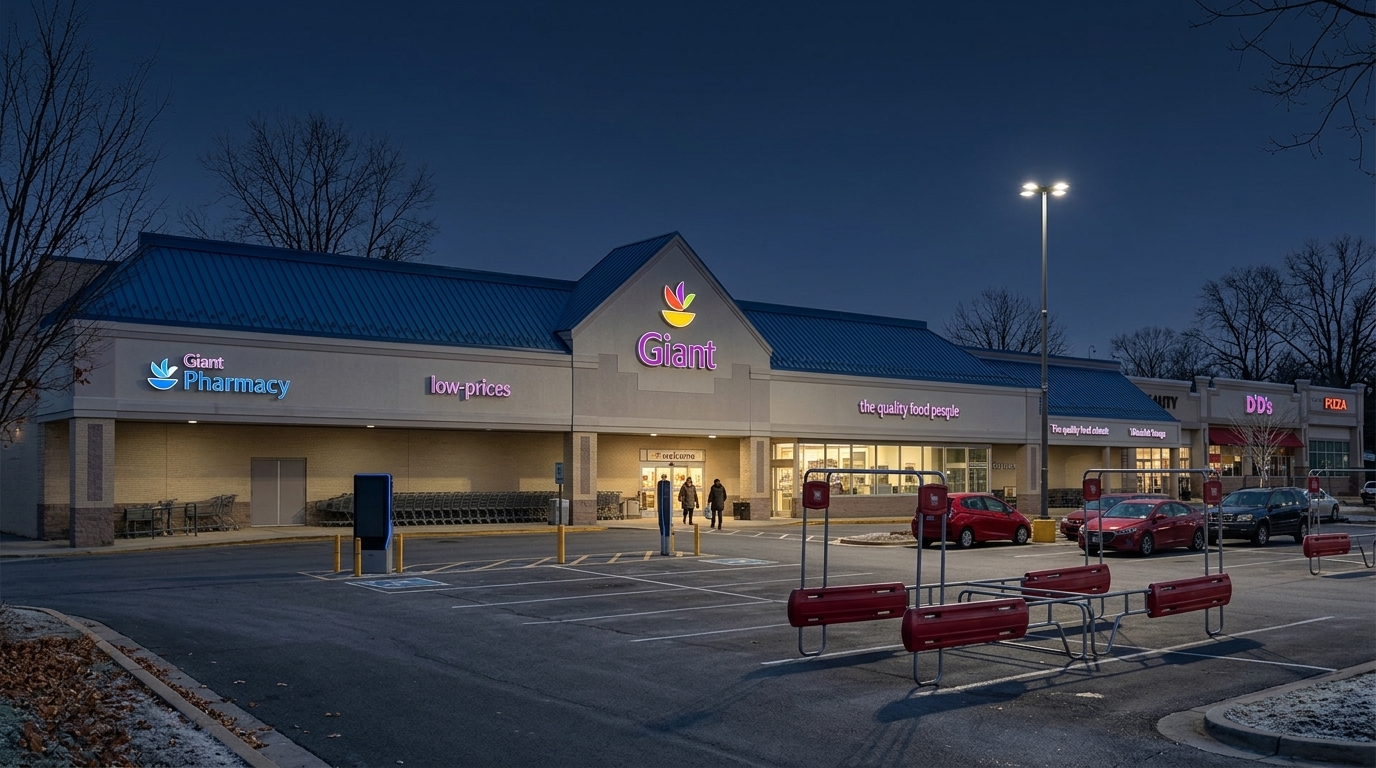
Giant Food operates 166 stores located in Delaware, Maryland, Virginia, and the District of Columbia. Founded in 1936 as Washington’s first mass-merchandised supermarket amid the Great Depression, the company pioneered early innovations in grocery retailing such as vertical integration. The chain competes as a regional leader in the mid-Atlantic by emphasizing full-service departments, quality private-label brands, and tight integration of digital shopping options with physical stores.
Giant Food is headquartered in unincorporated Prince George’s County, Maryland, near Landover, and is a subsidiary of Ahold Delhaize. The chain is known in business context as Giant-Landover, to avoid confusion with The Giant Company, a Pennsylvania-based sister chain also owned by Ahold Delhaize and often referred to as Giant-Carlisle. Within the Ahold Delhaize portfolio, Giant Food operates independently and maintains a primarily unionized workforce, distinguishing it from its non-union sister chain.
Retail Formats and Where It Operates
Giant Food operates traditional supermarkets ranging from 45,000 to 66,730 square feet in the mid-Atlantic region. Store formats include full-service produce sections, butcher and seafood departments, bakeries, and in-store pharmacies. Many locations feature prepared-food sections, including hot bars, salad bars, and grab-and-go offerings. The chain has incorporated co-branded locations, including PNC Bank branches and Starbucks coffee service in select stores.
The core geographic footprint spans Delaware, Maryland, Virginia, and the District of Columbia, with the greatest density in the Washington metropolitan area and Baltimore region. The company dominates its main market areas with 45 percent of the Washington market and a large share of the Baltimore market. Following early expansion into suburban shopping centers in the 1950s, Giant maintains presence across both dense urban and suburban markets within its four-state territory. Distribution is managed through a fresh distribution center in Jessup, Maryland, and additional supply-chain infrastructure supporting perishable and dry-goods operations.
Company Background
Giant was founded in 1936 by Nehemiah Meir “N.M.” Cohen and Samuel Lehrman. The company was Washington’s first mass-merchandised supermarket amid the Great Depression. Cohen was a kosher butcher who had immigrated from Eastern Europe; Lehrman provided initial capital and expertise. The first store became a benchmark for modern self-service retailing in the region.
Following World War II, Giant Food underwent rapid expansion, growing from 19 stores in 1949 to 53 by 1959 across Washington, D.C., Maryland, and Virginia. In 1955 the chain opened its first store in the Baltimore metropolitan area at Ingleside Shopping Center in Catonsville, Maryland. In 1956, the chain opened its first store in the Richmond, Virginia, market. In 1955 Giant Construction Company was incorporated to build Giant stores, reflecting vertical integration into real estate development. In 1958, riding a new merchandising trend of combination supermarket/department stores, Giant opened its first Super Giant store and within a year had opened eight more. Also in 1958, the company opened its new headquarters and distribution center on a 40-acre site in Landover, Maryland.
In 1957 Giant Food Shopping Center Inc. became Giant Food Inc., and fiscal 1958 saw sales of more than $100 million. In 1959 the company, with 53 stores (including nine Super Giant stores) went public. In 1962, Giant opened its first store with both food and a pharmacy. This was in Glen Burnie, Maryland. Giant is noted as the first grocery chain in the United States to bring pharmacy services in-store. Israel “Izzy” Cohen inherited the family mantle in 1964 and built the company into the 12th-largest food chain in the United States.
Around the time the Civil Rights Act of 1964 was passed, Giant began opening new locations in predominantly Black neighborhoods, in response to early criticism over failing to do so since beginning operations. In 1948 Giant bought the Sheridan Bakery, which had been supplying baked goods to the chain. Renamed for Jacob Lehrman’s daughter, Heidi Bakery continuously provided bread and baked goods for all Giant stores both from the original bakery location in Silver Spring, Maryland, and from the in-store bakeries developed in later years.
In 1975 Giant began using computer-assisted checkout and in 1979 it installed price-scanning equipment in all of its stores, becoming the first supermarket chain to do so. In 1983 Giant opened a 60,000-square-foot store in a former Super Giant. This flagship store stocked some 40,000 items and combined such features as gourmet food, cosmetics, bulk food items, an in-store bakery, and a salad bar. Cohen died in 1984 at age 93, having been active in the company until he was 90.
Cohen died in 1995 at the age of 83. In May 1998, Giant Food agreed to be acquired by the Dutch firm Royal Ahold N.V. Ahold, through its U.S. unit Ahold USA, Inc., completed its $2.8 billion acquisition of Giant in October 1998. To gain Federal Trade Commission approval for the deal, Ahold had to divest ten stores in Maryland and Pennsylvania, including the Super G outlets in the latter. Starting in 1994, they expanded into the Philadelphia/Delaware/South Jersey area, but under the name Super G, as to avoid confusion with future sister chain Giant of Carlisle.
In 2004, Ahold merged Giant and Stop & Shop and eliminated more than 600 positions at Giant’s Landover headquarters, creating Stop & Shop/Giant-Landover, which itself is a subsidiary of Netherlands-based Royal Ahold. In 2011 the two companies were separated and now operate independently. Also in 2005, Giant launched a private-label line of organic food products under the Nature’s Promise brand.
In 2006, Giant signed a five-year agreement with Starbucks Coffee to open Starbucks locations in several of Giant’s stores. The agreement was not renewed upon expiration in 2011 because many of the shopping centers that played host to Giant stores also were hosts of standalone Starbucks locations. In September 2012, Giant sold its 760,000 sq ft distribution facility in Jessup, Maryland. The company outsourced distribution to C&S Wholesale Grocers, relocating its operations to Pennsylvania.
On July 24, 2016, Ahold merged with Delhaize Group in a $28.8 billion transaction to form Ahold Delhaize N.V., under which Giant Food continues as a wholly owned subsidiary operating as Giant Food of Maryland, LLC.
Ownership, Structure and Financial History
Giant Food is a subsidiary of Ahold Delhaize, headquartered in unincorporated Prince George’s County, Maryland, near Landover. The chain operates as part of Ahold Delhaize USA, which manages the Dutch parent company’s U.S. supermarket portfolio. Ahold Delhaize’s U.S. brands include Stop & Shop, Food Lion, the GIANT Company, Giant Food, Hannaford, and online grocer Peapod. In the U.S. alone, they have over 2,000 stores and distribution centers.
Giant Food operates on the thin-margin economics typical of supermarket retail, with strength derived from high-volume turnover, private-label penetration, and scale advantages in procurement. The company’s regional focus and dense market presence support competitive pricing power. Vertical integration into distribution, prepared foods, and private labeling has historically been a defining business model, though later rationalization consolidated supply-chain operations with Ahold’s broader network.
As a subsidiary within a publicly held multinational, Giant Food does not report separate financial results. Ahold Delhaize operates under Dutch and Belgian governance and regulatory frameworks and reports consolidated financial performance. The chain’s profitability and growth depend on same-store sales momentum, market share defense against competitors, and operational efficiency within the parent company’s standards.
Product Range and Store Brands
Giant Food’s private-label portfolio includes multiple tiers: Nature’s Promise, Taste of Inspirations, Smart Living, Always My Baby, Companion, Etos, CareOne, Artisan Wine and Artie Wines. In 2005, Giant launched a private-label line of organic food products under the Nature’s Promise brand. Private-label items span produce, meat, dairy, frozen goods, pantry staples, health and beauty, and wine. Giant announced a new private-label Cook-in-Bag product line of convenient meal solutions that is available at all 164 Giant stores. The Cook-in-Bag product line is the latest addition to Giant’s private brand portfolio.
Most stores include full-service pharmacies, produce departments, butcher and seafood counters, and in-store bakeries. Select locations feature PNC Bank branches, co-branded Starbucks, and specialty prepared-food offerings such as sushi and hot bars. Fuel stations operate at many locations.
In July 2019, Giant introduced curbside pickup service, Giant Pickup, starting at select locations and expanding to 100 stores across its markets by year’s end, allowing customers to order online and collect groceries without entering the store. The company refreshed its home delivery option as Giant Delivers in October 2019, streamlining Peapod by Giant operations with dedicated trucks and faster fulfillment. The chain operates a loyalty program and offers digital coupons through its mobile app and website.
Pricing strategy emphasizes value and promotional intensity, competing against national discount chains and regional competitors. The private-label focus and regular promotional calendar support trade-down during economic weakness while maintaining margin sustainability.
People and Workplace
Giant Food maintains employee policies shaped by collective bargaining agreements (CBAs) with unions such as United Food and Commercial Workers (UFCW) Local 400 and Teamsters locals, covering aspects like scheduling, compensation, and benefits for its primarily unionized workforce. Part-time employees are guaranteed a minimum of 16 scheduled hours per week if available, with CBAs from 2019 and 2023 providing for wage increases (e.g., up to 24% over four years), stable health premiums, preserved pensions, and no-strike clauses during contract terms. Distribution and transportation employees fall under separate representation by the International Brotherhood of Teamsters, creating distinct bargaining dynamics focused on logistics-specific issues like delivery schedules and warehouse operations.
Giant Food store associates ratified a new four-year collective bargaining agreement negotiated between Giant Food and UFCW Locals 400 and 27. The agreement significantly enhanced the wages and benefits for 17,000+ represented associates. The new collective bargaining agreement took effect retroactively on 10/29/2023 and expires on 10/30/2027.
As part of a pension security agreement, the company made an $800 million investment in past and future pension benefits for its members. The Company and United Food & Commercial Workers (UFCW) Locals 400 and 27 fully implemented this pension security agreement that union members ratified on March 5, 2020. Giant Food’s current pension plans known as the Food Employers Labor Relations Association (FELRA) and UFCW Pension Plan and the Mid-Atlantic UFCW and Participating Employers Pension Plan (MAP) were combined into one plan for past pension benefits. Giant Food associates represented by UFCW Locals 400 and 27 participate in a new Variable Annuity Pension Plan intended to sustainably provide future retirement benefits.
Non-union policies, aligned with parent company Ahold Delhaize’s code of ethics, emphasize compliance with labor laws, ethical conduct, and food safety, supplemented by company-wide benefits including 401(k) plans, tuition reimbursement, paid time off, health coverage, employee discounts, and over $150,000 in annual scholarships.
Notable Developments and Outlook
Giant Food opened the first newly built store sporting its latest retail design, led by expanded fresh and prepared food departments. Located in Owings Mills, Md., the 66,730-square-foot location is part of a $175 million store upgrade/expansion program that the Ahold Delhaize USA chain unveiled at the end of 2018.
Giant Food invested $175 million capital in expansion and improvement of its store base over two years. Giant built the ground-up store in Fairfax Circle, Va., following two new stores the chain opened in Herndon and Alexandria, Va. Giant Food remodeled 24 locations to feature such new amenities as improved perishable, produce, beer, wine and spirits offerings; full-service florists; bigger natural and organic departments; hot Asian food bars; fresh-squeezed juice bars; better checkout zones; and full-service pharmacies.
In 2025, Giant Food held the grand opening of its newest store at South Lake Marketplace in Bowie, Md. The store featured full-service meat and seafood departments, an expanded gourmet cheese selection, expansive prepared food offerings, freshly made sushi, and a Starbucks. The retailer launched its 50th in-store Ledo Pizza location as part of the opening.
The company expanded its sales and merchandising operations and added 31,000 square feet of existing space at their headquarters building in Landover in 2021. Giant Food maintains a fresh distribution center in Jessup, Maryland, which handles perishable goods distribution and received a major upgrade completed in September 2020, enhancing capacity for produce, dairy, and other time-sensitive items.
Giant Food continues to adapt to changing consumer preferences through digital channels, same-store remodeling, and assortment expansion in high-growth categories. The chain prioritizes fresh-food visibility and prepared-food innovation to compete against e-commerce, discount competitors, and established regional chains. Union partnerships, achieved through recent multi-year labor agreements, have reinforced workforce stability and predictable cost structures. Medium-term priorities focus on store modernization, private-label momentum, loyalty-program penetration, and incremental store openings in underserved urban and suburban markets within its core mid-Atlantic footprint.
Leave a Reply