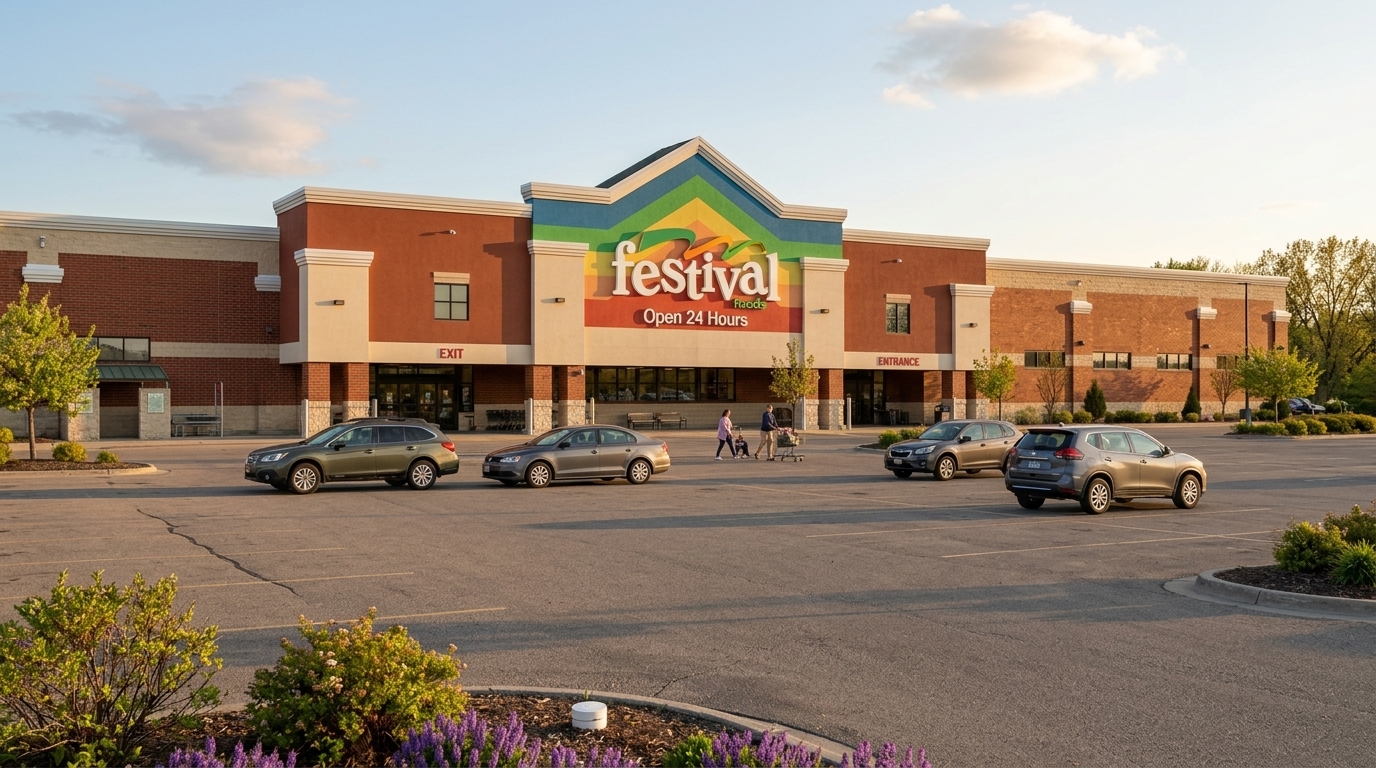
Festival Foods is an American supermarket chain that operates retail grocery locations throughout the state of Wisconsin. Originally founded in 1946 by Paul and Jane Skogen as a family-owned neighborhood store, the company expanded over the decades into a major regional presence before its transition to corporate ownership under The 1939 Group in 2025. The chain offers various products including meat and seafood, deli items, bakery goods, beer, wine and spirits, pantry staples, produce, frozen foods, dairy products, and options for natural and organic products.
At Festival Foods, customers are treated as guests. With family at its core, the company aims to give each and every guest the personal attention and support it would expect from its own families, going above and beyond to ensure expectations are met. This approach is summarized in the Boomerang Principle: every business decision is based on the question, “Will it bring the customer back?”
Origins and Early Growth
Festival Foods traces its origins to 1946, when Paul and Jane Skogen opened their first grocery store in Onalaska, Wisconsin, which became known as Skogen’s IGA. With just $500 borrowed, the couple opened a modest 3,000-square-foot store attached to their home, operating as an independent grocer affiliated with the Independent Grocers Alliance (IGA) network. In 1975, the very first Skogen’s Independent Grocers Alliance (IGA) opened in Onalaska’s Center 90 shopping center. Paul’s son, Dave, joined the family business and was committed to operating with a hands-on philosophy. From 1974 to 1982, the company grew to seven Skogen’s IGA stores in Wisconsin and Dave Skogen was named president of the company.
After Paul passed away in 1976, his son, Dave, along with his wife, Barb, and brothers, Gary and Tom, oversaw company operations. Dave Skogen was named the national IGA Retailer of the Year award. The family developed distinctive private-label products during this period. In 1987, the Skogen family created a premium quality blend of lean meats and savory spices researched from the Old World recipes of German sausage makers, proudly named Oktoberfest Brats.
The Skogen family identified a shifting trend in consumer buying habits and decided a change of store format was best for the company’s future. On June 29, 1990, they opened their first Festival Foods store in Onalaska. In 1992, Dave’s son, Mark, joined the company full-time after graduating from college. In 2003, Festival’s Boomerang Principle was born — every business decision made at Festival Foods is based on the question, “Will it bring the guest back?”
Expansion, Acquisitions and Ownership
Under third-generation leadership, Festival Foods expanded throughout Wisconsin, opening new locations in major population centers across the state. In 2006, Dave’s son Mark Skogen became CEO. Dave Skogen was named Grocer of the Year by the Wisconsin Grocers Association in 2005 for his leadership of the company. His son, Mark Skogen, became CEO in 2006 and later received the same Grocer of the Year honor in 2014.
In 2010, Festival Foods purchased the Apple Creek Inn of De Pere and renamed it The Marq. The Marq is a 550-seat banquet and catering facility. In 2013, Festival added a second Marq location in Suamico. On May 19, 2020, Festival announced the closure of the Marq due to the COVID-19 pandemic.
In December 2021, Festival Foods purchased Trig’s locations in Wausau, Weston and Stevens Point. In 2021, the company announced plans to open two additional locations in the Milwaukee area. Following these acquisitions and openings, Festival expanded its network through strategic store launches and additions throughout the 2020s, including locations in New London, West Allis, Hartford, Chippewa Falls, Kimberly, and Hudson.
In September 2025, the 1939 Group, Inc.’s announced a definitive agreement to purchase 100 percent of the shares of the Wisconsin-based parent company of Festival Foods and Hometown Grocers, Inc. The purchase included shares held by Mark Skogen, CEO of Festival Foods and Hometown Grocers, Inc, as well as the shares in the trust held by associates in their Employee Stock Ownership Plan (ESOP). On October 20, 2025, Todd Schnuck, Chairman and CEO of 1939 Group, Inc., announced the official closing of the purchase of Festival Foods and Hometown Grocers. Festival Foods retains its brand name and continues to operate from its Onalaska, Wisconsin headquarters as a sister company to Schnucks under the 1939 Group umbrella.
Stores and Regional Footprint
Festival Foods operates exclusively within Wisconsin, where it has become a prominent regional grocery presence. The chain’s stores are concentrated across the state, serving communities from the Mississippi River valley in the west to the Lake Michigan shoreline in the east. All Festival Foods locations operate under the single Festival Foods banner, distinct from the various banners operated by sister company Hometown Grocers.
The brand offers private-label goods supplied by UNFI alongside localized community sponsorship initiatives. In 2025, Schnuck Markets’ parent company, The 1939 Group, acquired all 42 Festival Foods stores in Wisconsin. Schnuck Markets operates 113 stores in Missouri, Illinois, and Indiana. Festival Foods operates as a member of the 1939 Group holding company, which is owned by the family that founded Schnuck Markets.
Merchandising and Own-Brand Products
Festival Foods carries a full range of grocery merchandise, from fresh produce and meats to packaged goods and beverages. The chain emphasizes quality fresh departments, including an on-site butcher, seafood counter, bakery, and deli. The brand offers private-label goods supplied by UNFI, one of North America’s leading wholesale food distributors. These private-label products span multiple price points and quality tiers, allowing the chain to offer both value-oriented and premium options alongside national brands.
Festival Foods has positioned itself as a community-focused grocer rather than a deep-discount operator, maintaining competitive pricing while emphasizing product quality and local connections. The chain’s approach to merchandising reflects its heritage as a regional independent grocer, with emphasis on fresh, locally sourced products and distinctive private-label items that differentiate it from larger national competitors.
Employment and Labor Relations
The company employs more than 7,000 full- and part-time associates and operates 42 full-service supermarkets across Wisconsin. Festival Foods became a Servant Leadership Company, with associates and management working ‘side by side’ to ensure each individual has everything they need to succeed within their position.
The company has maintained a reputation as a good employer within Wisconsin, emphasizing career development and community involvement. The acquisition by 1939 Group included the shares in the trust held by associates in their Employee Stock Ownership Plan (ESOP). This structure reflected the company’s long-standing commitment to employee ownership and participation in company success.
The Economics of the Business
Festival Foods operates in the highly competitive regional grocery market, where margins are characteristically thin and success depends on operational efficiency, customer loyalty, and differentiation. The chain’s business model emphasizes full-service supermarkets with multiple departments rather than smaller discount formats, positioning it to serve as a destination retailer for families seeking a complete grocery shopping experience.
For nearly 80 years under family ownership, Festival Foods maintained profitability through consistent customer focus and community engagement. The company remained independent and family-controlled longer than many of its regional peers, a testament to disciplined operations and local market strength. The acquisition by 1939 Group in 2025 reflected broader consolidation trends in the grocery industry, where regional chains have increasingly joined larger family-owned holding companies to access capital, supply chain efficiencies, and technology investments.
Controversies and Regulatory Issues
In December 2016, Festival was sued by Metcalfe Inc., which operates three grocery stores in Wisconsin, over the use of Festival’s “Road Sign Marks”, which both Festival and Metcalfe used to promote local products. Metcalfe accused Festival of “intentional, deliberate and willful” violations of trademark laws, since Metcalfe applied for a trademark on its “Wisconsin Food Miles” road sign as compared to Festival’s “Locally Grown” road sign. Festival said that “it would fight the suit”.
In September 2019, Festival Foods was fined $32,016 by the state Department of Agriculture, Trade and Consumer Protection for labeling errors. The company had 39 weight violations and two labeling errors that the state department found in seven Wisconsin stores based on legal documents filed in Eau Claire County Court.
Later Developments and Direction
Following the 2025 acquisition by 1939 Group, Festival Foods entered a new chapter under external ownership while maintaining its brand identity and operational independence. Mark Skogen departed from his position as CEO of Festival Foods and Hometown Grocers after the transaction closed, ending the company’s third generation of family leadership. Festival Foods, Hometown Grocers, and Schnucks continue operating under their existing banners – guided by shared values, community engagement, and an unwavering dedication to delivering exceptional experiences for every guest.
The acquisition positioned Festival Foods within a larger regional grocery network while preserving its Wisconsin focus and community relationships. Fueled by the strength of 1939 Group, the family of companies can look forward to continued investment and innovation amid a rapidly evolving retail landscape. Festival Foods maintains its headquarters in Onalaska and continues to operate as a distinct banner within the 1939 Group portfolio, competing alongside national and regional chains in a market increasingly defined by consolidation, omnichannel retail capabilities, and private-label innovation.
Leave a Reply