
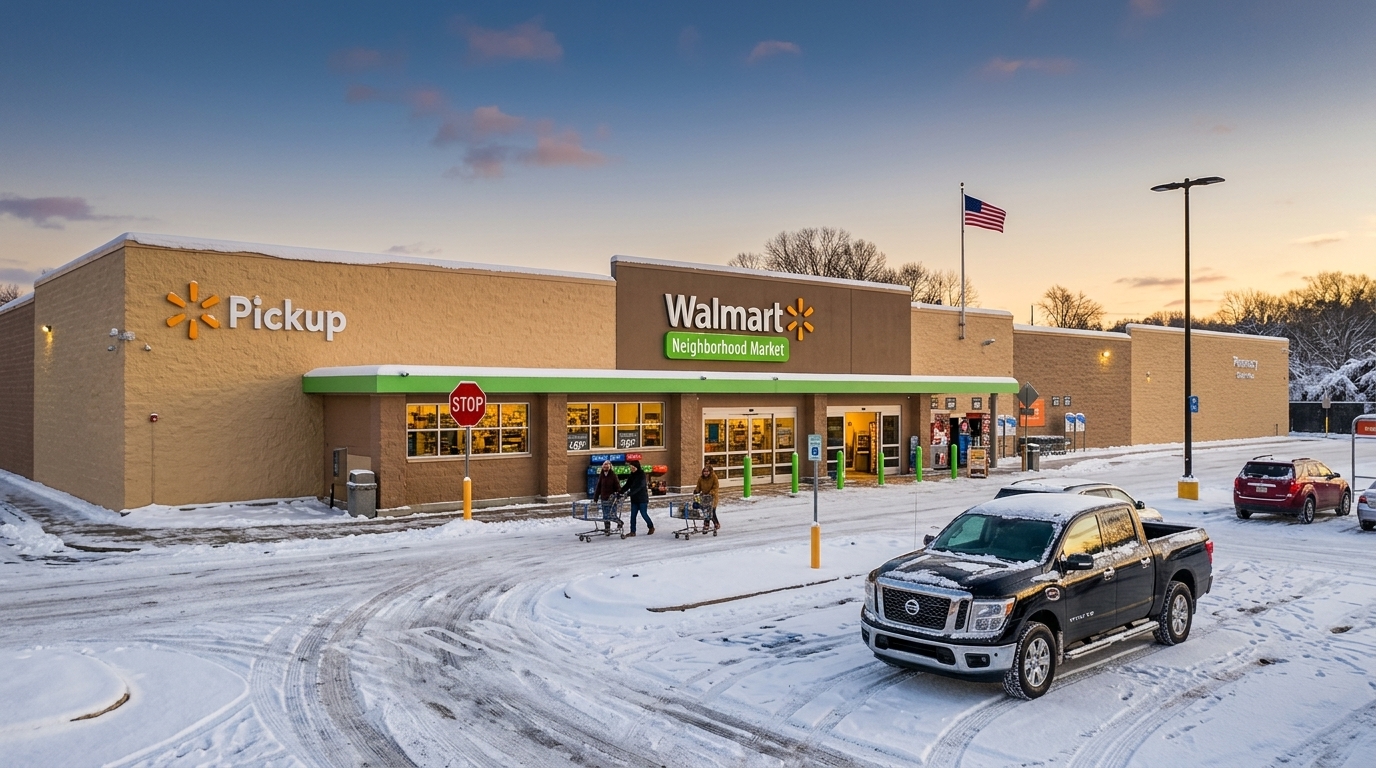
Neighborhood Market is a grocery store chain launched by Walmart in 1998, when the company introduced three stores in Arkansas. The banner operates as a smaller-format subsidiary of Walmart, designed to serve urban neighborhoods and communities underserved by larger supercenters. Stores range from 28,000 to 65,000 square feet, with an average size of about 42,000 square feet, making them roughly one-fifth the footprint of a typical Walmart Supercenter.
The chain emphasizes convenience and fresh groceries over the broader general merchandise offered at Supercenters. At launch, Neighborhood Markets featured a different variety of items than traditional Supercenters, with greater focus on grocery, and carried closer to 23,000 SKUs compared to a Supercenter’s 200,000. Stores are visually distinct from traditional Walmart locations, featuring a different color scheme with green taking over blue on signs and uniforms. As a Walmart subsidiary operating across the United States, Neighborhood Market competes in the compact grocery format alongside regional chains and discount retailers while positioning itself on price competitiveness and accessibility.
Origins and Early Growth
The first Walmart Neighborhood Market opened in Bentonville, Arkansas, in 1998. The format was designed at roughly 40,000 square feet—compared to the Supercenter’s 200,000 square feet—as a way to “fill in the gaps” for Walmart shoppers, bringing convenience ever-closer to home. The first Walmart Neighborhood Market opened ten years after the first Supercenter, but Walmart did not heavily focus on this model until the 2010s.
By 2010, Walmart had opened about 180 Neighborhood Markets, and that same year the company said it was ready to accelerate its expansion plans for the grocery stores. As of the 2009 fiscal year, Neighborhood Markets operated in 16 states, establishing a foothold primarily in the eastern and central United States before expanding westward.
Expansion, Acquisitions and Ownership
In 2004, Walmart acquired Amigo Supermarkets, which shares similarities with Neighborhood Market. In 2005, the first Canadian Neighborhood Market store opened, and there are currently three stores operating in Canada, marking the format’s entry into the international market.
The expansion phase of the 2010s saw the chain grow significantly across urban and suburban America. As of October 31, 2022, there were 682 Walmart Neighborhood Markets. However, store count trajectory later shifted: the highest number of locations reached 813 in 2019 before that number started to decline, reaching 695 total locations by the end of 2024. Neighborhood Markets that close often don’t make as much money as the company thought they would.
In 2024, Walmart initiated a strategic pivot toward larger format stores. Two new stores, one in the Dune Lakes area of Santa Rosa Beach, Florida, the other in the Vine City neighborhood of Atlanta, opened with 57,000 square feet of salesfloor and pickup and delivery space, about 17,000 square feet larger than the average Neighborhood Market. Walmart recently committed to opening or converting more than 150 stores in the next five years, with the Neighborhood Market format set to benefit.
Stores and Regional Footprint
Neighborhood Markets operate across multiple U.S. regions, with particular concentration in the South, Midwest, and portions of the Northeast and West Coast. The format has been especially prominent in urban areas and communities where traditional supercenters would be difficult to site or where the company identified gaps in fresh grocery access. In Chicago, Walmart opened several Neighborhood Markets in underserved areas known as “food deserts,” areas that lacked access to fresh, affordable groceries, and the company worked closely with local leaders and community organizations to ensure that the stores met the specific needs of each neighborhood. In 2015, a Walmart Neighborhood Market debuted in the Auburn Gresham neighborhood of Chicago on the corner of 76th and Ashland.
Similar to the Supercenter models, the Neighborhood Market branding has phased out over time, with several stores adopting the Walmart Market branding, with the name of the municipality put with “Market”. In 2014, Walmart rebranded its existing 21 Walmart Express locations to Neighborhood Market and opened all future Express stores under the Neighborhood Market banner.
As a subsidiary of Walmart Inc., Neighborhood Market is structured within the larger Walmart U.S. division and benefits from Walmart’s centralized supply chain, distribution network, and procurement scale. Neighborhood Markets are part of Walmart U.S., which consists of three retail formats: Supercenters, Discount Stores, Neighborhood Markets, and other small formats.
Merchandising and Own-Brand Products
Neighborhood Markets focus primarily on grocery and consumables, with dedicated fresh produce, meat, dairy, and bakery departments. On one side of the store, there is a full-service supermarket stocked with fresh produce, meats, dairy, deli items, floral arrangements, and baked goods, while the other side is dedicated to household products, such as cleaning supplies, health and beauty items, pet care products, greeting cards, and general merchandise. Many locations have transitioned to primarily self-service checkouts as of the early 2020s, and many stores offer drive-thru pharmacy tubes or windows.
Neighborhood Markets carry Walmart’s private-label brands prominently. Great Value, Walmart’s largest private brand and the largest food and consumables CPG brand in the U.S., was launched in 1993, and Great Value products can be found in nine out of 10 U.S. households. In April 2026, Walmart announced a comprehensive redesign of its flagship private brand, Great Value, marking the first full brand refresh in more than a decade. Marketside, sliced and prepared produce, ready-to-cook/eat meals, and packaged meat cuts and seafood are produced in Bentonville, and Oak Leaf, low-cost wines, are produced and bottled for Walmart selling at approximately $3 a bottle. Neighborhood Markets also stock Walmart’s health and beauty line Equate, and premium grocery brand Sam’s Choice.
The chain competes on price and value positioning rather than premium positioning. Great Value products are estimated to save the average family more than 35% annually compared to national brand equivalents. Neighborhood Markets leverage Walmart’s EDLP (Every Day Low Price) strategy and bundle pricing to attract cost-conscious shoppers.
In 2020, Walmart began testing drone delivery for select products in Fayetteville, North Carolina, and then in 2021 ramped up Neighborhood Market testing in Farmington, Arkansas, with drone delivery service running from 8 a.m. to 8 p.m., and once the company got everything working right, drone delivery expanded to select cities in three additional states: Georgia, Texas, and Florida, with groceries deliverable in as little as 30 minutes.
Employment and Labor Relations
Neighborhood Markets employ 95 workers on average per store, versus 300 for Supercenters. The leaner staffing model reflects the smaller store format and narrower merchandise assortment. Roles in Neighborhood Markets typically include cashiers, stockers, produce associates, deli staff, bakery associates, and pharmacy technicians, with supervisory and management positions present in larger units.
Labor relations have generally followed Walmart’s broader corporate labor policies. As of the time period covered in available sources, Neighborhood Markets operate under Walmart’s union status and wage structures, though unionization rates vary by location and have shifted over time with broader retail industry trends. Neighborhood Markets serve as entry-level employment pathways within Walmart’s organization, with associate training and advancement opportunities available consistent with Walmart U.S. policy.
The Economics of the Business
Neighborhood Markets operate on the thin-margin economics typical of the grocery industry, relying on volume sales and high inventory turnover. The smaller footprint reduces real estate and operating costs per square foot compared to Supercenters, while still maintaining the capital intensity of fresh grocery operations—including refrigerated departments, produce sourcing, and rapid perishable turnover.
The format’s economics depend on high population density and strong foot traffic, making location selection critical to profitability. Unlike Supercenters, which can absorb losses on groceries through general merchandise markups, Neighborhood Markets must drive profitability almost entirely through grocery and consumables margins. This structural constraint has contributed to the closure of underperforming locations and the recent shift toward larger-format Neighborhood Markets designed to improve the mix and scale.
Neighborhood Markets that close often don’t make as much money as the company thought they would, but with the company planning to add more large-model Neighborhood Markets in the future, the number of locations may go back up to its pre-2020 numbers. The 2024 introduction of the larger 57,000-square-foot format represents a deliberate effort to improve unit economics while preserving the neighborhood-focused positioning.
Rivals and Market Pressures
Neighborhood Markets compete directly with traditional regional supermarket chains, dollar stores, and Walmart’s own Supercenters in different geographies. Key competitors include Kroger-owned banners, Publix in the Southeast, Albertsons divisions, and independent supermarkets. Neighborhood Markets tend to drive business away from locally owned grocery stores because they are more conveniently located, and a Neighborhood Market coming to town can be a source of dread for local businesses because of Walmart’s predatory nature.
The rise of dollar stores has forced Walmart to invest in Neighborhood Markets as a defensive format. By offering fresh groceries and a focused shopping experience in urban and underserved areas, the banner counters discount dollar retailers’ expansion into consumables and helps Walmart defend market share in dense neighborhoods where Supercenters are impractical. E-commerce and omnichannel delivery also present both competitive pressure and opportunity—Amazon Fresh, Whole Foods, and specialized grocery delivery services compete for the same urban customer segment.
Food deserts and underserved communities remain a structural opportunity for the format. While the stores are already well-established in many parts of the United States, there are still opportunities to enter underserved regions and capture market share from traditional grocers, and Walmart’s success in urban markets like Chicago suggests that the company has the expertise and flexibility to adapt to diverse local contexts.
Later Developments and Direction
Neighborhood Market strategy has evolved significantly since 2020. After peak store count in 2019, the format contracted as Walmart reassessed profitability and redeployed capital. The 2024 shift to larger, modernized stores with enhanced fresh offerings, dedicated pickup and delivery infrastructure, and expanded pharmacy services signals a renewed strategic commitment to the format, though with a recalibrated unit design.
The two new larger stores in Santa Rosa Beach and Atlanta add a Health Services Room to their pharmacies to provide customers with privacy for vaccinations and consultations, and the addition of a Mother’s Room will allow nursing moms to shop these new stores while caring for their little ones. Neighborhood Markets are testing rapid four-week remodels to refresh stores faster, reduce disruption, and deliver a better, more convenient shopping experience.
The brand is also benefiting from Walmart’s broader private-label and sustainability investments. In fall 2025, Walmart announced its goal to remove synthetic dyes from its food private brands by January 2027, a commitment that extends to products sold in Neighborhood Markets. The format remains positioned as a testing ground for innovation, smaller-footprint grocery strategy, and targeted urban retail in an era of consolidation and e-commerce disruption.
Leave a Reply