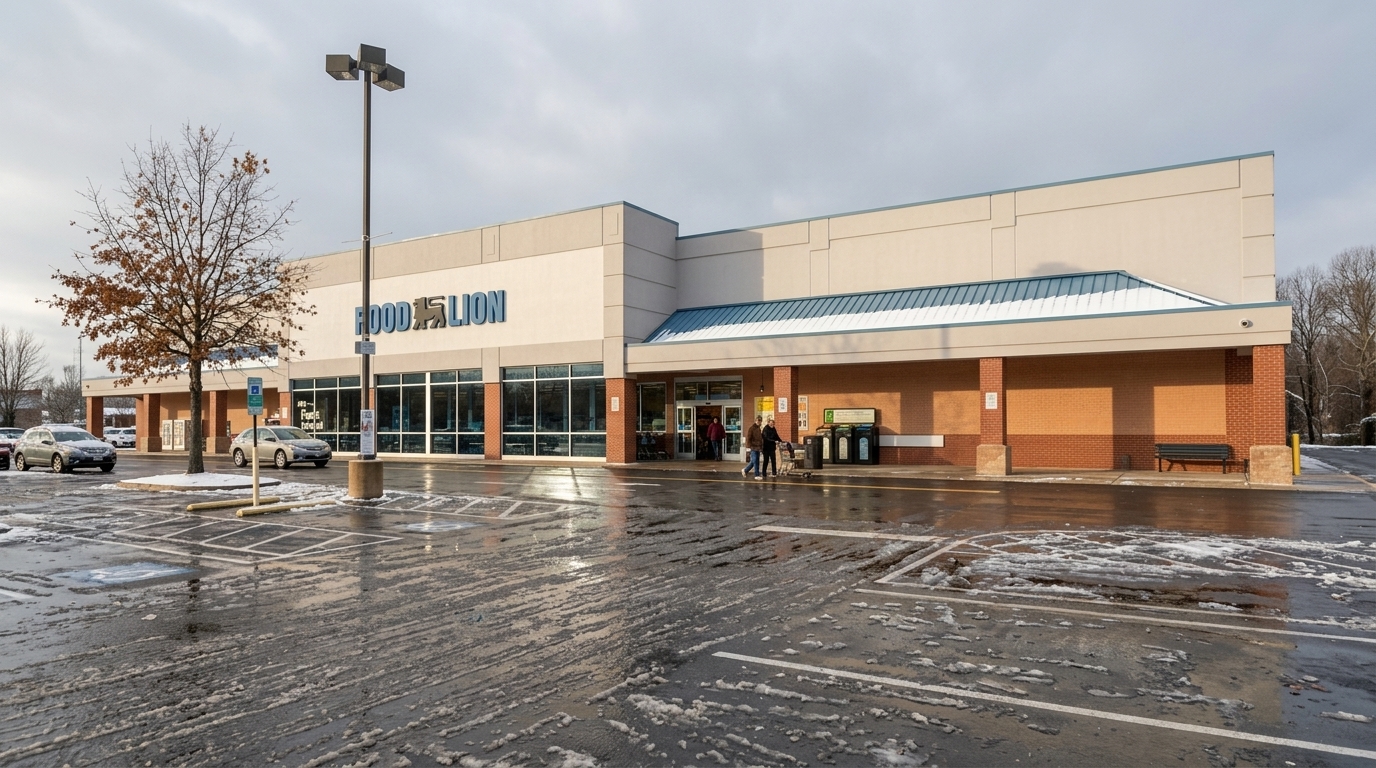
Food Lion was founded in 1957 in Salisbury, North Carolina, as Food Town by Wilson Smith, Ralph Ketner, and Brown Ketner. The chain operates over 1,000 supermarkets in 10 states: Delaware, Georgia, Kentucky, Maryland, North Carolina, South Carolina, Pennsylvania, Tennessee, Virginia, and West Virginia. Food Lion’s success has centered around its low-price, high-volume strategy; by cutting its overhead dramatically, the chain has been able to offer “everyday low prices” to consumers and still reap some of the highest profits in the supermarket industry. The chain is known for emphasizing convenience, accessibility, and competitive pricing in underserved and established markets across the Southeast and Mid-Atlantic regions.
Food Lion has been owned by Ahold Delhaize since 2016, following several mergers and acquisitions. Food Lion’s sister chains include Giant-Carlisle, Giant-Landover, Hannaford Brothers, Martin’s Food Markets and Stop & Shop. The company operates in a competitive landscape dominated by discounters, regional chains, and e-commerce grocery services, but maintains a strong regional presence through store density and local market adaptation.
History
Ralph W. Ketner, Brown Ketner, and Wilson Smith opened a Food Town supermarket in Salisbury, North Carolina in December 1957; the three men had worked together in the grocery business for some time at a small chain that was owned by the Ketners’ father but had recently been sold to Winn-Dixie. In 1968, Ralph Ketner cut prices dramatically, selling many items at or below their wholesale cost, and marketed the brand with the “everyday low prices” concept that other chains, like Wal-Mart, were beginning to embrace. The chain grew from seven stores to approximately 800 in 1991, the year in which Ketner retired.
The chain was acquired by the Belgian conglomerate Delhaize Group in 1974; Delhaize Freres & Cie, “Le Lion,” purchased a majority of Food Town’s shares. Food Town opened stores in Virginia in 1978 and in Georgia in 1981; in 1977 the chain operated 55 stores; by 1987, it ran 475. The Food Lion name was adopted in 1983 as Food Town expanded into Virginia and encountered several stores called Foodtown in the Richmond area; on December 12, 1982, Ralph Ketner announced the name change to “Food Lion,” and by the end of March 1983, all stores had been rebranded.
In November 1992, two ABC News producers obtained jobs at Food Lion grocery stores in North and South Carolina by submitting applications with false references; ABC broadcasted a report on “PrimeTime Live” alleging that Food Lion’s meat department required employees to engage in unsafe, unhealthy or illegal practices, including selling old meat that was washed with bleach to kill odor, selling cheese that had been gnawed by rats and working off the time clock. After the 1992 “PrimeTime” broadcast, Food Lion’s sales and stock price plummeted; the chain estimated it lost hundreds of millions in sales and more than $200 million in profits in the 18 months that followed. Food Lion was awarded $5.5 million in damages, which a judge reduced to $316,000; a U.S. Appeals Court, however, later ruled that Food Lion did not suffer direct harm and rescinded all damages. In the early 1990s, many alleged that Food Lion had violated Federal Labor Standards Acts regulating overtime, minimum wage, and child labor laws; consequently, Food Lion paid $16.2 million—at the time the largest settlement from a private employer for violating FLSA standards—to settle claims.
On January 7, 1994, Delhaize announced the first major round of store closings in what would become a yearly event; the stores to be closed included 47 of its brand-new stores in Texas and Oklahoma, as well as stores in Florida, Georgia, North Carolina, Pennsylvania, South Carolina, and Virginia. Beginning in 2003, Food Lion became active in “market renewals” in which every year the chain picks certain cities in its operating area where it remodels stores and updates product offerings; in 2003, Food Lion remodeled 68 stores in the Raleigh-Durham, North Carolina market, followed by 65 stores in the Charlotte area in 2004. In January 2012, Delhaize announced that it would close six Bottom Dollar stores and convert 22 others to Food Lion supermarkets as part of a restructuring; in August 2014, it was reported that Delhaize was putting the entire portfolio of Bottom Dollar Food locations up for sale; ultimately Bottom Dollar Food was shuttered and the stores sold to Aldi in early 2015. In June 2015, it was announced that Food Lion’s parent company, the Delhaize Group, and Ahold would merge into Ahold Delhaize; this merger was completed in July 2016. In July 2016, as part of the corporate merger between Delhaize and Ahold, Food Lion was required to divest 61 locations to a variety of competitors, including Supervalu and Weis Markets in Delaware, Pennsylvania, Maryland, West Virginia, and Virginia to satisfy the Federal Trade Commission’s review of the two parent companies’ merger.
Operations & Footprint
By 2015, Food Lion stores could be found in Delaware, Georgia, Kentucky, Maryland, North Carolina, Pennsylvania, South Carolina, Tennessee, Virginia, and West Virginia. The chain maintains significant market concentration in North Carolina and Virginia, with stores distributed across both urban and rural areas within its operating region. Food Lion spent seven years attempting to establish a presence in Bangkok, Thailand, starting in 1997; operated locally by Bel-Thai Supermarket Co, in 2004 it withdrew from the country, selling all branches to Tops Supermarkets. Food Lion is structured as a subsidiary of Ahold Delhaize USA, the U.S. division of Netherlands-based Ahold Delhaize, and operates independently within that corporate structure while benefiting from shared resources and purchasing power.
Products, Services & Merchandising
Food Lion offers a full selection of groceries, produce, meats, and dairy products, along with prepared foods, pharmacy services, and general merchandise. Food Lion introduced new private label brands including Smart Option, designed to provide customers with an aggressively priced option on key, highly consumable items, and Taste of Inspirations, which consists of premium products with quality that exceeds that of any other premium item Food Lion currently carries. Food Lion also created category brands that target specific segments throughout the store, including Nature’s Place, the natural and organic brand; Healthy Accents, the health and beauty care brand; and Home 360, the general merchandise brand. Customers can shop for more than 7,000 private brand items offered in stores, backed by Food Lion’s promise of quality and freshness.
Food Lion operates digital services including online ordering, curbside pickup, and home delivery through its Food Lion To Go platform. Despite the traditional focus on in-store shopping offered in the majority of its locations, Food Lion is increasingly incorporating modern conveniences like delivery, catering to evolving customer preferences. The chain offers self-checkout options at many locations and maintains an MVP loyalty program that provides personalized offers and discounts to members. New stores feature a large selection of organic, gluten-free and plant-based items, including Nature’s Promise, and in-store prepared cut fruit, sandwiches and salads, specialty cheeses and self-service hot wing and Asian food bars.
Work Environment & Employment
Food Lion employs a substantial workforce across its store base, with the chain recognized for offering entry-level employment opportunities in communities it serves. The company has faced significant labor challenges in its history, including wage and hour violations in the early 1990s that resulted in a substantial settlement. In 1986, Tom Smith, who started at the company in the 1950s as a grocery bagger, became CEO of Food Lion. The chain emphasizes in-store training and advancement pathways, particularly for store management roles. Food Lion does not operate as a unionized employer in most of its footprint, allowing the company to maintain flexible labor practices while competing on price.
Business Model & Financial History
Food Lion operates on the everyday low price (EDLP) model, relying on high transaction volume and operational efficiency rather than heavy promotional activity to drive profitability. The thin-margin nature of grocery retail means the chain depends on consistent same-store sales growth, supply-chain optimization, and private-label penetration to maintain margins. The chain sells many items at cost or even below to lure customers through its doors; by cutting its overhead dramatically, Food Lion has been able to offer “everyday low prices” to consumers and still manage to reap some of the highest profits in the supermarket industry. In March 2016, the company announced that it would make a $215 million investment in its greater Charlotte-area stores and western NC stores, including remodeling 142 stores, additional price investments, and investments in associates and the community through its Food Lion Feeds initiatives. As a subsidiary of Ahold Delhaize, Food Lion benefits from the parent company’s scale, purchasing power, and access to capital for reinvestment and expansion initiatives.
Competitive Landscape
Food Lion competes with regional chains including Harris Teeter, Food City, and local independents in the Southeast and Mid-Atlantic, as well as national discounters such as Aldi and Walmart in overlapping markets. The rise of dollar stores, online grocery delivery, and hard discounters has shifted consumer expectations toward value and convenience. Food Lion’s regional focus and store density provide competitive advantages in local market knowledge and supply-chain efficiency, but the company faces structural pressures from e-commerce penetration and consolidation among larger national players. The chain maintains differentiation through emphasis on fresh produce, local sourcing programs, and consistent everyday pricing rather than temporary promotions.
Recent Developments & Outlook
The grocer recently invested $484 million to remodel 153 stores throughout the greater Charlotte, N.C., area. Food Lion announced continued growth across the Carolinas with the opening of several new store locations in early 2026, with the first opening in Pontiac, South Carolina, continuing to build momentum for future growth in 2026 and beyond. This growth will be supported by a new distribution center planned for Burlington, North Carolina; Ahold Delhaize USA has partnered with Blackstone Credit & Insurance to financially help construct the highly automated facility; the distribution center will deliver fresh and frozen grocery items to stores operated by Food Lion, with construction expected to begin in the first quarter of 2026 and an anticipated start of operations in 2029. In partnership with parent company Ahold Delhaize USA, Food Lion aims to commit to heightened sustainability efforts, which include greater food transparency by 2025; reducing food waste by 50% by 2030 via composting, recycling and animal feed; and a 50% reduction in carbon emissions. The retailer has committed to donate 3 billion meals by 2032.
Leave a Reply