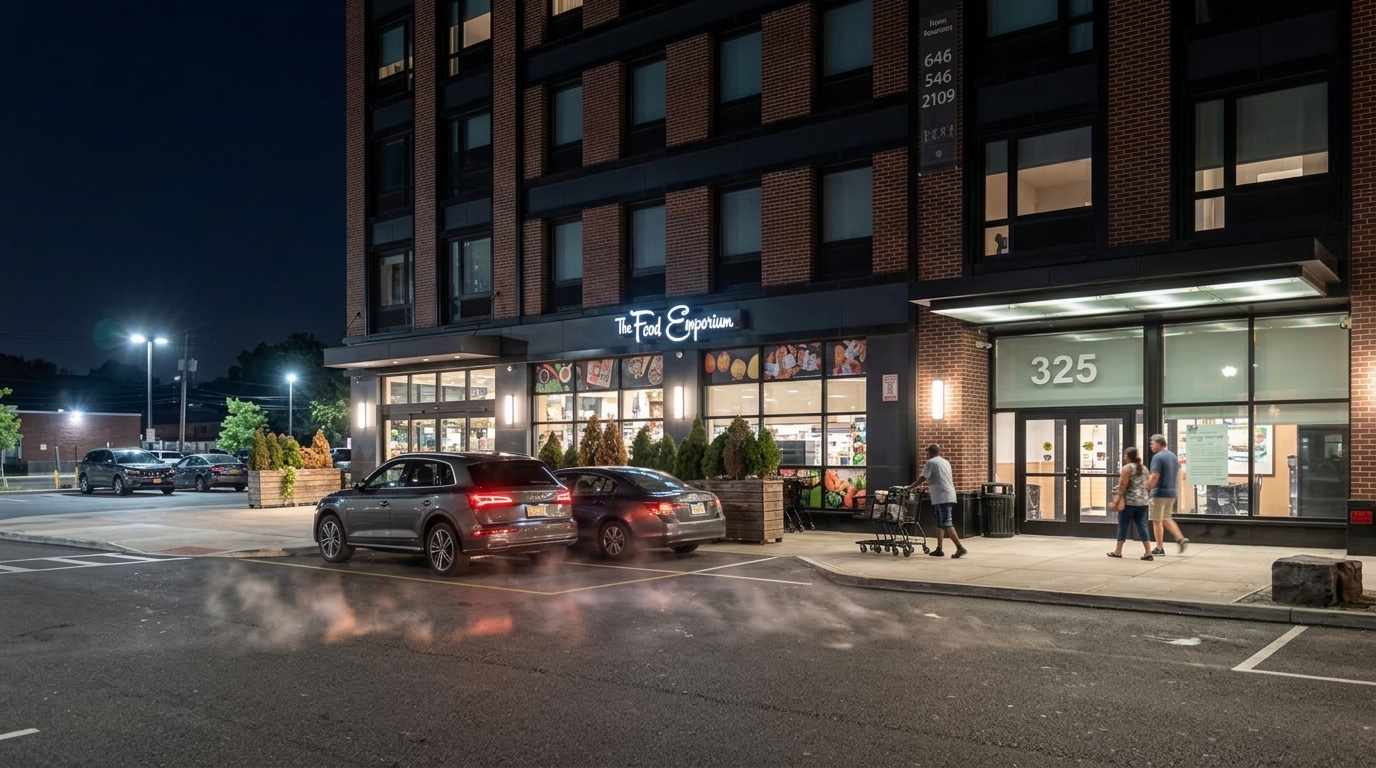
The Food Emporium is a chain of grocery stores in New York. The supermarket banner was created by Shopwell Inc., whose roots can be traced to Daitch Crystal Dairies (established 1919). Operating primarily under the ownership of Key Food Stores Co-op, Inc., a cooperative of independently owned supermarkets founded in Brooklyn on April 20, 1937, headquartered in Matawan, New Jersey, the chain competes in the upscale grocery segment of the New York metropolitan area. The Food Emporium grew throughout the 1990s, converting many of its New York-area A&P stores to The Food Emporium and expanding the chain to New Jersey. The banner is known for pairing conventional groceries with gourmet merchandise, specialty departments, and prepared foods, positioned toward affluent urban neighborhoods.
The 2000s brought new, stronger competition to the New York area, and the chain shrank, receding mostly to Manhattan. At the time of A&P’s liquidation in 2015, The Food Emporium had 11 stores. Following A&P’s bankruptcy, Key Food acquired the Food Emporium banner name and related intellectual property assets from A&P in December 2015. Key Food completed the purchase of 23 stores from the bankrupt A&P in November 2015, increasing its total number of stores to 212. The stores included three Pathmark, three A&P, 10 Waldbaum’s, four Food Emporium, and three Food Basics USA locations in New York and New Jersey. Key Food has since pursued a selective expansion of the Food Emporium banner in the Northeast and is a network of member-owned stores operating under the Key Food cooperative structure.
Retail Formats and Where It Operates
The cooperative operates stores under the Key Food Marketplace, Key Fresh & Natural, Food Dynasty, Urban Market, Food World, Food Universe Marketplace, SuperFresh, and The Food Emporium banners. Stores operate under the Key Food cooperative in all five boroughs of New York City, Long Island, upstate New York, New Jersey, Connecticut, Massachusetts, Pennsylvania, Rhode Island, Maryland, and Florida. The Food Emporium banner specifically focuses on the Northeast, with locations concentrated in New York and New Jersey. The chain has eight stores in New York City and one in Marlboro Township as documented in 2026, though Key Food continues to expand and rebrand locations under the Food Emporium banner. After a long construction process, Emporium Plaza opened in Brookfield, Connecticut, featuring a Food Emporium supermarket on the ground floor in a new-build building, opened in 2025. A Food Emporium opened in Maplewood, New Jersey in December 2025.
Company Background
Food Emporium’s history starts in 1919 when Louis Daitch founded Daitch Crystal Dairies, a public company trading on the American Stock Exchange. Over the years, he opened shops in the New York City area selling butter and eggs. Following World War II, Daitch Crystal Dairies enjoyed tremendous growth in the new supermarket format, emerging in the 1950s as a significant chain. In 1955, Daitch and its 34 stores (in New York City, Nassau, and Suffolk counties, and in Connecticut, merged with Shopwell Foods’ chain of 18 Westchester County supermarkets. Shopwell was founded by Sigmund Rosengarten, who entered the supermarket business as a butcher. The supermarket chain reached 103 stores in 1962.
During the course of trimming the size of the chain, the Rosengartens noticed that the remaining stores were mostly located in upper-income neighborhoods, such as Manhattan’s Upper East Side and in Westchester County. Not only did it make sense to cater to the higher-income customer, but the Rosengartens also recognized that no supermarkets in the area were doing much upscale marketing, leaving the business to smaller shops like Zabar’s and Balducci’s. From these insights came the idea of the Food Emporium format, which would mix regular and specialty items on the same shelves, rather than following the lead of other supermarkets, which at best offered a small gourmet corner. Shopwell’s decision to launch the Food Emporium format in 1979 was a timely one.
Shopwell Inc. was acquired by The Great Atlantic & Pacific Tea Company (A&P) in 1986 and at the time, the company operated the upscale, gourmet banner stores in and around New York City; Westchester County, NY; and Fairfield County, CT. The Food Emporium grew throughout the 1990s, converting many of its New York-area A&P stores to The Food Emporium and expanding the chain to New Jersey. In 1985, in an effort to strengthen its position in Canada, A&P acquired Dominion Foods and used The Food Emporium name in some stores soon after the acquisition. This format was garnished well into the mid-1990s. After A&P’s 1983 purchase of the Kohl’s Food Stores chain in Wisconsin and Illinois, many of those stores were re-branded as Kohl’s Food Emporium; new stores were opened as such. The Food Emporium remained the primary format of the Kohl’s stores until the Midwestern chain folded in 2003; the Kohl’s department store chain was not affected.
A&P entered Chapter 11 bankruptcy protection on December 12, 2010, and exited on March 13, 2012. On September 11, 2012, A&P announced its intention to sell its 16 The Food Emporium stores as part of its plan to return to profitability. The stores, as a chain, did not attract enough interest, and a few were sold piecemeal to Morton Williams and CVS, while leases were not renewed at others. On July 20, 2015, A&P announced that it was filing for bankruptcy for a second time. The company liquidated in late 2015, selling as many stores as possible to competitors, and closing the remainder. At the time, The Food Emporium operated 11 stores in Manhattan, and one in New Canaan, Connecticut.
Ownership, Structure and Financial History
Key Food Stores Co-op, Inc. is a cooperative of independently owned supermarkets, founded in Brooklyn, New York, on April 20, 1937. Its stores are located in Connecticut, Maryland, Delaware, Massachusetts, Rhode Island, New Jersey, New York, Pennsylvania, and Florida. The headquarters for the Key Food cooperative is in Matawan, New Jersey. In December 2015, Key Food acquired the Food Emporium banner name and related intellectual property assets from A&P. The cooperative also operates stores under the Key Food Marketplace, Key Fresh & Natural, Food Dynasty, Urban Market, Food World, Food Universe Marketplace, SuperFresh, and The Food Emporium banners.
As a cooperative structure, Food Emporium stores under Key Food operation function as independently owned and operated locations by member-owners of the larger cooperative network. The organization supports its members—small to mid-sized grocers—through centralized buying, private-label brands, marketing programs, and operational services, allowing them to offer quality products at affordable prices while maintaining local ownership and community ties. The Food Emporium banner operates on a selective, specialty upscale model within the broader Key Food network, positioned to serve affluent urban and suburban markets. In October 2020, the cooperative signed a 10-year contract with UNFI for the wholesaler to serve as the primary supplier for its 315 stores. However, in 2025 the contract between UNFI and Key Foods was cancelled by mutual agreement with UNFI indicating that the contract was not profitable.
Product Range and Store Brands
Food Emporium stores blend conventional grocery with gourmet and specialty merchandise. Food Emporium stocks a wide variety of gourmet and other expensive grocery items, as well as staples, and features such specialty shops as its Corner Deli, Seafood Cove, Corner Bakery, and Floral Shoppe. The chain also employs in-house chefs to perform cooking demonstrations. The Food Emporium is described as “the home of natural, organic, and non-GMO products” on the official website. Store formats typically include prepared-foods sections, bakeries, and specialty departments reflecting the brand’s premium market positioning. Stores under Key Food ownership carry the cooperative’s private-label brands and offer a mix of organic, specialty, and conventional product selections.
Market Position and Competition
The Food Emporium has faced sustained competitive pressure since its format emerged in the 1970s. The 2000s brought new, stronger competition to the New York area, and the chain shrank, receding mostly to Manhattan. In the early 2000s, the chain faced intensifying competition from emerging gourmet retailers like Whole Foods Market and Trader Joe’s, which offered similar high-end products at competitive prices and drew away customers in key urban markets. This pressure contributed to operational challenges for A&P, resulting in some store consolidations and a strategic retreat from less viable locations to maintain focus on core Manhattan sites. Under A&P ownership, the chain struggled with the same financial pressures that ultimately drove the parent company to bankruptcy.
Under Key Food ownership since 2015, the Food Emporium banner occupies a niche position as an upscale specialty banner within a cooperative network dominated by conventional supermarkets. While Key Food has expanded quite a lot over the last 10 years or so, and they’re adept at setting up a store to match the area it’s in, one thing they’re less skilled at is running high-end supermarkets (with the exception of a few specific operators, like Brooklyn Fare). There are several specialty selections and a notable collection of local products, but this is basically an everyday neighborhood supermarket — not a high-end store like The Food Emporium was once known as. The brand retains recognition in the New York market and serves as a banner for select Key Food locations seeking to position themselves toward affluent or quality-conscious consumers in urban and suburban Northeast markets.
Notable Developments and Outlook
After a long construction process, Emporium Plaza opened in Brookfield, Connecticut, with a Food Emporium supermarket on the ground floor in a new-build building, opened in November 2025. In Maplewood, New Jersey, a Food Emporium opened in December 2025. The Food Emporium is moving into the former Stop & Shop building on the corner of Route 35 and Laurel Avenue in Point Pleasant Beach, New Jersey. The Stop & Shop closed in 2024. Key Food is also working on converting the former Giant Farmers Market in Waldwick into a Food Emporium, apparently under new ownership, and the Green Way Markets in Maplewood will also soon become a Food Emporium. These openings reflect Key Food’s strategy to selectively rebrand and expand the Food Emporium banner in the Northeast, leveraging residual brand recognition in the market and positioning select locations as upscale or specialty-focused banners within the cooperative network. The banner’s future depends on Key Food’s ability to operate premium formats profitably within a cooperative structure primarily oriented toward conventional supermarkets and value positioning.
Leave a Reply