
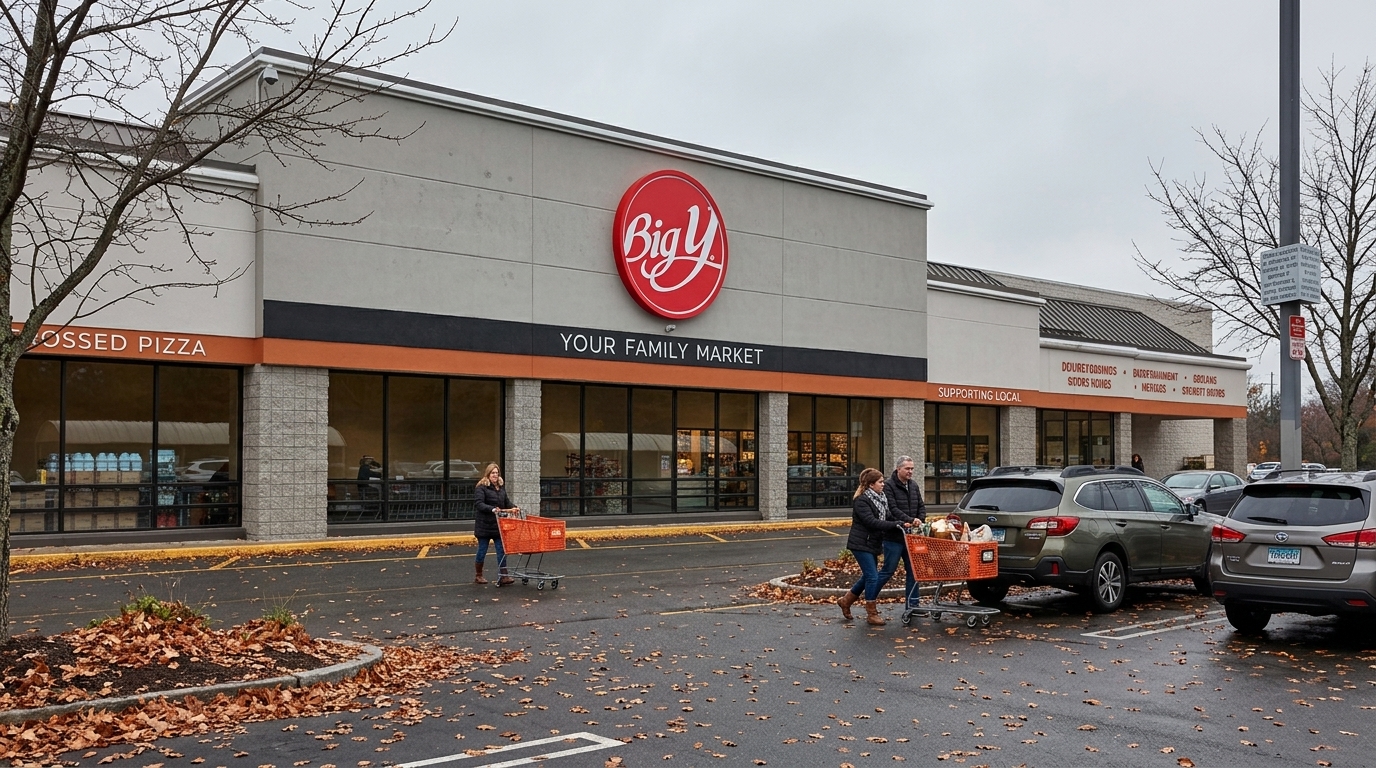
Big Y Foods, Inc. is an American, family-owned supermarket chain located in Massachusetts and Connecticut. The company is headquartered in Springfield, Massachusetts, and is currently run by cousins Charles and Michael D’Amour. Big Y expanded from a corner store into one of New England’s largest independent supermarket chains by focusing on fresh departments, localized merchandising, and community service.
It operates under the trade names Big Y World Class Market or Big Y Supermarket. The company operates full-service supermarkets alongside convenience formats and specialty liquor stores, serving a concentrated footprint across western and central Massachusetts and Connecticut. Big Y has built its reputation on fresh produce, prepared foods, and local product sourcing, competing in a region dominated by larger national chains while maintaining independent ownership and governance.
History
Big Y Foods got its start in Chicopee, Massachusetts, in 1936, when 30-year old Paul D’Amour, a Wonder Bread Baking Company route salesman, bought the Y Cash Market, a small grocery store where hamburger meat sold for 25 cents a pound and bread for a nickel a loaf. The store was so named because it was located at an intersection in the Willimansett section of Chicopee where two streets converged to form a “Y.” Paul purchased the store for $2,500 using an $800 family loan and assistance from his brother Gerald.
In the 1940s–50s Big Y transitioned from full-service counter retail to a self-service supermarket model, adding full-service meat counters and in-store bakeries to meet rising consumer demand as car ownership expanded. By 1947, the company incorporated as Big Y Foods, Inc., and opened a second location in a converted bowling alley in the Aldenville neighborhood of Chicopee, further solidifying its regional presence through affordable, no-frills retailing. In 1952, they took a radical step and opened a 10,000-square-foot store — nearly twice as large as grocery stores at the time.
By the 1950s and 1960s, as suburbanization accelerated, the company used its founding ethos to open multiple locations across western and central Massachusetts and northern Connecticut. In 1984, the company extended its operations into Connecticut with the acquisition of a supermarket in Stafford Springs; Big Y also purchased Adams Supermarket chain. By its 50th anniversary in 1986, Big Y had become the top-ranked private grocery chain in western Massachusetts, operating 21 stores and employing approximately 1,600 employees.
In 1990, Big Y initiated its Express Savings Club; company founder Paul D’Amour died at age 84. In 1993, the company introduced new community-service programs: Education Express, Educating Kids, and the Big Y Homework Helpline; Big Y also opened its first World Class Market in Springfield. The first store opened in Springfield, Massachusetts, in 1993 as a 64,000-square-foot flagship featuring expanded amenities like floral departments and in-store banking.
In 1998, the company moved into its new corporate headquarters, a 133,000-square-foot building in Springfield. Designed by Wrenn and Pepin Associates, the structure began as just a shell office building, but over the year in which it was built it developed into a complete corporate center dubbed the Store Support Center. In addition to executive office suites, it housed a conference center, cafeteria, physical fitness training center, and a museum dedicated to the company’s history. That same year, in 1998, Big Y opened a web site, offering to Internet browsers a range of data, including information on the individual stores in the Big Y chain, such as the various services that each of them offered to customers.
In 2001, the company rolled out its new interactive, computerized register system. In 2003, Big Y accelerated this format’s rollout by acquiring and converting four former A&P Super Food Mart locations into World Class Markets, enhancing its premium offerings amid competitive pressures. In late 2010 Big Y purchased seven stores from A&P, which was leaving central Connecticut. Four of these stores (Branford, Mystic, Old Lyme, and West Hartford) were renovated and re-opened as Big Y World Class Markets within a short period of time.
The 2013 launch of Big Y Express marked its move into multiformat retailing. In July 2016, Big Y entered into a purchase agreement with Ahold and Delhaize Group for eight Hannaford Brothers locations in Massachusetts as part of the divestiture of stores to gain clearance from the Federal Trade Commission for the impending Ahold/Delhaize merger. The new stores, all converted from Hannaford, are located in Kingston, Quincy, Norwell, Milford, Norwood, West Peabody, Saugus, and Easton.
In January 2024, Big Y announced it had taken over the leases of three never opened Amazon Fresh stores after the latter company reversed it decision to expand into Massachusetts and Connecticut.
Operations & Footprint
As of September 2023, Big Y operates 73 supermarkets in Massachusetts and Connecticut; many of which are located in the metropolitan areas of Springfield, Worcester, Greater Boston, and Hartford. In addition to its traditional supermarkets, Big Y owns and operates two specialty markets: Table & Vine, a large specialty liquor and wine store in West Springfield; and the Big Y Express Fresh Market, a smaller, urban market in Downtown Springfield.
Between 2013 and 2023, Big Y opened 16 gas stations and convenience stores in Western Massachusetts and Connecticut, under the name Big Y Express. Most Big Y Express stores are located adjacent to, or nearby, a full-size Big Y supermarket. Since entering the Connecticut market in 1984, Big Y has significantly expanded its presence there, now operating over 40 locations in the state.
All stores are self-distributed from centralized facilities in Springfield and a newer 425,000-square-foot Fresh and Local Distribution Center opened in 2021. In 1994, finding it difficult to hire and retain drivers and meet training and DOT (Department of Transportation) requirements, the company turned the task over to dedicated carriage-route providers, ultimately contracting with Ryder Integrated Logistics Inc. of Miami to handle this operation exclusively.
From 2019 through 2025 Big Y Foods maintained its private, family-owned status with an orderly leadership succession: Michael P. D’Amour was elevated to President & CEO in 2024 while Charles L. D’Amour became chairman, keeping control within the founding family and preserving strategic continuity and community focus.
Products, Services & Merchandising
The company specializes in groceries, fresh produce, bakery items, deli products, and pharmacy services. The company features a curated assortment heavily featuring local products supplied by more than 500 partners in the retailer’s operation regions. Big Y World Class Markets rival some of their giant, mass market rivals in their range of goods and services. Besides floral shops, bakeries, and delis, some provide banking, dry cleaning, photo processing, and even baby sitting services and propane sales.
Many stores also have Big Y Food Courts, where shoppers can lunch on prepared foods. Big Y also operates a Table & Vine shop, a gourmet food, fine wine, and liquor store located in its World Class Market in Northampton, Massachusetts.
Work Environment & Employment
Big Y is one of the largest independently owned supermarket chains in New England, and it employs over 12,000 people. The company has maintained a family-focused culture and has historically invested in employee training and community programs. In 1993, the company introduced new community-service programs: Education Express, Educating Kids, and the Big Y Homework Helpline.
Business Model & Financial History
Big Y Foods remains a privately held, family-run grocer founded in 1936 in Springfield, MA. The company has funded growth through retained earnings and debt rather than external equity investment, maintaining family ownership and control throughout its history. Key postwar expansion, intergenerational succession, and a deliberate avoidance of public markets and private equity shaped Big Y Foods ownership, concentrating control within the D’Amour family and affiliated trusts while funding growth via retained earnings, debt, and real estate strategies.
In 2021 Big Y was the 210th-largest private company in the United States, according to that year’s Forbes magazine “Largest Private Companies” list. The independent, family-owned model has allowed the company flexibility in pricing strategy, labor investment, and long-term planning without pressure from external shareholders, distinguishing it from publicly traded peers.
Competitive Landscape
Big Y operates in a highly consolidated regional market dominated by national chains, including Whole Foods Market, Walmart, and regional competitors. The company has differentiated itself through emphasis on locally sourced products, fresh departments, and community engagement rather than competing primarily on price with larger discounters. Its family-owned status and local governance enable faster decision-making and responsiveness to community preferences than corporate-controlled competitors.
Big Y focuses primarily on opening stores to strengthen its existing footprint, though that footprint is expanding slowly. The company faces structural headwinds from e-commerce, consolidation among large national chains, and price competition from dollar stores and discounters, but its regional density and local brand loyalty provide defensibility in its core markets.
Recent Developments & Outlook
On March 7, 2022, Big Y announced plans to open locations in Uxbridge and Pembroke. The Uxbridge location opened in October 2025, while the opening of the Pembroke location would be set back due to zoning related issues. The company continues its growth with planned expansions in 2026-2027, including a new supermarket in Orange at the Colonial Commons shopping center, set to open in spring 2027, and the confirmed new store at Westfarms Mall in Farmington, also scheduled for spring 2027.
Big Y has invested in digital capabilities and alternative formats to compete with larger retailers and adapt to changing consumer shopping patterns. The company operates e-commerce and curbside pickup services across its footprint and continues to explore opportunities for modest expansion within and adjacent to its current geography. Leadership succession in 2024 established continuity under third-generation family management, signaling intention to maintain the long-term, community-focused strategy that has defined the company since its founding.
Leave a Reply