
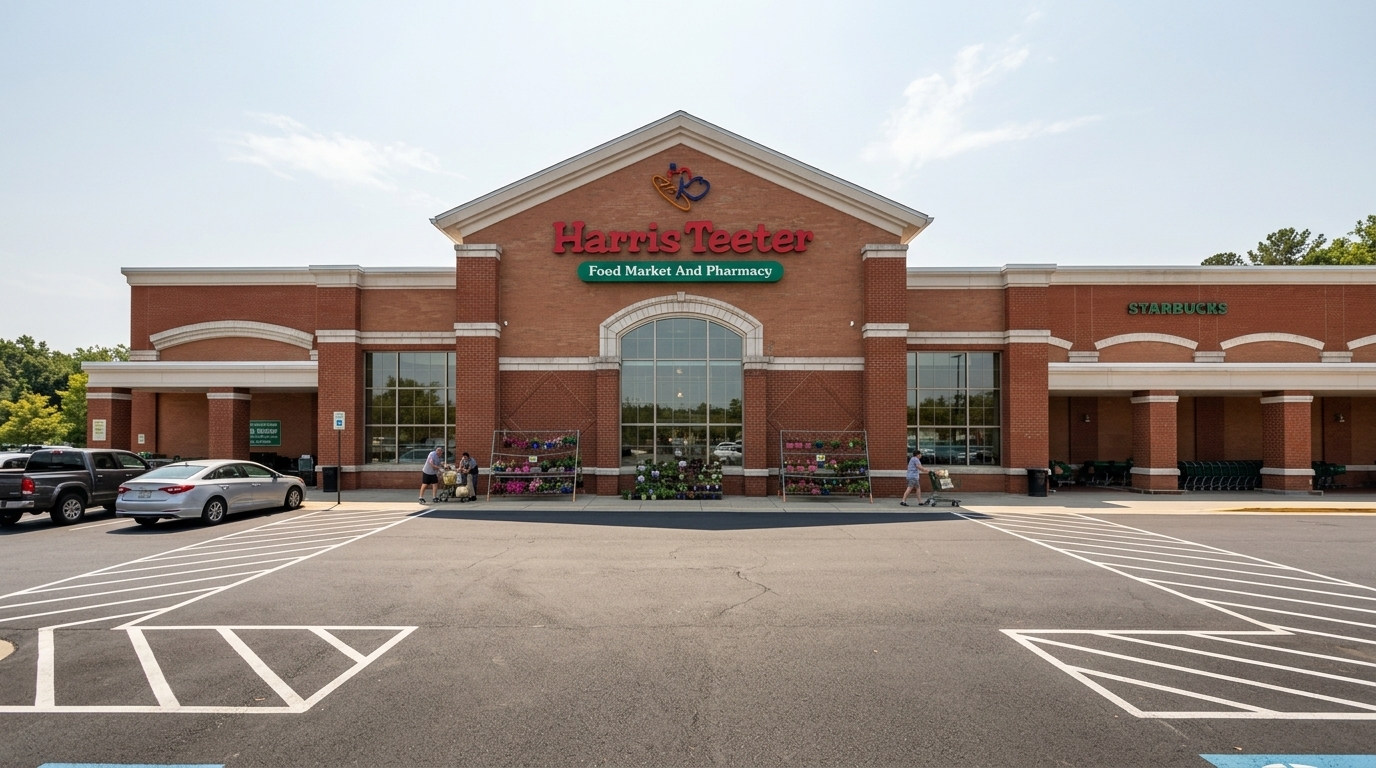
Harris Teeter was founded by two entrepreneurs, William Thomas Harris and Willis L. Teeter, who started their separate businesses during the Great Depression in Charlotte, North Carolina. Harris opened a full-service drugstore called Harris Drugs, and Teeter opened Teeters Food Mart. Harris borrowed funds in 1936 to open the Harris Super Market at 1704 Central Avenue, while Willis L. Teeter and his brother Paul borrowed $1,700 to open Teeter’s Food Mart in Mooresville, which opened on July 15, 1939. W. L. Teeter and W. T. Harris agreed to merge in November 1959, with the merger of 15 stores becoming official in February 1960. The new company became the largest independent grocery organization in the Carolinas.
Harris Teeter operates as a regional supermarket chain primarily serving the southeastern and mid-Atlantic United States. The company is based in Matthews, North Carolina, a suburb of Charlotte. As of January 2025, the chain operates stores in seven states (North Carolina, South Carolina, Virginia, Georgia, Florida, Delaware, Maryland) and Washington, D.C. The business model emphasizes fresh, high-quality products and exceptional customer service, positioning itself in upscale and middle-class urban markets rather than pursuing the lowest-cost retail approach.
Origins and Early Growth
Harris opened the Harris Super Market at 1704 Central Avenue in 1936 with borrowed funds. The store had eight employees and primarily sold dry groceries because frozen foods and refrigeration did not become common until World War II. Harris’s family members served as employees, with his brothers and brothers-in-law as store managers, his sister Sarah running the accounting department, and his wife’s sister serving as his personal secretary.
By 1957 the Teeter stores had expanded to include locations in Newton, Cornelius, Hickory, and Morganton, North Carolina, with a sixth store opening in November 1958. At a Food Dealers Association meeting, Teeter met Harris, and the two men decided that working together would increase the financial strength of their supermarkets, allow them to grow more rapidly, and decrease operating costs.
Expansion, Acquisitions and Ownership
Harris Teeter was purchased in 1969 by The Ruddick Corporation. The new owners introduced alcoholic beverages for sale for the first time. Harris, a devout Southern Baptist, had refused to allow the sale of alcohol, even after the merger. In 1970, the chain introduced the Big M discount concept to compete with other discount chains, with those stores mainly in working-class neighborhoods while middle and upper-class areas retained Harris Teeter. By 1976, the chain merged the two back to Harris Teeter/More Value and finally to just Harris Teeter again in 1979.
Harris Teeter’s 1980 acquisition of the Hunter Farms dairy in High Point, North Carolina, enabled the company to substantially reduce dairy costs. In 1984, Harris Teeter purchased several Food World stores in and around Greensboro, and as part of the purchase acquired a warehouse in western Greensboro, marking the first significant foray of the company outside its Charlotte base. Since 1984, Harris Teeter has focused more on higher-income urban sites.
This trend continued with Harris Teeter’s 1988 purchase of Big Star Supermarkets, giving it a foothold in the Raleigh-Durham market. The “Very Important Customer” program, popularly known as VIC, was introduced during Edward Dunn’s tenure as president and was one of the first widespread loyalty card programs now popular throughout American grocery stores.
On July 9, 2013, Harris Teeter Supermarkets announced that it was being acquired by The Kroger Company for $2.5 billion. The sale closed on January 28, 2014, though the company retained its name, brand, and headquarters in Matthews.
Stores and Regional Footprint
The chain expanded to Myrtle Beach, Charleston, and the Hampton Roads region of Virginia, while in 1993, Harris Teeter purchased five Bruno’s supermarket locations in South Carolina. In June 2015, Harris Teeter exited the Nashville market, where its growth was stunted by aggressive competition from Publix and other specialty grocers. Kroger had initially promised to keep the Harris Teeter stores open after the acquisition but later said the market “did not support Harris Teeter’s future business plans.” Harris Teeter closed one Nashville-area store soon after opening in the early-2000s, and five stores survived into 2015, with the remaining three converted to Kroger stores by 2016.
The chain’s largest store opened in winter 2018 at the New Bern Marketplace in New Bern, North Carolina, totaling up to 100,000 square feet. The store features a sushi train, burger bar, craft beers on tap and wines by the glass, a juice bar, in-store Starbucks, a drive-through pharmacy and a Harris Teeter Fuel Center. Harris Teeter operates grocery, frozen food and perishable distribution centers in Greensboro and Indian Trail, North Carolina.
Merchandising and Own-Brand Products
Harris Teeter carries health and beauty aids, school supplies, bakeware, kitchen tools, and seasonal items. The chain emphasizes a wide array of food items, such as a variety of meats, salad dressings, fruits, and vegetables, with stores including deli operations with chefs, a bakery, and a salad bar. Some stores have included freshly made omelets and coffee for breakfast.
Starting in the 2000s, Harris Teeter attempted to differentiate itself from competitors by “branding” departments. The first department to be “branded” was the meat department, which in June 2002 began offering “Harris Teeter Rancher” beef. This was followed by the introductions of the Farmers’ Market (produce department, October 2003), the Fisherman’s Market (seafood department, April 2004), and the Fresh Foods Market (deli/bakery, January 2005).
The VIC program was one of the first widespread loyalty card programs now popular throughout American grocery stores. Members earn fuel points with purchases and receive personalized discounts on selected items that change weekly. In June 2012, Harris Teeter acquired ten Lowes Foods store locations in the central Carolinas region. Harris Teeter operates concept stores in North Carolina called 201Central, which feature an international variety of wine, beer, specialty foods, and other selected merchandise.
Employment and Labor Relations
Tammy DeBoer became president on February 1, 2022, succeeding Rod Antolock in that position. In 1981, Harris Teeter was one of the first grocery chains to test plastic grocery bags. In 1985 the company added child-restraint belts to shopping carts. The chain’s flagship store during the 1980s was in Charlotte’s Cotswold neighborhood. It featured a waterfall and a fresh orange juice machine in the produce department, and for a brief period stocked fresh truffles that were flown in from France and priced at $300 a pound.
The Economics of the Business
The company kept its focus on bigger stores in more lucrative and upscale urban markets. In 1996, Harris Teeter sold seven stores in what Ruddick Corporation’s annual report called “less urban markets,” and closed down three small stores. In 2004, Harris Teeter ranked as the 37th largest supermarket in the United States. The chain’s business model relies on premium positioning and customer loyalty programs rather than aggressive discount pricing, emphasizing service and product quality as its competitive differentiators.
Rivals and Market Pressures
Harris Teeter competes head to head with Publix, which is also investing heavily and opening new locations near Harris Teeter stores. Food Lion, Lowes Foods, Aldi and Lidl are also seen as competitors for Harris Teeter. Wegmans has also expanded its presence in Harris Teeter territory. Harris Teeter’s regional heritage is part of its appeal, and although its pricing can be higher than some other local stores, its curation of products and ability to offer something unique is a major benefit.
Later Developments and Direction
Kroger has traditionally had a market-leading presence in some markets and initially promised to keep Harris Teeter stores open after the acquisition, but later said certain markets “did not support Harris Teeter’s future business plans.” Harris Teeter is now a wholly-owned subsidiary of The Kroger Co., maintaining its separate headquarters and operational independence while leveraging Kroger’s scale and resources. With plans to convert more Farm Fresh stores and the unveiling of its flagship store in New Bern, Harris Teeter has demonstrated strength at a time when many other grocers are trying to find their footing.
Leave a Reply