
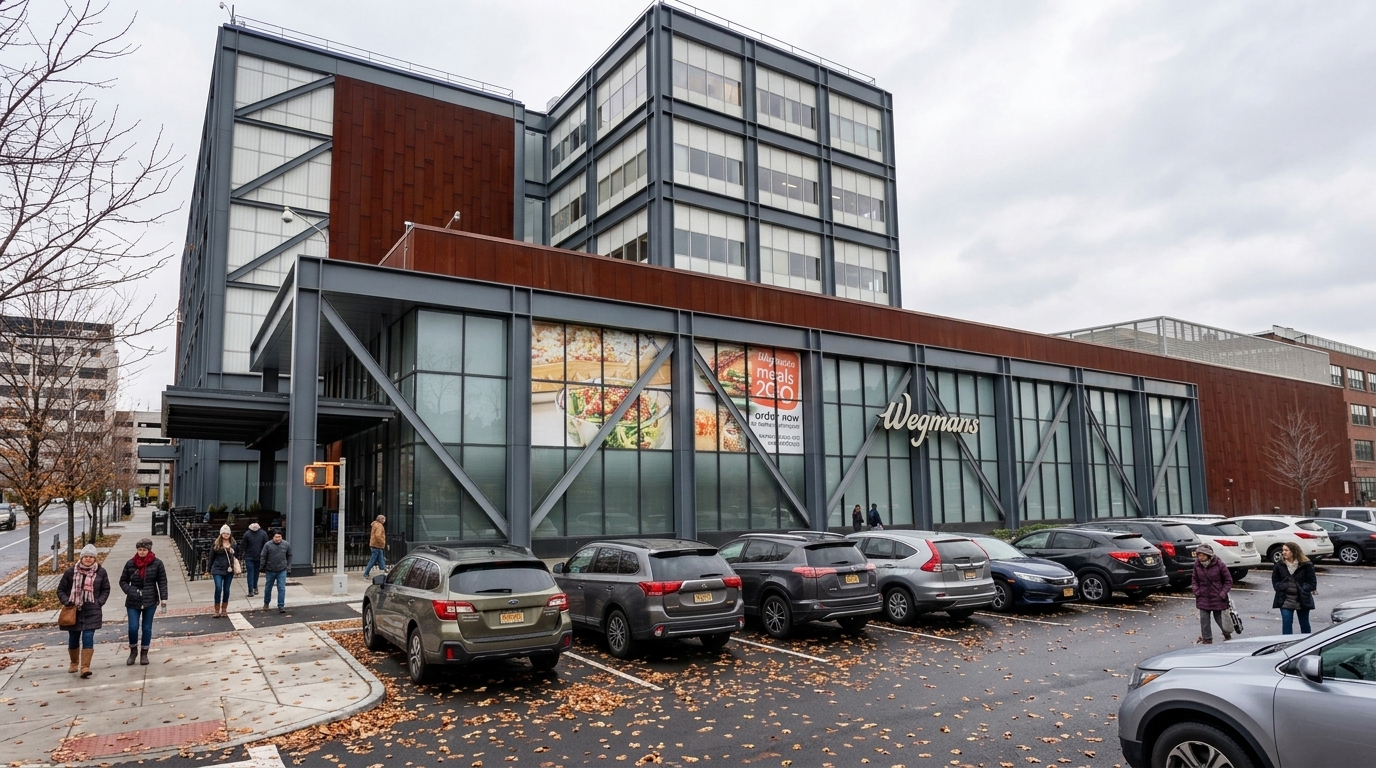
Wegmans is known for deep inventory rotation, extensive fresh-produce offerings, curated specialty sections (including cheese and international foods), and a strong private-label portfolio spanning grocery and prepared-foods categories. The chain has maintained a reputation for employee benefits and low turnover relative to industry norms, and it has consistently ranked among the nation’s best employers. Wegmans has appeared on Fortune’s annual “100 Best Companies to Work For” list since the list first appeared in 1998.
History
Wegmans was founded on January 30, 1916, in Rochester, New York. In 1916, brothers John and Walter Wegman became produce pushcart peddlers with a mission to bring fresh produce to the community. The new store was incorporated in 1931 as Wegmans Food Markets, Inc. In 1930, the two brothers made national headlines when they opened a 20,000-square-foot store — gigantic by standards of the day — with eye-popping innovations like vaporized water spray to keep produce crisp and a cafeteria that seated 300. In 1932, Wegmans introduced refrigerated display windows and vaporized water sprays to keep produce fresh, two things unique to Rochester supermarkets at the time. Frozen (then known as frosted) foods were introduced to their stores in 1940.
All stores were converted to self-service in 1949. Under Robert Wegman’s leadership from 1950, Wegmans transitioned from a local grocer into a regional supermarket leader by modernizing store formats, expanding product breadth, and emphasizing customer experience. In 1953, the company announced a series of broad programs of employee benefits for their more than 350 full-time employees, including an employee profit-sharing plan the following year. In 1968 Wegmans launched its private-label brand, improving margins.
In the 1990s the chain expanded into Pennsylvania and New Jersey. In 1987, Fortune magazine named Wegmans the best U.S. supermarket in terms of customer service. Wegmans was the parent company of Chase-Pitkin, a regional home improvement retailer. On October 4, 2005, Wegmans announced that it would close all Chase-Pitkin stores by early 2006 and focus on its supermarket operations. Chase-Pitkin stores were closed individually at various times throughout March 2006.
In January 2008, Wegmans announced that it would no longer sell tobacco products, due to tobacco’s negative effects on human health and the environment, and would offer smoking cessation programs to all employees. The decision drew praise from the American Lung Association of New York State, which presented Wegmans with the Lung Champion Award.
In November 2010, Walgreens filed a trademark infringement lawsuit against Wegmans, claiming the “W” in the Wegmans logo was too similar to that of Walgreens. The lawsuit was settled in April 2011, with Wegmans agreeing to discontinue use of its “W” logo by June 2012, although the supermarket retains the right to use the “Wegmans” name in script. Opened in 2007 in Canandaigua to develop sustainable growing practices and secure high-demand organic produce supply.
Operations & Footprint
It is headquartered in Gates, New York. The company continues to be owned and operated by the Wegman family. The chain operates a single banner format with stores concentrated in the Northeast and Mid-Atlantic regions. In June 2017, Wegmans partnered with Instacart to provide home delivery service. In February 2020, Wegmans announced that its Brooklyn store would offer grocery delivery to Manhattan residents as an expansion to its Instacart partnership.
Wegmans has invested in vertical integration across key product categories, including bakery, dairy, and prepared foods. In fact, the space that one Wegmans store occupies can be equal to double the space of other supermarkets — between 80,000 to 120,000 feet — which gives you a sense of just how big they are. Wegmans turns over its inventory as much as 100 times per year, compared to other stores who only turn inventory over 18 to 20 times. That’s a significant difference, and it explains why their produce is known for being fresh.
Products, Services & Merchandising
Wegmans stores feature extensive fresh departments, including produce, on-site bakeries, seafood counters, and full-service deli counters. The chain operates an upscale product assortment with emphasis on specialty items such as imported cheeses, international foods, and organic and natural products. Launched in the 1990s to offer chef-prepared meals, increasing basket size and distinguishing the brand from traditional supermarkets.
The app, reinforced by an Instacart partnership, handled approximately 15% of total sales volume by 2025, accelerating omnichannel capabilities. Wegmans offers a pick-up service called “personal shopping” at selected locations.
Work Environment & Employment
Founded in 1916 by brothers Walter and John Wegman, the company is still owned and operated by the Wegman family and employs almost 55,000 people. Pay, benefits, and career development opportunities at Wegmans outpace industry averages, and the employee turnover rate at the company is about half the average for the supermarket industry.
Employees can also take advantage of Wegmans employee scholarship program, which has awarded $145 million to over 46,500 employees since 1984. Wegmans has appeared on Fortune’s annual “100 Best Companies to Work For” list since the list first appeared in 1998. The company has been listed among the top four on the “100 Best Companies to Work For” list since 2016.
Business Model & Financial History
Wegmans operates as a family-owned, privately held enterprise, maintaining both independence and control of strategic direction. The company’s economic model relies on high inventory turnover, operational efficiency, and premium private-label and specialty merchandise that support higher margins relative to traditional discount-focused competitors. In 2009, Stores Magazine showed it to be the 74th-largest retailer in the United States with estimated revenues of $4.67 billion. The company has grown steadily through disciplined regional expansion rather than rapid acquisition or consolidation.
Competitive Landscape
Wegmans competes in a regional market dominated by larger national chains including Ahold Delhaize (Stop & Shop, Food Lion) and traditional regional competitors. The chain’s differentiation centers on fresh merchandise quality, in-store prepared-food offerings, and above-average employee treatment and store experience. Of all the groceries in all the regions in all the world, Wegmans is firmly entrenched in the number one spot, according to surveys from Consumer Reports. They’ve been clenching that number one vote since 2006, beating out other fierce competitors like Publix, Market Basket, and Trader Joe’s. The premium positioning limits direct overlap with discount grocers such as Aldi or Walmart, and the specialized in-store offerings compete partially with specialty retailers.
Recent Developments & Outlook
In recent years, Wegmans has pursued selective geographic expansion while strengthening digital and omnichannel capabilities. The company has expanded into new markets including North Carolina (opening its 100th store) and Delaware, while deepening its presence in existing regions. Digital investments, including development of proprietary mobile ordering and its Instacart partnership, represent the company’s primary vehicle for competing in e-commerce while protecting store traffic.
Strategic priorities include maintaining inventory freshness and category excellence in fresh foods and prepared meals, further development of organic and specialty produce (including supply from company-owned farms), and enhancement of omnichannel fulfillment. Long-term challenges include managing labor costs in a competitive retail environment, defending premium positioning against both discount and e-commerce competitors, and maintaining operational efficiency as the chain grows beyond its traditional Northeast and Mid-Atlantic stronghold.
Leave a Reply