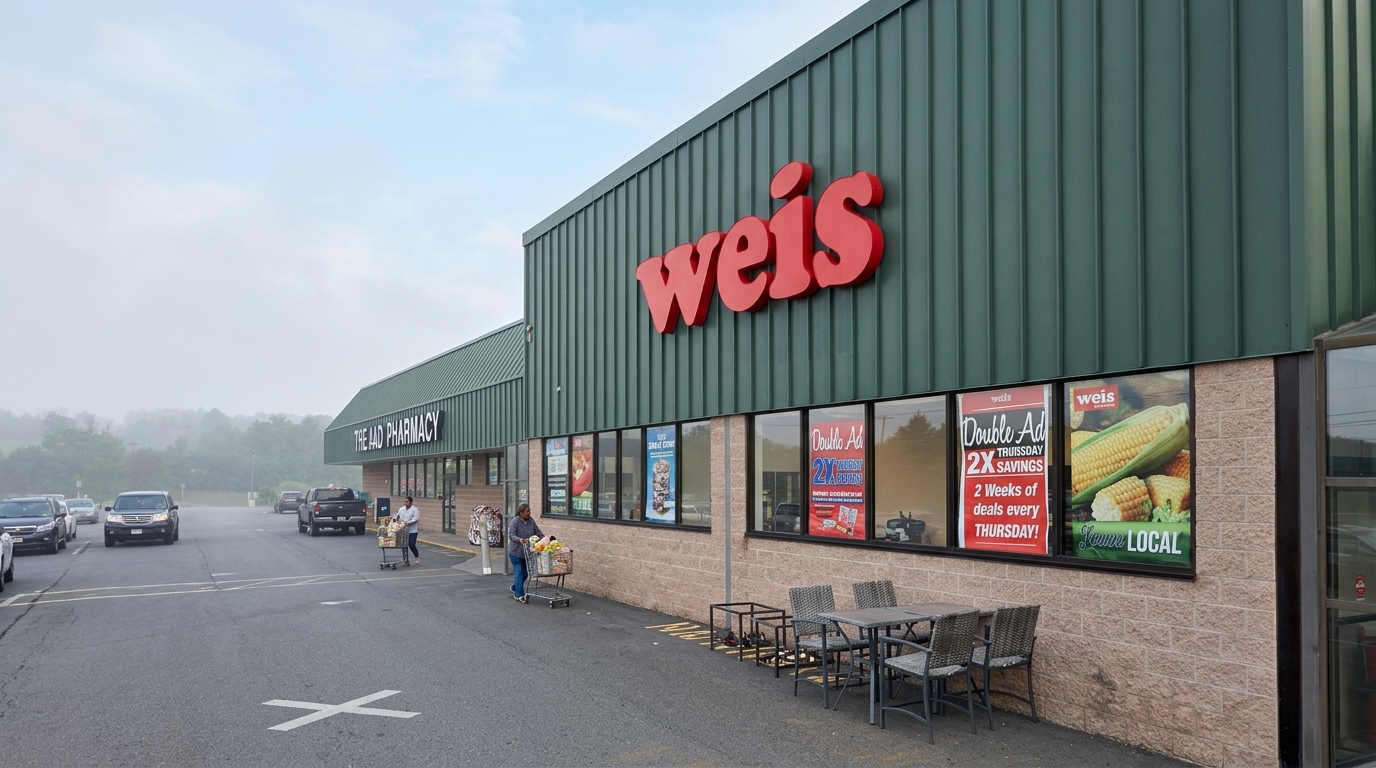
Weis Markets owns and operates its own dairy, ice cream, and meat processing plants, along with a dedicated fleet of trucks and substantial real estate holdings, ensuring product quality and efficient distribution. The company maintains a loyalty program and digital commerce capabilities, and in recent years has expanded its service offerings to include pharmacy services and fuel stations. Weis Markets remains family-controlled, with the founding family maintaining significant influence over strategic direction and operations.
History
Harry and Sigmund Weis founded Weis Markets in 1912 when they opened a small neighborhood store known as Weis Pure Foods on Market Street in Sunbury, Pennsylvania. The store did not operate on credit, with sales only for cash, unlike similar stores of the era that operated on credit allowing customers to build tabs paid periodically; this cash-based approach lowered prices by up to 25%.
In 1915, a second Weis store opened in Harrisburg, Pennsylvania. The Weis brothers expanded through Central Pennsylvania in the 1920s–30s, opening dozens of neighborhood shops and building a local low-price reputation. Private-label products were introduced in the 1920s, and by the mid-1990s, this category grew to include over 2,000 items.
The company closed several corner grocery stores in Harrisburg in 1938, replacing them with their first self-service, consolidated supermarket. By 1955, the company had consolidated all of its corner grocery stores into supermarkets, with 35 stores. In the 1950s and 1960s, Weis expanded its reach, first to York and then Lancaster by 1960.
Weis expanded to Maryland in July 1967, opening its first non-Pennsylvania store in Hagerstown. In November 1967, the company purchased the five-store Albany Public Markets chain based in Albany, New York, in an all-cash transaction, operating Albany Public Markets as a subsidiary with the company’s management team intact. Weis closed its Albany Public Markets chain in October 1986, leasing the nine stores to Grand Union.
The company purchased two regional chains in the Poconos and Lehigh Valley region: Mr. Z’s, a 14-store chain of IGA supermarkets, in 1992, and King’s, a six-store chain based in Hamburg, in 1994. Mr. Z’s and King’s were operated under separate banners for years before all stores were re-branded as Weis.
Weis Markets became publicly traded in 1965. Robert F. Weis, the son of Harry Weis, died in October 2015 at the age of 96; a philanthropist, Weis donated millions of dollars to charities, food banks, and other organizations. In March 2017, Weis Markets opened a 65,000-square-foot store in Hampden Township, Pennsylvania, featuring a pub, ice cream parlor, expanded takeout food selection, a drive-thru pharmacy, and a beer cafe selling 900 varieties of beer and 500 varieties of wine.
In late September 2019, Weis acquired two Thomas’ Food Market stores, one in Dallas, Pennsylvania and another in Shavertown, Pennsylvania, reopening the Dallas location under the Weis banner and closing the Shavertown location.
Operations & Footprint
Weis Markets operates stores in Pennsylvania, New York, New Jersey, Maryland, Delaware, Virginia, and West Virginia. The chain’s headquarters and primary distribution center remain in Sunbury, Pennsylvania. In 2024, construction began on six new stores, with three slated for opening in Maryland in 2025 and another in Delaware in early 2026.
The company operates a vertically integrated supply chain, controlling production and distribution of key product categories. Weis Markets owns and operates its own dairy, ice cream, and meat processing plants, along with a dedicated fleet of trucks and substantial real estate holdings. This integration provides cost control and supply consistency across the chain. The company also operates fuel centers at select locations and maintains a network of pharmacies within stores.
Products, Services & Merchandising
Weis Markets offers a wide array of products, including groceries, fresh produce, meats, dairy, bakery items, and pharmacy services. In the 1920s, Sigmund and Harry Weis began offering their own branded products, including coffee, mayonnaise, salad dressings, and canned goods. The company maintains an extensive private-label assortment across multiple tiers, supporting both value and premium product positioning.
Weis Markets operates fuel stations at select supermarket locations, a service that began in 2004. The company offers online grocery ordering with home delivery and in-store pickup options. Weis is expanding in-store pharmacy services, nutritional consulting, and loyalty-program features to capture health-conscious consumers and increase basket frequency.
Work Environment & Employment
Weis Markets is a significant regional employer with operations spanning multiple states. The company has historically emphasized employee development and training. Job postings and employee testimonials reflect advancement opportunities within store operations, management, and corporate functions.
Employment practices and workplace culture have evolved as the company has grown. The company maintains equal opportunity employment policies and has navigated standard labor-relations matters common to unionized and non-unionized grocery operations. Employee benefits and compensation structures are competitive with regional grocery chains.
Business Model & Financial History
Weis Markets’ founding business model eliminated credit sales and operated on cash only, which allowed prices to be lowered by up to 25%. This model prioritized volume sales at thin margins, a strategy that remains central to the company’s value positioning. The grocery retail business operates on narrow margins, requiring scale and operational efficiency to remain profitable.
Weis Markets became publicly traded in 1965. The Weis family maintains a controlling interest, holding around 61% of shares as of June 2025. In June 2025, the company bought back 2.15 million shares for $140 million, primarily to address estate tax obligations for Patricia R. Weis’s estate, with the Weis family retaining approximately 61% of outstanding common stock.
Institutional investors hold substantial portions of the company’s stock; as of early 2025, institutional investors such as Dimensional Fund Advisors LP and Vanguard Group Inc. collectively own over 38% of the company’s stock. The company’s capital structure reflects a blend of family ownership and public market investment, typical of long-established regional grocers.
Competitive Landscape
Weis Markets competes in a fragmented regional grocery market dominated by larger national chains and strong regional competitors. The mid-Atlantic region supports competition from national chains such as Walmart, Target, and Kroger, as well as regional players like Giant Food and Shop-Rite. Weis Markets has traditionally differentiated itself through local store presence, fresh departments, fuel offerings, and community engagement.
The grocery industry faces structural pressures from e-commerce competitors, discount grocers, and consolidation among traditional chains. Weis Markets’ regional focus and family ownership provide some insulation from broader market disruption, though expansion of delivery services and online grocery ordering has become essential for competitive viability. The company’s private-label portfolio and integrated supply chain offer cost advantages in a price-sensitive market.
Recent Developments & Outlook
In 2024, the company completed 11 major and 15 minor remodels, alongside opening five new fuel centers. In Q4 2024, the company saw a 46% surge in online sales, reflecting growing digital commerce adoption.
Leadership targets a 20 percent reduction in carbon emissions by 2027, driven by solar installations at distribution hubs and efficiency upgrades. Capital plans and the rollout of automated micro-fulfillment centers aim to reduce fulfillment costs and improve order speed for Weis 2 Go, the company’s digital commerce platform. Analysts expect focus on fill-in acquisitions within the existing seven-state territory to enhance distribution efficiencies and scale.
Leave a Reply