
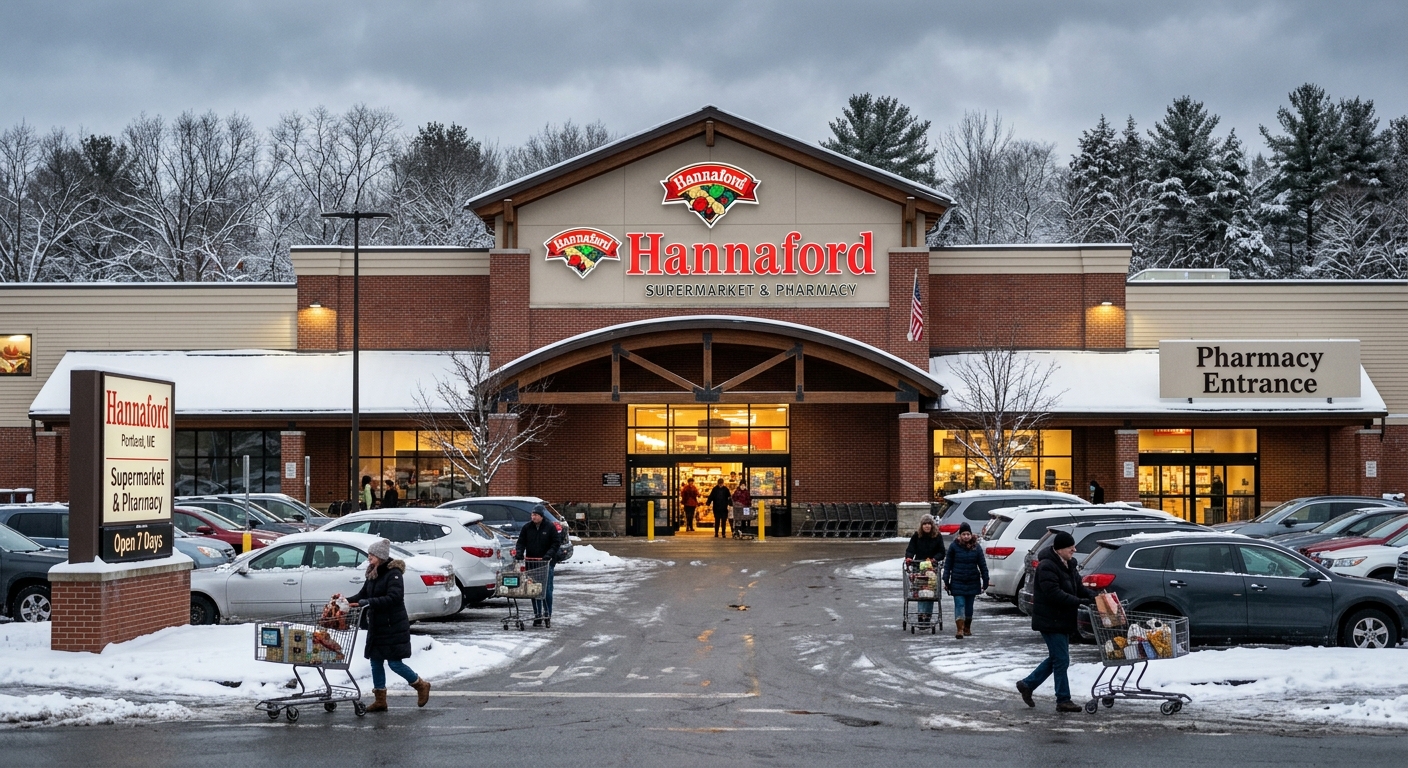
Hannaford Supermarkets is a supermarket chain operating across the northeastern United States, with a footprint concentrated in northern New England and upstate New York. Known formally as Hannaford Bros. Co., the chain operates full-service grocery stores that combine conventional supermarket offerings with fresh produce, prepared foods, pharmacy services, and an emphasis on local sourcing. It is a long-established regional player whose roots stretch back to the 19th century.
The company is part of the international retail group that also owns several other prominent U.S. grocery banners, giving it the scale advantages of a large parent while retaining a distinct regional identity. Hannaford is notable for its early and sustained investments in nutrition labeling, store-brand quality, and energy-efficient store design, which have shaped its reputation among shoppers in its core markets.
History
Hannaford traces its origins to 1883, when Arthur Hannaford began selling fresh fruit and vegetables from a cart in Portland, Maine. The business grew into a produce wholesaling operation and, over the following decades, expanded into broader grocery distribution and retail. The Hannaford Bros. name became established as the company moved from wholesaling toward operating its own supermarkets across Maine.
Through the mid- and late 20th century, Hannaford expanded its retail presence across northern New England and into New York. The company at various points operated under additional banners and experimented with combination food-and-drug store formats. It became a publicly traded company before being acquired in 2000 by the Belgian retail group Delhaize, marking a major ownership change.
In 2016, Delhaize merged with the Dutch retailer Ahold to form Ahold Delhaize, bringing Hannaford under the same corporate umbrella as sister U.S. banners. Through these transitions, Hannaford continued to operate under its own name and management, preserving its regional brand while gaining access to shared distribution, procurement, and private-label resources. A notable event in the company’s history was a large data breach disclosed in 2008, which exposed payment-card information and drew significant attention to grocery-sector data security.
Operations & Footprint
Hannaford’s stores are concentrated in Maine, New Hampshire, Vermont, Massachusetts, and New York. The chain operates primarily under the Hannaford banner, focusing on full-service supermarkets rather than a wide range of distinct formats. Its geographic concentration in the Northeast gives it density and brand recognition in markets where larger national chains have historically had a lighter presence.
The company is privately held within the Ahold Delhaize group rather than independently public, and it benefits from shared corporate infrastructure across the parent’s U.S. operations. Distribution is supported by regional warehousing and logistics networks, including facilities in Maine, that supply stores across the chain’s territory. Hannaford has historically emphasized supply-chain relationships with local and regional farmers and producers, which supports its positioning around fresh and locally sourced products.
For current store counts and other live operational figures, readers should consult the accompanying key facts box, as these numbers change over time.
Products, Services & Merchandising
Hannaford stores carry a standard supermarket assortment spanning fresh produce, meat and seafood, dairy, bakery, packaged grocery, and frozen foods. Many locations include pharmacies, prepared and ready-to-eat foods, and expanded natural and organic selections. The chain has placed particular emphasis on fresh departments and on highlighting locally produced goods.
The company offers private-label products, including store brands developed and shared across the broader parent group, which span value-tier and premium-quality lines. Hannaford was an early adopter of nutrition-guidance systems, having introduced a shelf-tag rating program designed to help shoppers identify more nutritious products, a feature that distinguished it among conventional grocers.
Hannaford’s pricing posture has generally combined competitive everyday pricing with weekly promotions and a customer loyalty and rewards program. Like most modern supermarket operators, it has expanded digital services over time, including online ordering, grocery pickup, and home delivery. Because these tools evolve frequently, they are best understood in general terms rather than by specific feature.
Work Environment & Employment
As a large regional employer, Hannaford provides a substantial number of jobs across its store, distribution, and corporate operations in the Northeast. Roles range from entry-level store positions to pharmacy, management, and supply-chain careers, and the company has long been a significant employer in its home state of Maine.
Hannaford generally offers the mix of pay, benefits, and scheduling typical of large supermarket employers, along with training and internal advancement pathways. The company has periodically been recognized for workplace and community initiatives in its operating regions. As with many grocery chains, the workforce reflects a blend of part-time and full-time roles, and labor representation varies by location and function.
Business Model & Financial History
Hannaford operates within the structurally thin-margin economics of the grocery industry, where profitability depends on high sales volume, efficient operations, and disciplined cost control. Revenue is driven primarily by everyday food and household purchases, supplemented by higher-margin categories such as prepared foods, pharmacy, and private-label goods.
The chain’s competitive position rests on scale advantages derived from its parent group, including shared purchasing power, distribution infrastructure, and private-label development. Its pricing approach blends competitive base pricing with promotional activity, a common model among conventional supermarkets seeking to balance value perception with margin.
The most significant financial and ownership milestones in Hannaford’s history are tied to its transitions from a public company to acquisition by Delhaize in 2000, and then into the combined Ahold Delhaize organization formed in 2016. Operating within a large multinational parent provides Hannaford with financial stability and investment capacity, while the broader group absorbs much of the capital-markets exposure. Current revenue and comparable point-in-time financial figures are maintained in the accompanying key facts box.
The model’s structural strengths include strong regional density, brand loyalty, and access to parent-group resources. Its vulnerabilities mirror those of the broader grocery sector: intense price competition, exposure to discounters and e-commerce, and the ongoing need to invest in digital fulfillment and store modernization.
Competitive Landscape
Hannaford competes with a range of conventional and alternative grocery operators across the Northeast, including regional supermarket chains, national players, warehouse clubs, mass merchandisers, and dollar and discount formats. In its core markets, it faces both traditional grocers and the expanding presence of low-price and online competitors.
The chain differentiates itself through its emphasis on fresh and locally sourced products, nutrition labeling, store cleanliness and layout, and its established regional reputation. Structural pressures affecting the company include the growth of e-commerce grocery, the spread of hard discounters, and ongoing industry consolidation that intensifies competition for scale and efficiency.
Strategically, Hannaford has positioned itself as a quality-focused regional supermarket that leverages the resources of a large parent while maintaining a local identity. This combination has helped it sustain a durable presence in markets where it has long operated.
Recent Developments & Outlook
In recent years, Hannaford has continued to invest in store updates, digital ordering and fulfillment, and sustainability initiatives, including energy-efficient store design and food-waste reduction efforts that have drawn industry attention. As part of Ahold Delhaize’s U.S. operations, the chain benefits from coordinated investment in technology, supply chain, and private-label development.
Looking ahead, Hannaford’s prospects are tied to its ability to defend its regional position against discounters and online competitors while maintaining its differentiated emphasis on fresh, local, and nutrition-focused offerings. Continued investment in digital convenience and operational efficiency is likely to remain central to its strategy. For the most current figures on the company’s size, leadership, and financial performance, readers should refer to the accompanying key facts box.

Leave a Reply