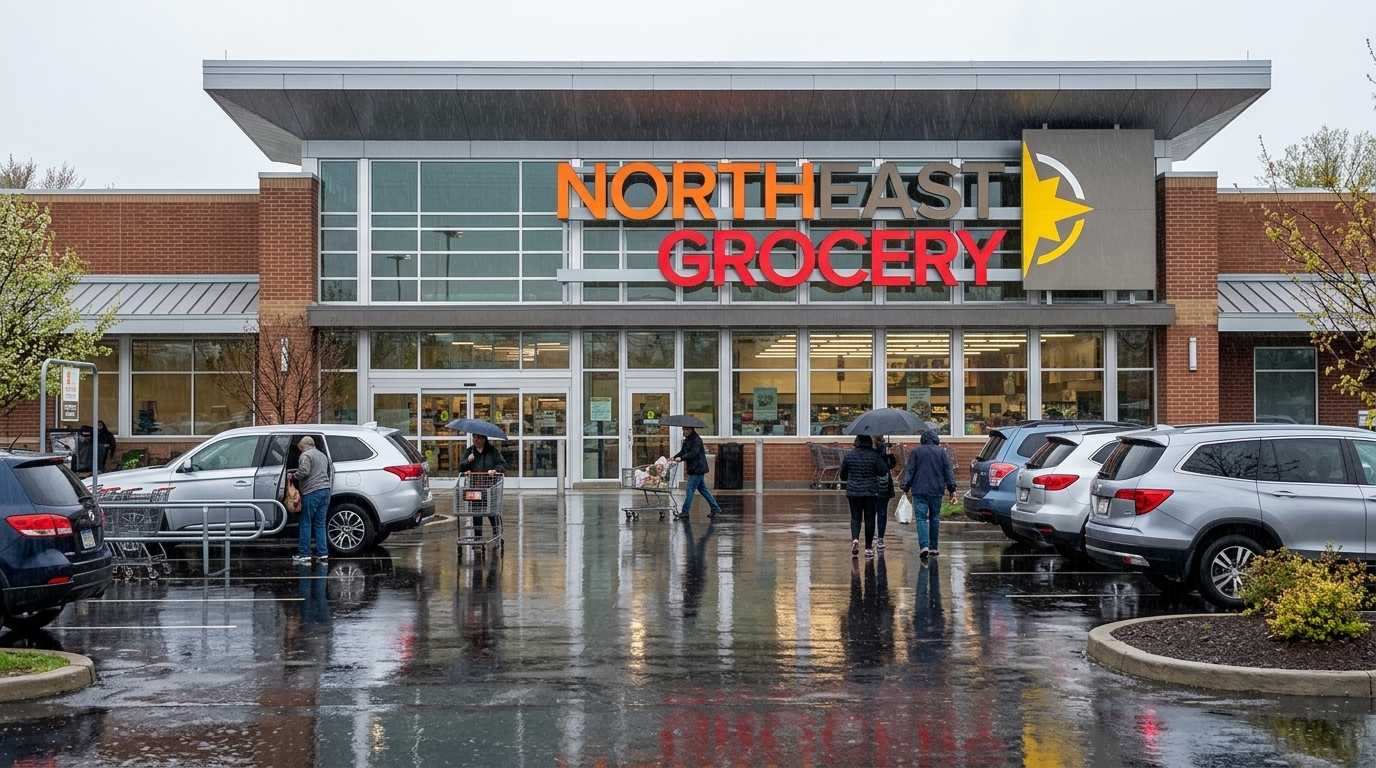
Northeast Grocery is a privately held regional chain headquartered in Schenectady, NY. The three banners maintain distinct identities and local management while leveraging shared supply chain and technology infrastructure. The company competes in a consolidating regional market where scale, operational efficiency, and localized merchandising are critical advantages against both national chains and hard-discount competitors.
History
Golub Corporation traces to 1932 when brothers Ben and Bill Golub opened Public Service Market in Schenectady, evolving into Price Chopper by 1973. Price Chopper grew steadily throughout the latter half of the twentieth century, expanding its footprint across Upstate New York and into New England. Golub Corporation was initially 100 percent family and employee-owned.
Tops Markets began in 1962 in Niagara Falls by Armand Castellani and Thomas Buscaglia, focused on one-stop neighborhood retailing. Tops was acquired by Ahold in 1991, sold to Morgan Stanley PE for $410 million in 2007, then experienced a management buyout in 2013. Tops filed Chapter 11 in 2018 and eliminated nearly $400 million of debt during restructuring.
Golub-founded rebranding to Market 32 in mid-2010s was financed via internal cash flow and private credit to preserve ownership control. This premium format banner was designed to appeal to higher-income shoppers and offer elevated private-label products and specialty departments.
On February 8, 2021, Price Chopper and Tops announced plans to merge. Northeast Grocery, Inc. was formed on November 8, 2021, through the merger of the Golub Corporation and Tops Markets to create a unified regional grocer capable of competing with national chains and e-commerce. The new parent company would be headquartered in Schenectady, New York, while Price Chopper and Tops would retain their primary offices in Schenectady and Williamsville, respectively. As a condition of regulatory approval, the FTC required the divestiture of 12 stores. These stores were sold to C&S Wholesale Grocers with most reopening under the Grand Union banner.
Operations & Footprint
Northeast Grocery operates supermarkets across New York, Vermont, Connecticut, Pennsylvania, Massachusetts and New Hampshire. The company operates under three banners: Tops Friendly Markets, Price Chopper and Market 32. Both banners were expected to continue operating with local management under the new corporate structure.
Northeast Grocery is a privately held regional chain headquartered in Schenectady, NY. The move combined legacy brands and supply chains to improve purchasing power and operational efficiency across the Northeast Grocery Company footprint. From 2022–2025 NGI consolidated distribution networks and administrative functions to reduce overlap, improving supply chain efficiency and lowering operating costs per store.
Products, Services & Merchandising
Northeast Grocery operates conventional supermarkets and a premium banner format. Between 2022 and early 2025 NGI converted 50 stores to Market 32, reflecting the company’s pivot toward premium formats and higher average transaction values. The stores offer standard grocery assortments including produce, dairy, meat, deli, and prepared foods, alongside pharmacy and general merchandise categories typical of full-service supermarkets.
AdvantEdge and BonusPlus programs expanded through 2025 to serve millions of active users, supporting personalized offers and driving higher frequency among loyalty members. In 2024, a unified retail media network was launched that created a high-margin revenue stream using first-party data. AI-driven inventory management was rolled out that reduced food waste by 15 percent chainwide.
Work Environment & Employment
Northeast Grocery maintains a significant workforce across its operating footprint. The company employs workers in store operations, supply chain, merchandising, and corporate functions. As a consolidated entity combining two previously independent chains, the merger brought together distinct workplace cultures and labor relationships, with both unionized and non-union operations represented across different regions and banners.
Business Model & Financial History
Like traditional supermarket operators, Northeast Grocery operates on thin margins in a capital-intensive, inventory-heavy business. Success depends on scale economies in procurement, efficient logistics, labor productivity, and customer traffic density. At formation NGI targeted supply-chain synergies to reduce cost inflation impacts; public disclosures in 2021–2022 projected combined annual purchasing scale exceeding $6 billion, enhancing negotiated vendor terms across the Northeast Grocery Company footprint.
The divergent ownership histories—Golub’s family/ESOP model versus Tops’ corporate and private equity episodes—converged in 2021 when the two chains merged to form Northeast Grocery, combining community-focused ownership culture with scale from prior buyouts and reorganizations. John Persons became CEO in 2024, chairing strategic execution alongside Golub family and former Tops executives to maintain parity and continuity.
Competitive Landscape
Northeast Grocery competes across its six-state footprint against national operators including Walmart and Kroger subsidiaries, regional chains such as Giant Eagle and ShopRite networks, and expanding hard-discount competitors including Aldi and Lidl. Price-conscious consumers in the region increasingly choose discount grocers, while some shoppers trade up for premium or specialty formats. The shift toward e-commerce and omnichannel fulfillment has intensified competition and raised capital requirements for technology and fulfillment infrastructure.
By 2025 NGI held top-three market share in several New York and Vermont metros, supported by localized assortments, expanded private-label offerings and targeted store formats. The company’s regional concentration and local management model provide advantages in tailoring assortments and promotions to community preferences, though this focus also constrains geographic growth opportunities.
Recent Developments & Outlook
Northeast Grocery Company history highlights industry-first loyalty marketing, a 2021 merger, a 2024 unified retail media network launch, and leadership change in 2024 that accelerated digital transformation amid inflation and competitive pressure from hard discounters. Store remodeling and banner conversions continue as strategic priorities, with additional investments expected in technology infrastructure to support omnichannel capabilities and operational efficiency.
The company faces structural headwinds common to regional grocery operators: labor cost inflation, supplier consolidation limiting negotiating leverage in some categories, and sustained pressure from discount formats and e-commerce. Strategic responses include private-label expansion, store format optimization toward premium banners in strong markets, and deepening loyalty and data analytics capabilities. The merger has created a platform large enough to invest in technology and scale shared services, though integration execution remains ongoing through the mid-2020s.
Leave a Reply