
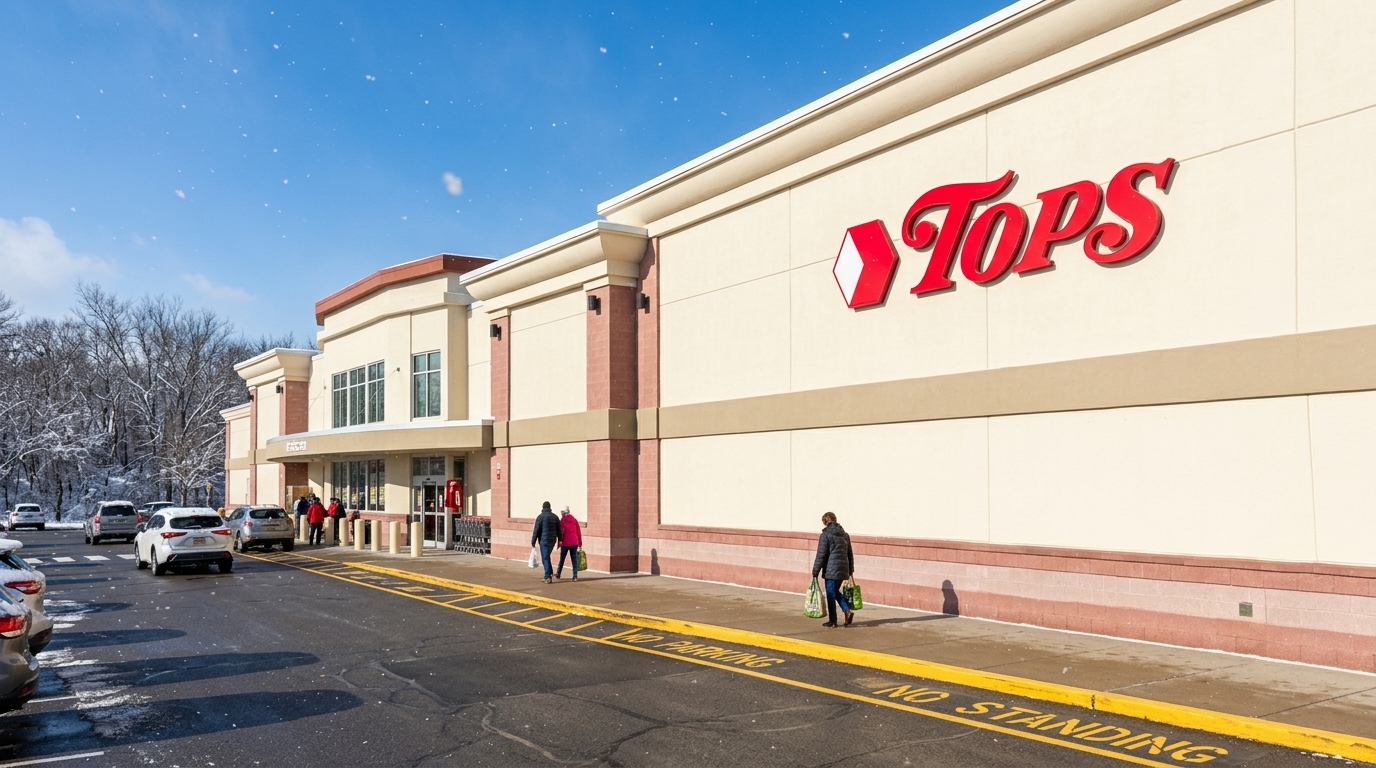
Tops Friendly Markets was co-founded by Armand Castellani and Thomas Buscaglia. Castellani’s family came to the United States in 1920 and settled in Niagara Falls, where his father, Ferrante, opened a small neighborhood grocery store. Following his mother’s death in 1933, Castellani left school to help manage the store. He continued to do so until joining the Army in 1941. After World War II, Castellani returned to the family business. In 1951, he set out on his own and opened the Great Bear Market in Niagara Falls. Shortly thereafter, he partnered with Buscaglia, owner of a grocery equipment firm, T.A. Buscaglia Equipment Co. Throughout the 1950s, Buscaglia, as CEO, and Castellani worked together, entering into a cooperative agreement with other small stores to build the foundation of what was to become the Tops Friendly Markets chain.
In 1962, franchise systems were established for supermarkets, under the Tops Friendly Markets name, and for smaller stores as B-Kwik. In February of that year, Tops signs went up on seven stores, and the chain was born. By the end of the year, NFS was composed of 15 franchised stores throughout Western New York, employing a total of 300 associates. Throughout the 1960s, NFS implemented warehousing and centralized purchasing to allow the company to grow efficiently. In 1967, Buscaglia died and Armand Castellani took over as chief executive officer. The next year, NFS went public, trading on the American Stock Exchange. The following year, 1969, NFS entered the convenience store market by opening the first Wilson Farms Neighborhood Food store in Tonawanda, New York.
The 1970s saw Tops Friendly Markets, under the leadership of Castellani and Nanula, continue to grow in Western New York, and thrive where competitors struggled. Early in the decade, Tops began to build more company-owned stores. By the mid-70s, the company had expanded into the Rochester area, and over time, it became the only real competitor to Wegmans in the region. Also during this time, Tops Friendly Markets opened its first Pennsylvania store in Bradford.
In 1983, SB Investors, a private, New York-based investment group, purchased NFS. By this time, operations had grown to include 65 Tops stores, 50 Wilson Farms stores and 15 B-Kwik Food Stores, employing 7,000 associates. In 1985, Castellani was named chairman of the board and Nanula succeeded him as CEO. The following spring, SB Investors became known as Tops Friendly Markets, Inc., as the company went public for the second time, this time on NASDAQ. The following year, as Tops Friendly Markets celebrated its 25th anniversary, a $196 million leveraged buyout of the company was engineered between a group of Tops Friendly Markets executives and private equity firm Riordan, Freeman & Spogli.
In 1987, Tops installed electronic scanners, one of the last supermarkets to do so. A new era began March 27, 1991 as Tops Friendly Markets, which had grown to 145 total stores and 11,000 associates, was acquired by Ahold, a major international food retailer based in the Netherlands. The same year, the first Tops Friendly Markets International Super Center opened in Amherst. At that time, the 112,000 sq ft store was the largest in Western New York, and boasted the biggest in-store bakery in the entire U.S.
The 1990s were marked by a new growth in operations, including the 1996 merger with Finast in Northeast Ohio, expansion across New York, the construction of a new headquarters in Amherst, New York, and the opening of an 848,000 sq ft distribution center in Lancaster. By 1998, Tops Friendly Markets’ market area stretched from Sandusky, Ohio, to Utica.
In February 2001, Ahold acquired 56 Grand Union stores, 22 of which were converted into Tops Friendly Markets. In 2002, the company celebrated its 40th anniversary, and founder Armand Castellani died at the age of 84. In 2007, Ahold announced that they would sell Tops Markets to Morgan Stanley Private Equity. In the fall of 2007, then president and CEO Frank Curci, led the deal that returned Tops Markets back to local operation. In 2010, Tops acquired The Penn Traffic Company, a deal which resulted in bringing 64 new stores into its family. In July 2012, Tops announced its purchase of 21 Grand Union Family Markets stores. In November 2013, six members of Tops’ executive team, led by Chairman and CEO Frank Curci, purchased the company from Morgan Stanley Private Equity, returning it back to complete local ownership.
In 2018, after a series of store closures, Tops Friendly Markets filed for Chapter 11 bankruptcy protection and the chain emerged 6 months later after clearing $720 million in debt. On February 8, 2021 Tops Markets and Price Chopper/Market 32 announced that they entered into a definitive merger agreement. The company operates as a subsidiary of Northeast Grocery, Inc., following a 2021 merger with Price Chopper and Market 32 that created a combined entity with nearly 300 stores across the Northeastern United States.
Operations & Footprint
Tops Friendly Markets operates neighborhood stores across New York, Pennsylvania, and Vermont. The company is headquartered in Williamsville, New York, and operates two distribution facilities in Lancaster and West Seneca, New York. Following the 2021 merger with Price Chopper and Market 32, Tops operates as a subsidiary of Northeast Grocery, Inc.
In-store amenities at Tops include in-store pharmacies; in-store butchers, where meat is cut fresh every day; in-store bakeries, and ready-to-eat prepared foods in the stores’ Carry Out Cafés. In most locations, Tops also includes on-site fuel stations where customers can take advantage of Tops’ Gas BonusPoints program. Tops makes available state-of-the-art technology throughout the store including recipe kiosks, EasyWeigh stations and EasyScan (self-scan) checkout lanes.
Products, Services & Merchandising
Tops considers its stores to have a “neighborhood grocer” feel—each store customized to fit the community it surrounds, with the product mix reflecting the cultural and ethnic characteristics of local areas. The International stores feature additional floor space and a product mix of many foods from different world cultures which up until then had not been widely available in the Buffalo area.
Tops maintains a weekly promotional pricing strategy and outstanding vendor relationships, which allow the company to focus on providing an excellent value to their shoppers through a variety of discounts and added value programs through their TOPS BonusPlus® loyalty program. In 2008, the grocery chain started selling coffee and doughnuts from Toronto-based chain Tim Hortons inside stores in either a full-scale or quick-stop format. That same year, chicken wings from Buffalo’s Anchor Bar got a prime spot in the store’s carryout section, which sells ready-to-eat foods.
Work Environment & Employment
When acquired by Ahold in March 1991, Tops employed 11,000 associates across 145 total stores. The company has maintained a strong presence as a regional employer in upstate New York, emphasizing community engagement and local economic impact throughout its decades of operation.
Business Model & Financial History
Tops operates on a traditional supermarket model emphasizing value, community engagement, and localized merchandising. The chain built its foundational strength through cooperative purchasing and centralized warehousing beginning in the 1960s, which allowed independent and franchised operators to compete effectively against larger national chains. The early cooperative structure differentiated Tops from centralized competitors by preserving local control while leveraging collective purchasing power.
The company has experienced multiple ownership transitions and capital restructurings. After recording revenues of $790 million and net profits of $6.6 million for the year that ended June 28, 1987, Tops was again taken private. Management hired New York investment banker Goldman Sachs, which then found a buyer: the Los Angeles-based merchant banking firm of Riordan, Freeman & Spogli, which paid about $280 million, including debt, for the company. Following its 1991 acquisition by Ahold, the chain underwent expansions and consolidations tied to broader corporate strategy. In 2018, Tops filed for Chapter 11 bankruptcy protection and emerged 6 months later after clearing $720 million in debt.
Competitive Landscape
Tops operates in a highly competitive regional market dominated by larger chains. By the mid-70s, the company had expanded into the Rochester area, and over time, it became the only real competitor to Wegmans in the region. The merger with Price Chopper/Market 32 in 2021 consolidated two significant regional operators to create a more competitive counterweight to national and international grocery retailers operating in the Northeast. The broader competitive environment includes national chains, discount grocers, and e-commerce fulfillment services that have reshaped the traditional supermarket landscape.
Recent Developments & Outlook
On February 8, 2021, Tops Markets and Price Chopper/Market 32 announced that they entered into a definitive merger agreement. The merger created Northeast Grocery, Inc., a combined entity with nearly 300 stores across the Northeastern United States. Under the new corporate structure, Tops operates as a subsidiary while maintaining its regional brand identity and local management presence. The integration of these two long-established regional chains positions the combined company to leverage scale advantages while preserving the community-focused merchandising approach that characterized both organizations historically.
Leave a Reply