
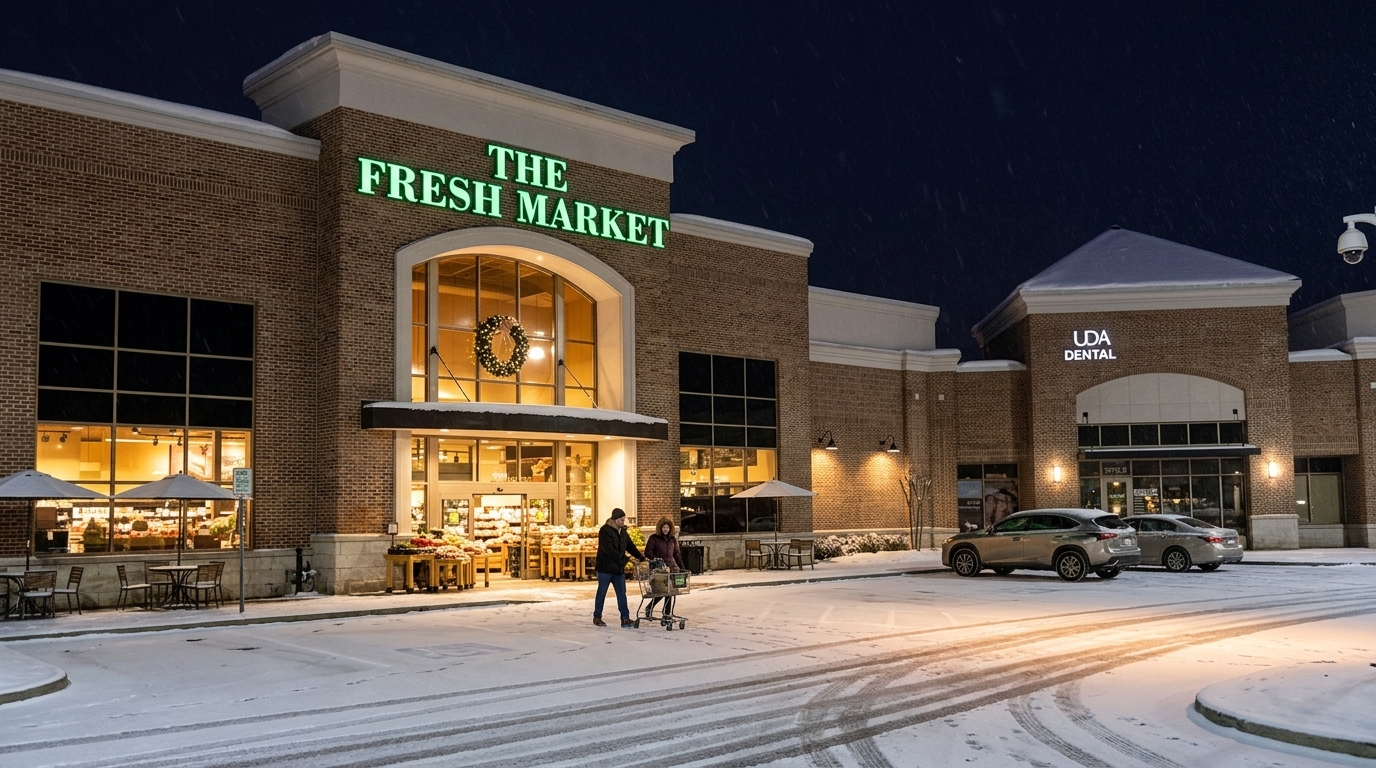
The Fresh Market is an American chain of supermarkets based in Greensboro, North Carolina. The chain brings back the feeling of open European-style markets, operating as a premium specialty retailer focused on fresh perishables, artisanal goods, and curated international selections in small-format stores averaging about 21,000 square feet. This positioning has distinguished The Fresh Market in a competitive landscape dominated by conventional supermarkets and discount chains, earning recognition from shoppers who prioritize quality and shopping experience over price competition alone.
The Fresh Market was founded by Ray and Beverly Berry on March 5, 1982, in Greensboro, North Carolina. The initial 14,000-square-foot store differentiated itself from conventional supermarkets with a farmer’s market atmosphere, complete with locally-grown produce, bins of freshly roasted coffee, an old-world style butcher shop and fish market, in-store bakery, fresh cheeses and cured meats, and floral stands. The Berrys’ idea was to develop a better grocery store that brought back the feeling of open European-style markets.
Retail Formats and Where It Operates
The Fresh Market stores place a heavy emphasis on fresh produce, meats, deli and prepared foods, along with organic and conventional groceries, merchandised in an easy-to-shop footprint that is about half the size of a conventional supermarket. Meat and seafood are 100% service and sales associates eagerly engage shoppers in conversations and offer meal and cooking suggestions; store managers are more apt to be on the sales floor assisting customers than in the office or stockroom. All stores are leased rather than company-owned.
Geographically, the chain operates in 22 states in the United States, mainly Florida, North Carolina (where its headquarters is located), Virginia, and Georgia. The states with the most Fresh Market locations are Florida with 51 stores, North Carolina with 21 stores, and Virginia with 13 stores. The chain’s footprint spans the Southeast, Midwest, Mid-Atlantic, and Northeast regions, with Florida accounting for the largest concentration of stores.
Distribution relies on third-party logistics partners. Its primary distributor is Milford, Del.-based Burris Logistics, supplying the chain out of Atlanta and New Castle, Del., while Medford, N.J.-based Haddon House supplies specialty grocery. This model reflects the scattered, non-contiguous nature of The Fresh Market’s store network, which operates one or two locations in most markets rather than building density in any single region.
Company Background
Ray Berry decided to leave his job in which he oversaw 3,600 7-Eleven stores for The Southland Co. (now 7-Eleven Inc.). With his wife Beverly, he founded The Fresh Market as a reaction against the massive warehouse-style supermarket model that had become dominant by the 1980s, offering instead an intimate, curated shopping environment inspired by his travels to European food markets.
The company expanded steadily through the 1990s and 2000s, growing from its single Greensboro location to a regional presence. By 2005, the chain had grown to 53 locations, emphasizing upscale fresh foods and a European-style market atmosphere to differentiate from conventional grocers. Hitting 100 stores across 20 states at the time of its initial public offering in November 2010, which raised $290 million and fueled further development in the Midwest and Mid-Atlantic regions. Post-IPO, the company accelerated expansion, though growth remained disciplined given the niche positioning.
The company’s first store in the West opened in October 2012 in Roseville, California. However, in March 2014, the company announced that it was closing all three of its Sacramento area stores including its Roseville store. The West Coast venture proved challenging and was short-lived. In 2012, Fresh Market acquired and remodeled four locations of longtime family-owned Houston grocer Rice Epicurean Markets. These locations were subsequently closed in May 2016 when Fresh Market shuttered its 13 locations in Texas, Iowa, Missouri, and Kansas.
In 2016, less than six years after going public, The Fresh Market announced that it had been acquired by a private equity company called Global Apollo Management, for roughly $1.36 billion. Reuters reported that same-store sales were down, with the chain “struggling to keep up with Whole Foods Market Inc at the high end of the market while being squeezed by Wal-Mart Stores Inc on the cheaper end.” In April 2016, certain Apollo affiliated funds and certain other investors acquired the stock of The Fresh Market. The acquisition was effected through a tender offer followed by a merger. As a result, The Fresh Market became a privately-held company and The Fresh Market’s common stock ceased trading on the NASDAQ.
Under Apollo ownership, the company underwent significant changes. The Fresh Market spent the next few years trying to staunch the bleeding—slashing prices; remodeling spaces to feature more product-dense, vertical grocery aisles; swapping out the antiques for colorful food photos; and introducing thousands of new products to its inventory, including household items, baby products, and even all-American favorites like Oreo cookies and Special K cereal. However, this strategy of broadening assortment and emphasizing grocery items diluted the brand’s core identity.
Larry Appel succeeded Brian Nicholson as CEO in September 2017, who had been serving as interim CEO since Rick Anicetti resigned in July. In 2018, The Fresh Market announced that it would be returning to its “specialty roots”—ramping up its selection of curated seasonal items and product assortments, re-emphasizing idiosyncratic features like bulk candy and nuts, and doubling down on its selection of house-prepared ready-to-cook meals. The company had 186 stores in 26 states in 2016, but by 2020 The Fresh Market operated 161 stores in 22 states.
In March 2020, former Sobeys executive Jason Potter joined The Fresh Market as president and CEO, taking over from Larry Appel, who resigned. Appel had served as the natural and organic grocer’s CEO since September 2017. The leadership transition occurred amid the early stages of the COVID-19 pandemic.
Cencosud acquired 67% of The Fresh Market—its first U.S. venture—from private-equity firm Apollo Global Management in May 2022 in a deal valued at $676 million. As of July 5, 2022, Cencosud successfully completes the process for the acquisition of 67% of The Fresh Market Holdings, Inc. Greensboro, North Carolina-based The Fresh Market and Brazilian cash-and-carry supermarket chain GIGA Atacado were integrated into Cencosud’s operations in first-quarter 2023. This marked Cencosud’s entry into the U.S. supermarket sector after decades operating in South America.
Chile-based retail group Cencosud has become the sole owner of US supermarket chain The Fresh Market (TFM). This follows the acquisition of the remaining 33% stake in the company from asset manager Apollo Global Management for $295 million (€252 million). The full acquisition was announced in 2025, consolidating all ownership under the Chilean parent company while allowing minority shareholders including the Berry family to retain equity stakes.
Ownership, Structure and Financial History
Founded in 1982, The Fresh Market went public via a $290 million IPO in November 2010, when the company had 100 stores in 20 states. The public period lasted six years, during which the chain expanded rapidly but faced mounting competitive pressures. The Fresh Market agreed to be acquired by an affiliate of private equity firm Apollo Global Management for $1.36 billion, with Apollo-affiliated funds paying $28.50 per share in cash.
Apollo’s ownership from 2016 to 2022 saw structural changes and strategic repositioning. The transaction was financed primarily through the incurrence of $800 million in new senior secured notes and an equity contribution of approximately $525 million from funds managed by Apollo in addition to the equity rollover from the Berrys. The Fresh Market also entered into a new $100 million revolving credit facility concurrently with the closing of the merger. This debt-heavy capital structure constrained the company’s flexibility and was later refinanced.
The Cencosud acquisition in 2022 brought a strategic realignment. Cencosud holds a put option to buy the remaining 33% of The Fresh Market. In its fourth-quarter 2022 presentation, Cencosud said it sees an opportunity to triple the size of The Fresh Market’s business, including 75 “new, low-risk” stores, for a potential $900 million in added sales. The retailer operates at the niche end of the grocery market, relying on premium positioning and superior fresh offerings to sustain margins in a low-margin industry. The Fresh Market operates small-box stores (an average of 21,000 square feet) in major markets with strong shopper demographics, as well as via its extensive fresh food and meal offerings, which account for about 70% of its sales.
Product Range and Store Brands
The Fresh Market’s assortment centers on perishables and specialty foods. The North Carolina-based specialty grocer aims to provide its customers a “treasure hunt” experience, exposing them to products sourced both locally and from around the world. The stores are filled with curious produce like jackfruit and purple cauliflower and feature olive oil and balsamic vinegar stations where you can refill your bottles. During apple season, The Fresh Market stocks up 15 varieties of apples and in the summer, 14 varieties of melons. Certain hard-to-find tropical fruits such as jackfruit, rambutan, lychees, and cotton candy grapes are also made available when in season.
The Fresh Market Stores, with their carefully curated private label brands, high-quality prime beef, and local organic produce, target middle to upper-class families. Almost every department of The Fresh Market features a generous offering of imported food products. The chain offers jumbo blueberries from Peru, watermelon-basil and elderflower-flavored sparkling waters from Australia, switchle from the United Kingdom, holiday cookies from Germany, and winter glögg from Sweden.
The company maintains a loyalty program, online ordering with curbside pickup and delivery options, and a mobile app to serve customers. At The Fresh Market, there is a specialty food curator for each department — from grocery to produce to cheese and so on. The video series Meet the Curators launched by The Fresh Market in 2019 introduced shoppers to some of the curators at the chain, such as certified olive oil expert Emily Reass, who shared tips on how to pick the best quality olive oil, and meat and seafood expert and director Peter Mayes, who gives a peek into the store’s specialty meat offerings, like prime beef.
Market Position and Competition
The open European market-inspired chain faces stiff competition from big players such as Whole Foods, Kroger, and Walmart. The chain has struggled competing against Whole Foods Market Inc at the high end of the market while being squeezed by Wal-Mart Stores Inc on the cheaper end. Unlike these competitors, which operate across multiple formats and price tiers, The Fresh Market remains a single-banner, premium-positioned specialist. Its smaller store footprint and niche focus limit scale advantages while requiring operational excellence in the categories where it competes.
In 2025, the retailer achieved a historic sweep in USA TODAY’s 10Best Readers’ Choice Awards, securing first place across all six grocery-related categories: Best Grocery Store, Best Store Bakery, Best Store Deli, Best Store for Produce, Best Store Prepared Foods, and Best Grocery Store Loyalty Program. This marked the fourth win for Best Grocery Store, following victories in 2021, 2022, and 2023. These accolades reinforce positioning as a quality-focused destination for discerning shoppers willing to pay premium prices for superior fresh offerings and service.
Notable Developments and Outlook
The chain’s growth trajectory has been measured and selective. During Q2, The Fresh Market opened its second location in Carmel, Indiana, bringing the chain’s store count back up to 160 across 22 states and marking its first store opening under Cencosud. Expansion under Cencosud reflects a longer-term vision to grow the chain within the United States while maintaining its specialty positioning and premium brand identity.
Cencosud noted that, including financial and commercial synergies, The Fresh Market generated a total financial impact of $75.8 million in its first year under the company’s management. The Fresh Market contributed with an adjusted EBITDA of $210 million and an adjusted EBITDA margin of 10.4% to the company’s consolidated result, exceeding estimates. The addition to Cencosud’s portfolio has proven financially accretive, supporting confidence in the acquisition strategy.
Chilean holding company Cencosud announced it has acquired full ownership of premium supermarket chain The Fresh Market. The supermarket business in the United States has shown positive performance and is entering a new stage of growth. With full ownership secured, Cencosud can pursue expansion and operational integration more directly, though maintaining the brand’s specialty character remains essential to its competitive positioning in the crowded U.S. grocery market.
Leave a Reply