
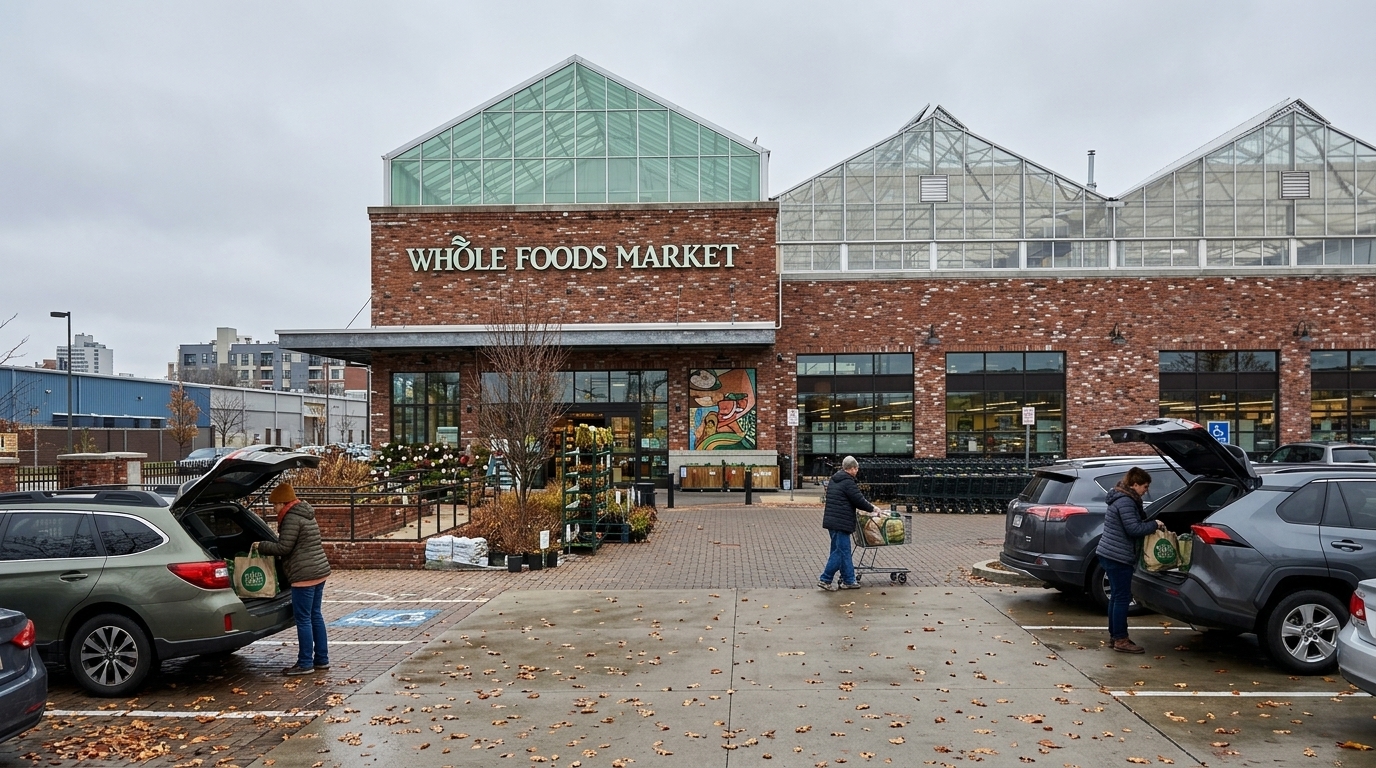
Whole Foods Market began in 1978 when John Mackey and Renee Lawson borrowed $45,000 from family and friends to open SaferWay, a small natural foods store in Austin, Texas. Two years later, they partnered with Craig Weller and Mark Skiles, owners of Clarksville Natural Grocery, to merge the two operations, resulting in the opening of the original Whole Foods Market in 1980 with a staff of 19. The first store measured 12,500 square feet—far larger than typical health food stores of the era—and its selection, clean appearance, and knowledgeable staff attracted not only those committed to natural foods but also mainstream shoppers who had never entered a small health food store before. The company discovered early that many customers were willing to pay a premium price for food products considered more healthful and devoid of artificial ingredients.
The first store offered organic fruits and vegetables, dried beans, whole grains, fresh fish, all-natural beef, locally baked bread, and selections of cheese, beer, wine, and coffee that far exceeded conventional supermarket offerings. At the time, there were fewer than half a dozen natural food supermarkets in the United States. In 1981, shortly after opening, the store was devastated by a major flood; sewage was forced out of pipes, inventory was ruined, and looters damaged the building. However, employees and local volunteers rallied to clean up and rebuild, reopening the store 28 days later.
History
By 1985, two more Whole Foods Markets had opened in Austin and another in Houston. Beginning in 1984, expansion continued out of Austin to Houston and Dallas, with entry into New Orleans through the purchase of Whole Food Company in 1988, followed by a store opening in Palo Alto, California in 1989. A restaurant venture opened in 1985 subsequently failed, costing Whole Foods $880,000. Mark Skiles left the company in 1986, while Craig Weller headed up Texas Health Distributors, the wholesale division founded in 1980.
In October 1986, Whole Foods made its first acquisition when it purchased Bluebonnet Natural Foods Grocery in Dallas. From this point forward, the company expanded rapidly through both new store openings and acquisitions. By the start of the 1990s, Whole Foods’ annual sales exceeded $45 million, and the company declared itself the largest seller of organic food in the country.
The company made its initial public offering on January 23, 1992. The IPO raised $23.4 million at an offering price that enabled accelerated domestic growth, while a secondary offering in 1993 generated an additional $35.4 million. Prior to the IPO, in November 1991, the company acquired Wellspring Grocery in North Carolina, adding two stores and marking entry into the Southeast. Whole Foods’ $26.2 million acquisition of Bread & Circus in October 1992 brought six stores in Massachusetts and Rhode Island and a central distribution center in Boston.
Throughout the 1990s, Whole Foods fueled rapid growth by acquiring other natural foods chains including Wellspring Grocery of North Carolina, Bread & Circus of Massachusetts and Rhode Island, Mrs. Gooch’s Natural Foods Markets of Los Angeles, Bread of Life of Northern California, Fresh Fields Markets on the East Coast and in the Midwest, Bread of Life of Florida, Detroit-area Merchant of Vino stores, and Nature’s Heartland of Boston. The company purchased Allegro Coffee Company in 1997. The company’s 100th store opened in Torrance, California in 1999.
Starting its third decade, Whole Foods continued acquisitions, including Natural Abilities in 2000, which operated as Food for Thought in Northern California. In 2001, Whole Foods moved into Manhattan, generating substantial interest from the media and financial industries. In 2002, the company expanded into Canada, and in 2004, it entered the United Kingdom with the acquisition of seven Fresh & Wild stores.
The largest single acquisition came in 2007 when Whole Foods purchased Wild Oats Markets for approximately $565 million, acquiring 109 stores across 23 states and British Columbia. The FTC filed a suit in federal district court to block the proposed acquisition on antitrust grounds. However, in August 2007, the U.S. District Court for the District of Columbia denied the Federal Trade Commission’s request for a preliminary injunction related to the proposed merger. A 2009 FTC settlement required Whole Foods to sell 32 premium natural and organic supermarkets and related assets to restore competition in 17 geographic markets impacted by the acquisition.
On August 28, 2017, John Mackey, the last remaining co-founder, sold the company to Amazon for $13.7 billion. In June 2015, Whole Foods announced a new format called 365 by Whole Foods Market, a millennial-focused, more affordable store concept featuring digital price tags, in-store communication via smartphone app, zero-waste goals, and LED lighting. In January 2019, the company announced the 365 by Whole Foods Market concept would be discontinued, though existing locations remained open and were subsequently converted to regular Whole Foods stores by year end.
Operations & Footprint
Whole Foods operates primarily in the United States, Canada, and the United Kingdom. The 500-store total comprises 483 locations in the United States, 13 in Canada, and 4 in the United Kingdom. Of the 500 current stores, 217 (43 percent) were opened after the 2017 Amazon acquisition, meaning nearly half the network is less than seven years old.
As a subsidiary of Amazon, Whole Foods operates as a privately held company. Each Whole Foods location is built around eight to ten teams, grouped from departments like produce, meat, prepared foods, and checkout. The teams have a remarkable degree of autonomy in deciding what to order, how to price items, and how to run promotions. This decentralized approach to purchasing and merchandising reflects the company’s long-standing emphasis on local relevance and community integration.
Distribution and supply chain operations remain centralized through regional distribution centers, with coordination through both traditional logistics and newer Amazon technologies. Whole Foods has a rolling ten-year distribution arrangement with UNFI.
Products, Services & Merchandising
Whole Foods emphasizes organic and natural products across all categories. The original store offered organic fruits and vegetables, dried beans, whole grains, fresh fish, all-natural beef, locally baked bread, and selections of cheese, beer, wine, and coffee far exceeding conventional supermarket offerings. This product mix—blending certified organic staples with mainstream convenience items—became the company’s defining merchandising strategy.
First launched in 1997, 365 Everyday Value has been a highly successful private label for the retailer and one of the first widely available natural store lines. The grocer carries more than 2,600 items under its store brand, with nearly 1,000 of those items organic as of the end of 2023. Whole Foods’ private label brands also include Whole Foods Market, Whole Trade, and Engine 2 plant-based products. The 365 by Whole Foods Market brand emphasizes sustainability efforts, such as pole-and-line caught canned tuna from certified sustainable fisheries and wild-caught caviar from certified sustainable sources.
In April 2007, Whole Foods Market launched the Whole Trade Guarantee, a purchasing initiative emphasizing ethics and social responsibility for imported products from the developing world, with criteria including fair prices, environmentally sound practices, and stipulations that one percent of proceeds go to the Whole Planet Foundation for micro-loan programs. Whole Foods Market has maintained a policy of donating at least five percent of its annual net profits to charitable causes.
Following the Amazon acquisition, digital services have expanded. Amazon and Whole Foods technology teams integrated Amazon Prime into the Whole Foods point-of-sale system, enabling Prime members to receive special savings and in-store benefits. Amazon Prime members can now order groceries online and pick them up in store for free.
Work Environment & Employment
Employees at Whole Foods Market are called “team members,” a terminology that reflects the centrality of teams to the operational core of the organization. The company has appeared on Fortune’s “100 Best Companies to Work For” list every year since the list began. New associates undergo a 60-day process involving various interviews and assessments; after the trial period, the existing team votes on whether to fully vest the new associate, requiring a two-thirds majority vote to become an employee.
In September 2015, Whole Foods announced layoffs of 1,500 jobs—1.6 percent of its workforce—to lower prices, with eliminated positions coming from regional and store levels. In 2016, Whole Foods hired Kulture Consulting, a labor relations consulting firm, on May 23, 2016. In August 2009, co-founder and CEO John Mackey published an editorial in The Wall Street Journal criticizing the Patient Protection and Affordable Care Act, which proved controversial in the natural foods community.
Whole Foods’ team-based hiring model has been a hallmark of its culture. Designing around semi-autonomous teams became one way to reinforce company culture, with hiring new members through a team effort ensuring that the DNA of Whole Foods culture continued to replicate.
Business Model & Financial History
Net profits for supermarkets typically hover around 1 percent, but Whole Foods has aimed for much higher margins of between 3 and 6 percent. This margin strategy, combined with premium pricing for organic and natural products, has been central to the company’s profitability model despite operating in a notoriously thin-margin industry.
Whole Foods’ growth took place amid one of the largest waves of corporate mergers and acquisitions in U.S. history, enabled by corporate investors who had rarely shown prior interest in natural foods, with three venture-capital firms owning one-third of the company by the late 1980s. By the end of 1991, Whole Foods had 10 stores, more than 1,100 employees, sales of $92.5 million, and net profits of $1.6 million. By 1996, company management was setting aggressive expansion targets: 100 stores and $1.5 billion in sales by 2000, with fiscal 1995 sales at $496.4 million.
The chief beneficiary of the organic and natural foods boom was Whole Foods Market, whose 900 percent growth in the 1990s produced a billion-dollar juggernaut with 78 stores in 17 states. The company’s acquisition-driven expansion strategy allowed it to rapidly build national scale while absorbing established regional brands and their customer bases.
Prior to the Amazon acquisition, Whole Foods faced financial pressures. Whole Foods had been under shareholder pressure due to its NOPAT dropping by 18 percent over 18 months leading up to the 2017 acquisition. Its stock price fell by more than half and activist investors like Jana Partners began to assert ownership rights.
Competitive Landscape
When Whole Foods opened in 1980, there were fewer than half a dozen natural food supermarkets in the United States. The company pioneered the mainstream supermarket model for organic and natural foods at a time when such products were largely confined to small specialty shops. This first-mover advantage proved durable despite intensifying competition.
Conventional grocery chains and big-box retailers such as Walmart have come to embrace organic foods. Although natural foods stores pioneered the organic marketplace, today they account for a little more than 40 percent of that market’s revenue in the U.S. This shift reflects the broader mainstreaming of organic foods—a trend partly driven by Whole Foods’ own success in legitimizing and popularizing the category.
Some observers, such as national director of the United States Organic Consumers Association Ronnie Cummins, have opined that Whole Foods is now a big-box retailer more concerned with competing with other large retailers than with ethics and sustainability. Researcher Stacy Mitchell of the New Rules Project argues that the corporation’s aggressive marketing of local food is more hype than substance.
Whole Foods has frequently been the subject of resistance or boycotts in response to proposed store locations, and has been criticized for its aggressive policy of promoting its own in-house brands at the expense of smaller or local independent brands.
Recent Developments & Outlook
In August 2017, founder John Mackey sold Whole Foods to Amazon for $13.7 billion, marking the largest acquisition in Amazon’s history at that time. Amazon and Whole Foods technology teams began integrating Amazon Prime into the point-of-sale system, with plans to invest in additional areas including merchandising and logistics to enable lower prices.
Whole Foods pivoted away from its decentralized purchasing model, forgoing local vendors to stock larger national brands—a shift underway before the acquisition but continuing apace under Amazon. Increasingly, Whole Foods has opted to bypass external suppliers altogether, relying more heavily on its own 365 Everyday Value brand private-label products.
In January 2019, Amazon announced plans to acquire some former Sears and Kmart locations from Sears Holdings to facilitate expansion into previously unserved areas, with vacant locations to be demolished or remodeled to create new Whole Foods Market locations. Whole Foods’ recent growth strategy includes the introduction of new formats like its Daily Shop stores and an expansion of direct-to-consumer shipping for private-label products, with 100 stores in the pipeline as of 2025.
Leave a Reply