
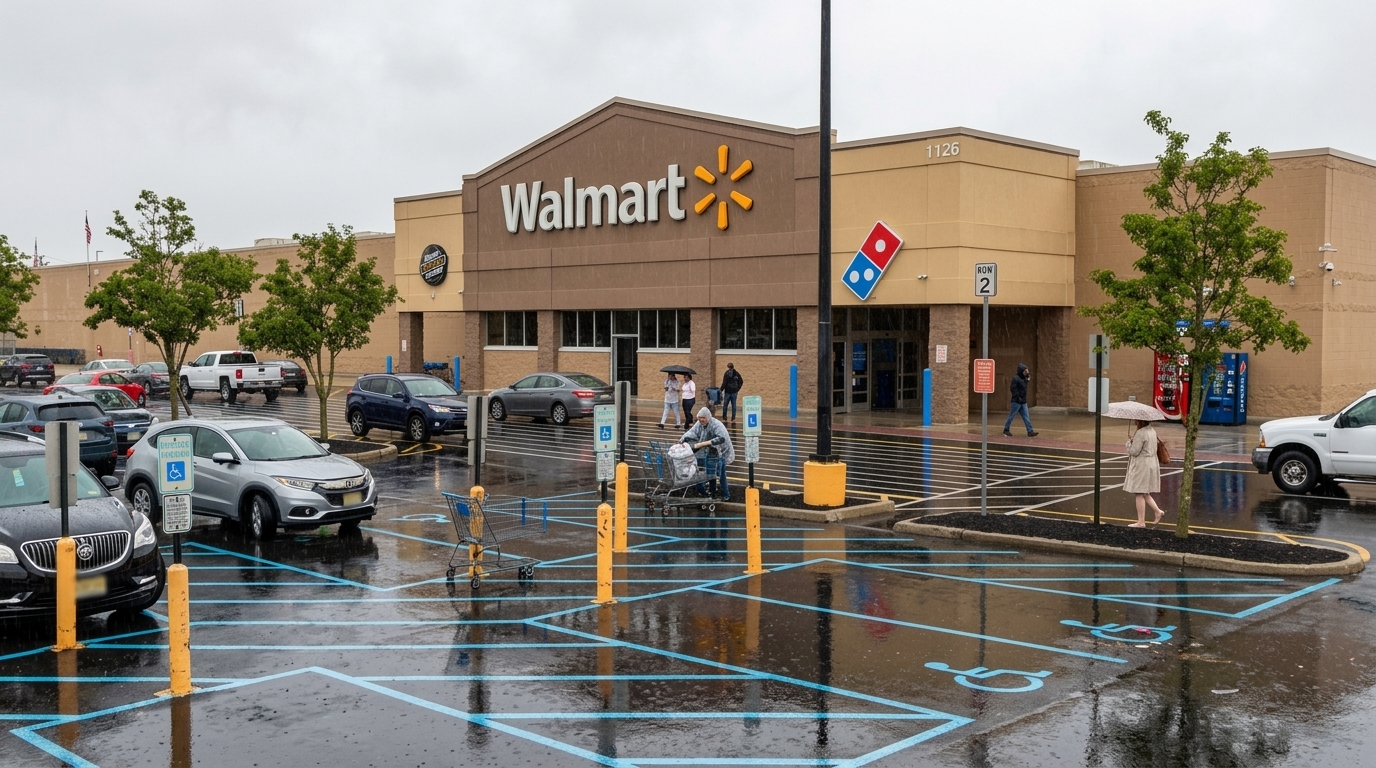
Walmart Inc. is an American multinational omnichannel retail corporation that operates a chain of hypermarkets (also called supercenters), discount department stores, grocery stores, pharmacies, and gas stations in the United States and 19 other countries. It is headquartered in Bentonville, Arkansas. The company has become synonymous with everyday low pricing and efficient logistics, fundamentally reshaping retail competition across North America and beyond. It also owns and operates Sam’s Club retail warehouses. Through more than six decades of operations, Walmart has evolved from a single discount store into a global retail giant that ranks among the world’s largest corporations by revenue.
As a public, family-owned company, Walmart remains controlled by the founding Walton family while trading on public markets. The retailer operates through multiple store formats and banners, each serving different customer needs and regional markets. A Walmart Supercenter is a large-format retail store that combines grocery, general merchandise, and essential services under one roof, offering a complete shopping experience. In addition to its core discount and supercenter models, the company has built smaller, specialized formats to compete in urban and convenience segments. The business model centers on maximizing sales volume through consistent low pricing, a supply chain engineered for efficiency, and strategic private-label brands that reinforce value positioning.
History
Sam opened the first Walmart in 1962 at the age of 44 in Rogers, Arkansas. In 1950, the Waltons left Newport for Bentonville, where Sam opened Walton’s 5&10 on the downtown square. Before launching Walmart, Walton had established himself as a savvy variety-store operator. By 1962, along with his brother Bud, he owned 16 stores in Arkansas, Missouri, and Kansas (fifteen Ben Franklins and one independent, in Fayetteville). The first Walmart departed from that model, embracing a discount format targeting small towns underserved by major retailers. When that company’s executives rejected his concept for a new discount store chain to be based in small towns, Walton decided to set up such a chain on his own.
Early growth was rapid. By the end of the 1970s, Walmart had 276 stores with annual sales of $1.24 billion (equal to $5.2 billion in 2024 dollars). Walmart reached $1 billion in annual sales, faster than any other company at that time. Walmart has 276 stores and employs 21,000 associates. Throughout the 1970s and early 1980s, Walmart began acquiring companies, starting with 16 Mohr Value stores followed by the Hutcheson Shoe Company. By this time, Walmart began expanding the range of services available in its stores, adding pharmacies, auto-service centers, and jewelry departments.
In the 1980s, the first Sam’s Club opens, serving small businesses and individuals, and the first Walmart Supercenter opens, combining a supermarket with general merchandise. The first Sam’s Club was opened by Walmart, Inc. in 1983 in Midwest City, Oklahoma under the name “Sam’s Wholesale Club”. Also in 1988, the first Wal-Mart Supercenter was opened in Washington, Missouri. The supercenter concept features everything contained in an average Walmart discount store, in addition to a tire and oil change shop, optical center, one-hour photo processing lab, portrait studio, and numerous alcove shops such as banks, cellular telephone stores, hair and nail salons, video rental stores, and fast-food outlets.
In 1991 Walmart surpassed Sears, Roebuck & Company to become the country’s largest retailer. International expansion began shortly after. Walmart expanded worldwide this year, with the opening of their first store outside the United States in Mexico City. 1994: Walmart enters Canada through the acquisition of Woolco, a former subsidiary of Woolworth. 1995: Walmart enters Argentina, followed by Chile and Brazil. The company also had stores in all 50 states by the end of the year.
Sam Walton died in 1992, shortly after receiving the Medal of Freedom. His eldest son, S. Robson Walton, succeeded him as chairman of the corporate board of directors, on April 7, 1992. In February 1988, company founder Sam Walton stepped down as chief executive officer, and David Glass was named to succeed him. Leadership transitions positioned the company for continued expansion under professional management while maintaining family control.
In 1994, the National Advertising Review Board challenged the Walmart slogan, “Always the low price. Always,” contending that it implied that Walmart’s prices were always the lowest and could mislead some shoppers. In response, Walmart adopted a new slogan, “Always low prices. The company achieved remarkable scale through the 1990s. By the end of the 1990s, Walmart had 1,140,000 employees, making it the largest private employer in the world. There were more than 4,500 Walmart and Sam’s Club stores throughout all 50 states and over 1,000 international stores, and the company had annual sales of $165 billion.
Operations & Footprint
It is headquartered in Bentonville, Arkansas. The company operates stores across the United States, Canada, Mexico, and markets in Central and South America, Europe, and Asia. Expanding inside Oklahoma by 1968 and throughout the rest of the Southern United States by the 1980s, ultimately operating a store in every state of the United States, plus its first stores in Canada, by 1995. Walmart’s entry into some countries, like Mexico and Canada, has been extremely successful, while its ventures into markets like Germany and South Korea were less fruitful. The company has exited some markets where performance did not meet expectations, including Germany in 2006 and South Korea in the same year.
The company is controlled by the Walton family. Walmart operates as a public corporation traded on stock exchanges, with Gregory B. Penner, son-in-law of S. Robson Walton and the grandson-in-law of Sam Walton, serves as chairman of the board. The company manages diverse retail operations through multiple banners and formats, each calibrated to serve specific geographic markets and customer demographics.
With nearly 700 stores across the country, the format has allowed Walmart to try new things and tailor our offerings to meet the unique needs of each community we serve. The company also operates under formats including discount stores focused on general merchandise, Neighborhood Markets targeting urban and smaller-town grocery segments, and international banners adapted to local markets. The Neighborhood Market format is introduced with three stores in Arkansas.
Distribution and logistics form a cornerstone of competitive advantage. Walmart operates over 150 distribution centers globally, strategically positioned near major transportation corridors and high-demand retail clusters. This geographic optimization enables most U.S. stores to receive replenishment shipments within 24 hours. A core strength of the Walmart supply chain lies in its network of Regional Distribution Centers (RDCs), which leverage cross-docking systems. Goods move directly from inbound to outbound trucks with minimal storage time, accelerating inventory turnover, reducing warehousing costs, and keeping store shelves stocked with remarkable speed and precision. To ensure every aspect of the supply chain is able to function, it takes a fleet of 6,500 tractors, 55,000 trailers and more than 7,000 drivers to accomplish the task.
Products, Services & Merchandising
Walmart operates as a general merchandise retailer spanning grocery, health and beauty, apparel, home goods, electronics, and seasonal items. Many stores include pharmacies, optical centers, and financial services. The various kinds of departments in Walmart include Electronics & Office, Movies, Music & Books, Home, Furniture & Patio, Home Improvement, Clothing, Shoes & Jewelry, Baby & Toddler, Toys & Video Games, Food, Household & Pets, Pharmacy, Health & Beauty, Sports, Fitness & Outdoors, Auto & Tires, Photo, gifts & personalized shop, Halloween, Party & Sewing. Supercenters combine a full grocery supermarket with general merchandise, fuel stations, and service departments.
Private-label brands form a critical element of merchandise strategy. Great Value is Walmart’s flagship private brand, and Walmart says it spans nearly 10,000 food and consumables products. Other major Walmart private brands include Equate, Mainstays, Marketside, Freshness Guaranteed, Sam’s Choice, bettergoods, and numerous category-specific labels. The Equate brand was originally created by L. Perrigo Company in 1986 and was sold to Walmart in 1993. Great Value, a Walmart private label grocery brand, was established by Walmart in 1993 to provide consumers with high-quality products at affordable prices. On April 15, 2026, Great Value unveiled the new logo, the first in over a decade, which features a deeper shade of blue. The typography was tightened to include a subtle “smile” shape within the letters E and V.
The everyday low price (EDLP) strategy has driven merchandise and pricing decisions for decades. As a pricing strategy, Walmart founder Sam Walton used EDLP when opening his first stores. Whereas Kmart had been successful with a High-Low strategy, Sam Walton believed early on that keeping prices low (even at a slimmer margin), would bring higher profits through greater sales volume. One of the pillars of Walmart’s EDLP strategy is direct sourcing. By negotiating directly with manufacturers and cutting out intermediaries, Walmart can secure products at lower costs, which it passes on to customers at lower prices.
Digital and omnichannel services have become integral to operations. Walmart.com is founded, allowing U.S. customers to shop online. In the past three years, Foran worked to improve the shopping experience by using technology that enabled online grocery ordering, which can now be picked up for free at more than 1,200 locations. Walmart Pay, a fast, easy and secure way for customers to make purchases with their smart phones, becomes a popular in-store payment method. The company supports curbside pickup, home delivery, and marketplace options through its digital ecosystem.
Work Environment & Employment
Walmart has long grappled with labor relations despite its position as the largest private employer in the United States. 1970s-1980s: Initial, localized attempts at unionization in various Walmart stores. These efforts are met with resistance and are largely unsuccessful. 1990s: The UFCW launches a more coordinated effort to organize Walmart workers, facing increased resistance from the company. 2005: UFCW attempts to organize meat cutters at a Walmart store in Jacksonville, Texas, but the company closes the meat-cutting department and outsources the work, effectively preventing unionization. Walmart is not currently unionized and has a long history of union-averse activity.
Pay and benefits remain areas of ongoing attention. Campaigns by unions helped lay the groundwork for Walmart’s finally agreeing to improve worker pay. But unions in 2004 intensified their focus on tarnishing the company’s image, creating initiatives such as Walmart Watch and Wake Up Walmart based on the belief that if the country’s biggest employer raised wages and working conditions other companies would have to follow. Worker pay averaged $17.06 an hour by earlier this year, the result of five rounds of wage increases that started in 2015. A reorganization of workers into small teams in 2020 boosted wages and created new opportunities for advancement. Walmart cross-trained employees to perform a range of tasks and gave them fuller responsibility for their work, hiking about 15% of the hourly workforce’s wages and creating new higher-paying “team lead” positions at its Supercenters.
In 2015, wage increases drew market reaction. Investors punished Walmart for paying employees better. Its shares fell about 3% when it announced the wage increases in 2015, and plunged 10% the day its chief financial officer presented to investors about the related near-term decline in profits that the expense involved. Training and advancement remain priorities; Walmart opens its first training Academy in South Carolina, with 200 total locations planned at stores across the U.S. The company maintains employee benefits including health insurance, retirement plans, and educational programs.
Business Model & Financial History
Walmart’s core business model relies on high-volume sales at low margins, enabled by efficient operations and direct supplier relationships. Walmart uses an Everyday Low Price (EDLP) pricing strategy as a factor in the company’s revenue model. The objective of this pricing strategy is to attract large numbers of customers to achieve high sales volume and, consequently, a profitable business. High sales volume ensures profitability despite thin profit margins and low selling prices linked to Walmart’s cost leadership generic strategy for competitive advantage.
The company went public in 1976. By 1976 Walmart was a publicly traded company with share value north of $176 million. Growth accelerated through the 1980s and 1990s. Walmart employs 371,000 associates in 1,928 stores and clubs. Walmart celebrates its first $1 billion sales week. In 1990, US sales had quadrupled to $32 billion over the previous five years and Walmart acquired The McLane Company, a food service distributor, which was later sold to Berkshire Hathaway in 2003.
Walmart expands into Canada with the purchase of 122 Woolco stores. The 1990s produced explosive growth through new store construction, international expansion, and the roll-out of the Supercenter format. Their stores also achieved the billion-dollar sales mark in one week in December 1993. By the early 1990s, Walmart’s stock worth had jumped to $45 billion. Profitability improved as the company scaled its private-label assortment and refined supply chain efficiency.
More recent acquisitions have strengthened digital and marketplace capabilities. Wal-Mart Stores, Inc. and Jet.com, Inc. today announced they have entered into a definitive agreement for Walmart to acquire Jet for approximately $3 billion in cash, a portion of which will be paid over time. Additionally, $300 million of Walmart shares will be paid over time as part of the transaction. Online retailer Jet.com and Heyneedle, a subsidiary of Jet.com, become part of the Walmart family. The acquisition of VIZIO in December 2024 is a strategic move expected to bolster its advertising business and contribute to overall future growth. This aligns with its digital transformation strategy.
Competitive Landscape
Walmart faces competition across multiple retail channels and price tiers. Traditional competitors include regional and national supermarket chains, discount retailers like Dollar General, and specialized department and category retailers. Online platforms, particularly Amazon, represent an emerging competitive threat across general merchandise and grocery categories. The everyday low price strategy gives Walmart a competitive advantage by distinguishing it from retailers that rely on high-low pricing. Shoppers attracted to consistent value tend to prefer Walmart over competitors that may offer occasional deals but generally maintain higher prices.
Walmart’s scale and supply chain efficiency provide structural advantages. The Walmart supply chain is considered a gold standard in global logistics. Its unmatched scale, integration of advanced technologies, lean management practices, and strategic supplier partnerships allow Walmart to operate with high efficiency and resilience. The company’s private-label portfolio covers more categories and achieves wider consumer recognition than most competitors. Penetration of digital channels and marketplace expansion have allowed Walmart to compete in channels historically dominated by specialty online retailers.
Structural market pressures include e-commerce growth, consolidation among grocers, and intensifying price competition from discount chains and warehouse clubs. Walmart has responded by expanding store formats, investing in fulfillment technology, and integrating online and physical-store operations. From a single discount store in Arkansas, Walmart has grown into a global retail giant with annual sales reaching over $600 billion. The company remains the dominant food and general merchandise retailer across most North American markets.
Recent Developments & Outlook
Walmart has pursued aggressive store expansion and modernization in recent years. The company has a robust five-year plan through 2029 to build or convert over 150 locations and remodel 650 stores in 2024. This includes expanding its Neighborhood Market format and testing new concepts with enhanced grocery selections. In 2024, the company began testing larger, more omnichannel-focused stores for the format, and this year kicked off a new rapid remodel program that pares down the timeline for store updates from several months to just one month.
E-commerce and digital services remain growth priorities. Global e-commerce sales saw a 22% increase in fiscal Q4 2025, with U.S. e-commerce up 20%. The Walmart Marketplace is a key growth driver, surpassing 200,000 active sellers by mid-2025, with 44,000 new sellers joining in the first five months of the year. Marketplace expansion and advertising services represent higher-margin revenue streams complementing traditional retail sales.
Sustainability and supply chain innovation continue to shape strategy. Last summer, it announced it would open five new high-tech perishable sorting and packaging centers, as well as add more automation to four separate perishable distribution facilities. These high-tech centers enable the company to double storage and volume processing capacity compared with its traditional facilities. Walmart’s drone delivery network, operational in 36 US states, has decreased per-package emissions compared to traditional van deliveries for small-item orders. The company has also deployed geospatial technology to optimize delivery zones and improve route efficiency.
Future priorities center on strengthening position in grocery, expanding omnichannel capabilities, and maintaining cost discipline. The company balances investment in modernization against the thin margins inherent to retail and grocery operations. International operations continue to present growth opportunities and challenges as Walmart adapts formats and assortments to local markets. Competitive pressure from e-commerce and low-cost discounters will likely intensify, placing continued emphasis on operational efficiency and customer experience.
Leave a Reply