
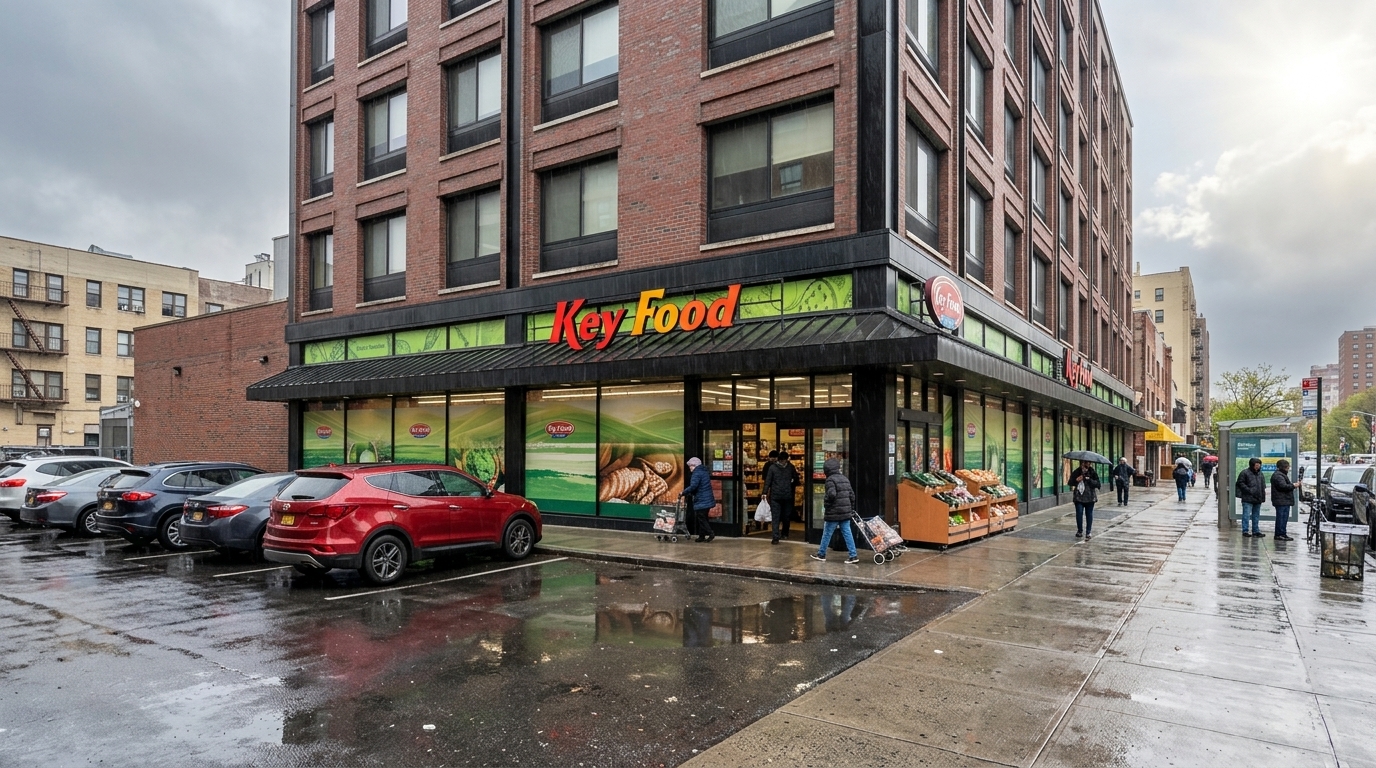
Key Food Stores Co-op, Inc. is a cooperative of independently owned supermarkets, founded in Brooklyn, New York, on April 20, 1937. Its stores are located in Connecticut, Maryland, Delaware, Massachusetts, Rhode Island, New Jersey, New York, Pennsylvania, and Florida. The cooperative’s founding purpose centered on enabling independent grocers to aggregate their buying power through shared purchasing and distribution, thereby securing more favorable terms from suppliers and enhancing their competitiveness against dominant chains. Structured as a retailer-owned cooperative, Key Food allowed member stores to retain operational independence while benefiting from centralized support in merchandising, logistics, and advocacy, a model that emphasized mutual aid over corporate consolidation.
The headquarters for the Key Food cooperative is in Matawan, New Jersey. The cooperative also operates stores under the Key Food Marketplace, Key Fresh & Natural, Food Dynasty, Urban Market, Food World, Food Universe Marketplace, SuperFresh, and The Food Emporium banners. The chain operates as a member-owned cooperative rather than a corporate entity, allowing each store to maintain local ownership while leveraging the cooperative’s collective buying power and support services. This structure distinguishes Key Food from typical supermarket chains and has enabled it to remain competitive against larger national retailers.
Origins and Early Growth
Key Food Stores Co-operative, Inc. was established on April 20, 1937, in Brooklyn, New York, as a cooperative comprising independent grocers responding to the economic hardships of the Great Depression. This formation united small-scale supermarket owners who faced intense competition from emerging large chain retailers and sought collective strategies to sustain their businesses amid widespread financial strain.
The cooperative model proved durable through the mid-century decades. In July 2000, Key Food began outsourcing its distribution and transportation operations to Grocery Haulers, Inc. As part of the deal, the company sold its fixed assets, including two New York-based warehouses and inventory to GHI. This strategic decision allowed the cooperative to focus on member support rather than infrastructure ownership. Key Food first experimented with home delivery in 1998, when two stores owned by Gemstone Supermarkets partnered with Homedelivery.com.
Expansion, Acquisitions and Ownership
The cooperative expanded modestly through the 2000s and 2010s. In 2011, Key Food expanded to Connecticut and New Jersey, with stores in Stamford and Jersey City. It also launched a new banner, Fresh n’ Save Marketplace, with two locations in Staten Island and Queens. In August 2012, the co-op reopened its South Street Seaport location as 55 Fulton Market, a 23,000 square feet, two-floor flagship store.
Key Food began adding new store concepts in 2013. The cooperative took over two Queens CTown locations in January 2013, converting them to Key Food stores. In December 2013, Key Food debuted its upscale Urban Market concept in Williamsburg, Brooklyn. A second location opened in Long Island City a year later.
The most transformative moment came in 2015. In November 2015, Key Food completed the purchase of 23 stores from the bankrupt A&P, increasing its total number of stores to 212. The stores included three Pathmark, three A&P, 10 Waldbaum’s, four Food Emporium, and three Food Basics USA locations in New York and New Jersey. The acquisition made it the largest grocer in New York City. In December 2015, Key Food acquired the Food Emporium banner name and related intellectual property assets from A&P. The company also acquired the SuperFresh name and assets in February 2016. In total, it took control of 11% of A&P’s 297 stores at the time of its bankruptcy.
The cooperative expanded geographically beginning in 2019. In January 2019, Key Food opened its first location in Florida. When Fairway Market filed for bankruptcy in January 2020, Key Food purchased its Georgetown, Brooklyn store. In late 2020, the co-op moved its corporate headquarters from Staten Island to Matawan, New Jersey. By January 2023, Key Food had 62 locations in Florida and four stores in Pennsylvania.
Stores and Regional Footprint
Key Food’s operations are predominantly concentrated in the Northeastern United States, with a strong presence in New York (including all five boroughs of NYC, Long Island, and upstate), New Jersey, Connecticut, Massachusetts, and Pennsylvania. The cooperative also has an expanding footprint in Florida. The member-owned model has enabled the chain to maintain a strong presence in dense urban markets where independent operators can thrive.
Key Food operates through multiple store banners, each serving different market segments. The primary store banner is Key Food, which represents standard supermarket formats focused on everyday grocery needs. Variations include the Key Food Marketplace banner, designed for larger formats that incorporate expanded departments such as enhanced produce, bakery, and prepared foods sections to offer a more comprehensive shopping experience. Additionally, the SuperFresh banner is utilized for full-service supermarkets, typically featuring pharmacies and broader service offerings in select markets.
Distribution arrangements changed significantly in 2020. In October 2020, the cooperative signed a 10-year contract with UNFI for the wholesaler to serve as the primary supplier for its 315 stores. Under the deal, UNFI supplied a broad range of products, including conventional, natural, organic, and international groceries, with projected sales of approximately $10 billion over 10 years. The partnership ended on September 20, 2025, after a cyberattack disrupted UNFI’s operations in June 2025, exacerbating ongoing profitability issues for the wholesaler. In response, Key Food transitioned its Northeast conventional products business—covering about 375 independent retailers, primarily in New York City’s five boroughs—to C&S Wholesale Grocers, resuming a prior relationship to maintain supply continuity. To diversify its supply base post-UNFI, Key Food established a partnership with G&C Foods in September 2025 for its Florida operations. G&C, operating from a distribution facility in Alachua, Florida, provides refrigerated, frozen, and dry food products to over 100 Key Food stores in the state, offering next-day delivery and enhancing regional coverage in the Southeast.
Merchandising and Own-Brand Products
Key Food developed its private-label strategy to strengthen member competitiveness. In October, the co-op introduced its Urban Meadow private label. Key Food Stores Co-operative announced it was launching a new private brand called Urban Meadow that could replace specific store brand private items across its 240 stores following a test period. The brand debuted recently with a limited number of peanut butter SKUs in 20 stores. Urban Meadow rolled out across multiple categories and banners, signaling the cooperative’s commitment to offering quality products at prices competitive with national brands. The brand encompasses diverse food categories, from deli items to dairy products, allowing member stores to maintain consistent pricing and quality across the network.
Controversies and Legal Issues
Key Food’s history included notable controversies during the 1980s. During the 1970s and ’80s, Key Food was connected to a trucking firm that committed $10 million worth of tax fraud. In 1984, LAMM Food Corporation of Port Washington, New York – an affiliate that operated four Key Food stores at the time – was among three chains charged with price fixing for conspiring to stop redeeming discount coupons at double and triple their face value in 1981 and 1982. On November 30, 1986, Key Foods president Camillo D’Urso went missing while fishing in Key Largo. He was never found and was presumed to have drowned. In February 1987, Pasquale Conte, owner of the affiliated Tapps Supermarkets and a director of the cooperative, was arrested for his involvement in the attempted murder of a defendant in the Pizza Connection trial. Long suspected of mob ties, Conte was involved in a heroin smuggling operation with the Sicilian Mafia. Conte later pleaded guilty in 1994 to a 1990 mob-related murder and was sentenced to seven and a half years in prison. These incidents reflected vulnerabilities within a large cooperative of autonomous member stores, issues the organization addressed through governance reforms in subsequent decades.
Employment and Workforce Impacts
The cooperative’s expansion and restructuring created significant employment shifts. In January 1997, nearly 100 workers were laid off from the co-op’s warehouse in Canarsie when distribution operations were moved to New Jersey. Another 200 jobs were saved after a union agreement kept the Brooklyn facility open. The 2015 acquisition of A&P stores brought substantial job preservation—the acquisition increased its total number of stores to 212—though the transition to different ownership and operating models required workforce adjustments across locations.
Later Developments and Direction
Key Food has pursued aggressive geographic expansion and operational modernization in recent years. Key Food continued its physical expansion in 2025 by opening new stores in former Rite Aid locations across the Northeast. In September, a store opened at 196 East Hartsdale Avenue in Hartsdale, New York, filling a gap left by the pharmacy chain’s closure and serving the local community with fresh produce, bakery items, and groceries. The entry into former retail spaces represents a strategy to increase convenience and foot traffic in established neighborhoods.
The cooperative model has enabled Key Food to adapt to competitive pressures while maintaining member autonomy. The shift from single wholesaler dependence to a diversified supply base with UNFI, C&S, and G&C Foods reflects operational maturity and risk mitigation. As the grocery industry continues to consolidate, Key Food’s emphasis on local ownership, community integration, and member support services provides a sustainable differentiation strategy against national chains and e-commerce competitors.
Leave a Reply