
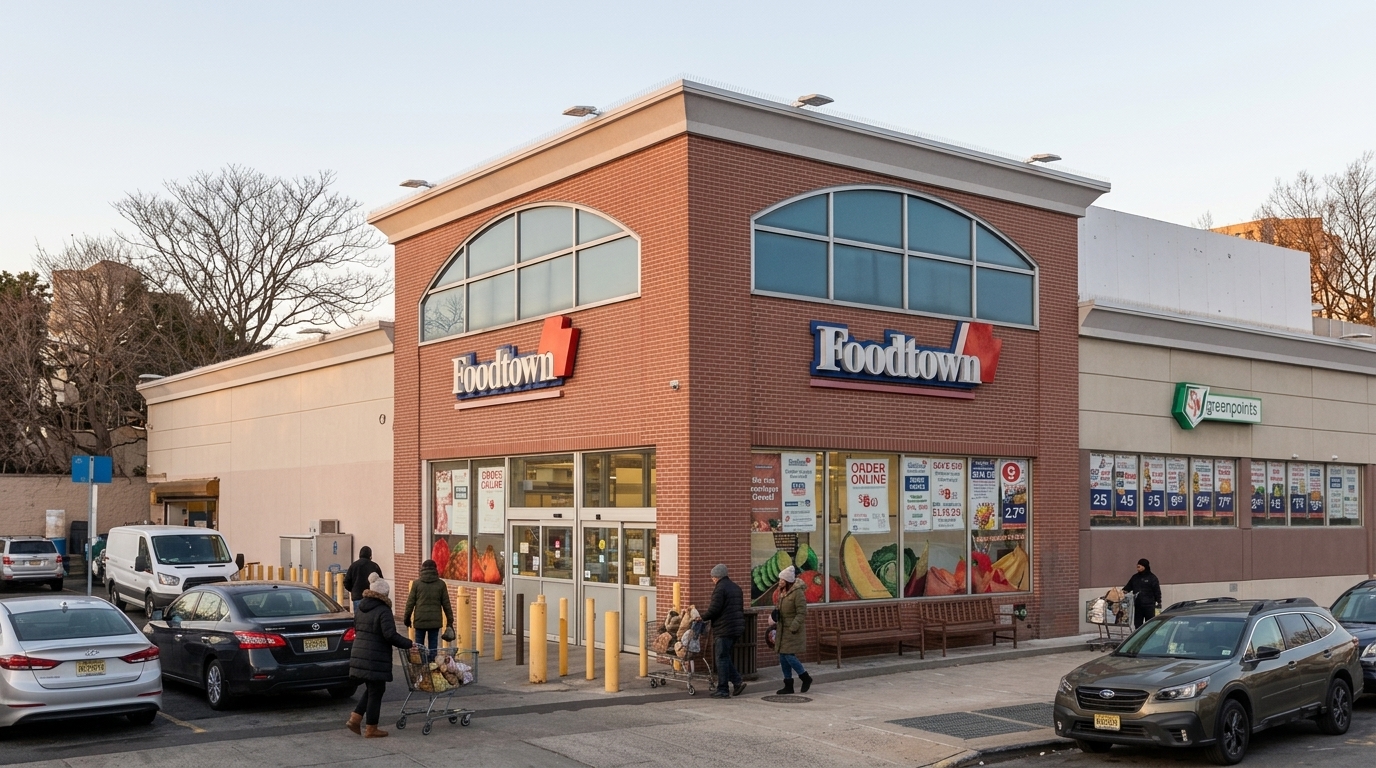
Foodtown is a northeastern United States supermarket cooperative founded in 1955 by Twin County Grocers in New Jersey. Each Foodtown is independently owned and operated, with some owners operating multiple stores. Foodtown encounters intense competition from established regional supermarket operators in overlapping territories, particularly in the New York-New Jersey metro region. ShopRite operates stores leveraging extensive private-label offerings and aggressive pricing, while Stop & Shop operates locations benefiting from integrated supply chains and frequent promotions.
The chain encompasses stores across New Jersey, New York, and Pennsylvania, with membership in Allegiance Retail Services, LLC—a retailer-owned cooperative based in Iselin, New Jersey. Foodtown operates primarily in the northeastern United States, with a heavy concentration in New York state. Stores are largely situated within the New York City metropolitan area, encompassing urban enclaves in Brooklyn, Queens, the Bronx, and Staten Island, alongside suburban sites in Nassau and Suffolk counties on Long Island.
Retail Formats and Where It Operates
Foodtown functions as a voluntary retail cooperative, wherein independent store owners serve as members who collectively own the banner while retaining full operational control over their individual locations. Allegiance delivers centralized services including bulk procurement, private-label product development, advertising campaigns, merchandising guidance, and technological tools, enabling members to secure competitive supplier terms and reduce costs through shared volume.
Stores are largely situated within the New York City metropolitan area, encompassing urban enclaves in Brooklyn, Queens, the Bronx, and Staten Island, alongside suburban sites in Nassau and Suffolk counties on Long Island. The cooperative operates a mix of full-service supermarkets with varying formats, adapted to neighborhood demands by independent operators. Renovations and banner conversions have been key to modernization, with ARS overseeing reopenings such as the Throggs Neck Super Foodtown in October 2025 and the Clove Road Foodtown in April 2025, incorporating updated layouts for fresh produce and prepared foods to counter urban competition.
Company Background
Foodtown was founded in 1955 by Twin County Grocers in New Jersey. The cooperative model allowed independent grocers to pool resources for better buying power and marketing. Early growth focused on the New York metropolitan area and New Jersey, emphasizing quality products and customer service to compete with larger chains. By the 1970s, Foodtown had solidified its presence in the northeastern United States, operating as the retail arm of Twin County Grocers and expanding to include stores in urban and suburban neighborhoods.
In the 1980s and 1990s, Foodtown was a major grocer on Long Island and in New Jersey. In 1994, Foodtown’s parent company, Twin County Grocers, was headed by Martin Vitale and was supplying 165 Foodtown stores, resulting in a wholesale revenue of over $1 billion. The cooperative introduced modern store formats and private-label products to compete with expanding national chains.
The mid-1990s brought severe challenges. In 1995, the Dutch retailer Ahold purchased all forty-five of the Foodtown stores operated by Melmarkets and Mayfair Supermarkets. In 1998, the lost volume from the Ahold acquisition and damage from the embezzlement scandal forced Foodtown’s parent, Twin County Grocers, into bankruptcy. The Twin County CEO, Martin Vitale, eventually pleaded guilty to stealing $4.2 million from the cooperative, as well as bribing a leader in the United Food and Commercial Workers union in New Jersey. Following these events, many Foodtown stores converted to other banners or simply closed.
In 2004, Foodtown closed its supply warehouse. In 2006, a franchisee briefly expanded the banner to Florida by acquiring and rebranding two former Winn-Dixie stores in West Palm Beach and Davie, though this venture was short-lived. In 2012, various independent grocer cooperatives came together to form Allegiance Retail Services, with the Foodtown cooperative being the largest founding member. On February 10, 2016, Allegiance Retail Services purchased the intellectual property of former A&P division Pathmark through a bankruptcy auction. Since then, Allegiance has reopened the Pathmark chain with a single location in Brooklyn, New York.
Ownership, Structure and Financial History
Foodtown functions as a voluntary retail cooperative wherein independent store owners serve as members who collectively own the banner while retaining full operational control. Founded in 1955, this model allows proprietors to adapt merchandising, pricing, and community initiatives to local demands, fostering agility absent in centralized corporate chains.
Foodtown’s parent company, Allegiance Retail Services, also supplies Foodtown-branded items and acts as a supplier for other independent grocers that do not operate under the Foodtown banner. Allegiance is responsible for advertising, marketing programs, technological services, and negotiating with suppliers on behalf of its members. It is also responsible for producing various products under the Foodtown brand name, which are provided to all of the different members in the cooperative.
In 2021, the company converted its stores to “employee-owned” by adopting an employee stock ownership program (ESOP). Foodtown employees pay nothing to participate in the ESOP. Full- and part-time workers and managers become eligible for the program after working at Foodtown for a year. Employees are 20 percent vested after a year in the program, which means they collect 20 percent of the value of their shares if they leave Foodtown. Vesting increases to 40 percent after three years and 60 percent after five. After six years employees are fully vested.
The cooperative operates on a low-margin model typical of grocery retail, relying on volume and operational efficiency to achieve profitability. The regional focus positions Foodtown in densely populated areas with high demand for affordable groceries, but it constrains scale compared to national players.
Product Range and Store Brands
Foodtown offers a range of private label brands through its membership in Allegiance Retail Services, a retailer-owned cooperative that provides exclusive products to member stores. The primary Foodtown brand covers everyday essentials such as pantry staples, dairy, and household items, designed to deliver quality comparable to national brands at lower prices. For natural and organic options, the Green Way brand features products like fresh produce, snacks, and cleaning supplies, emphasizing sustainable sourcing and affordability for health-conscious shoppers. Rancher’s Legend serves as a premium line focused on high-quality meats, including beef and poultry, with an emphasis on taste and tenderness.
Key features include a free Club Card loyalty program for personalized discounts, weekly promotional circulars, and online shopping with home delivery options at select locations. Through partnerships like the 2017 collaboration with Freshop (now NCR Voyix), Foodtown stores adopted customized online ordering platforms, enabling personalized shopping experiences and curbside pickup; this contributed to sustained double-digit sales growth in digital channels over subsequent years.
Many Foodtown locations feature fresh-cut meat departments, produce sections, and deli counters tailored to neighborhood preferences. Services vary by location, with some stores offering prepared foods and pharmacy services through independent operators.
People and Workplace
In 2021, the company converted its stores to “employee-owned” by adopting an employee stock ownership program (ESOP). “We realized we had to do it when we saw the job our associates did during COVID,” said Noah Katz, the president and CEO of PSK Supermarkets. This represented a significant shift toward employee ownership across the cooperative network.
PSK owns 14 supermarkets in Nassau County, Long Island, New York City and as far north as Columbia County. Including in Cold Spring, 10 operate under the Foodtown banner while four are branded as Freshtown or Pathmark stores. Employee ownership “gives everyone a stake in the company” and “helps reduce turnover.”
Foodtown stores emphasize community engagement and customer service as core operational values. The cooperatively owned model allows for flexible wage and benefit structures tailored to local market conditions, while the ESOP has created alignment between employee and owner interests.
Market Position and Competition
Foodtown encounters intense competition from established regional supermarket operators in overlapping territories, particularly in the New York-New Jersey metro region. ShopRite operates stores leveraging extensive private-label offerings and aggressive pricing, while Stop & Shop operates locations benefiting from integrated supply chains and frequent promotions that challenge smaller banners like Foodtown. Other rivals include Acme Markets and relaunch efforts for Pathmark—a sister brand under the same Allegiance Retail Services cooperative—which employs similar low-price strategies but targets distinct store formats.
The chain’s limited footprint reflects its cooperative structure, where independent grocers license the Foodtown banner to serve localized communities rather than pursue broad national expansion. The cooperative competes by offering neighborhood-specific assortments, lower overhead compared to fully corporate chains, and owner-operator relationships that foster local accountability.
Notable Developments and Outlook
Renovations and banner conversions have been key to modernization. Expansions included 10 new Foodtown openings and conversions, such as two Brooklyn locations in 2023 and the Noll Street store in January 2024, targeting dense neighborhoods with tailored assortments. Despite these efforts, challenges persist from aggressive discounters and lease disputes, exemplified by the permanent closure of the Port Monmouth Super Foodtown in October 2025 after failed negotiations, ending 60 years of operation.
The Foodtown store in Astoria, Queens, New York, shuttered on October 18, 2024, as confirmed by store management, reducing the chain’s footprint in a densely populated urban area. Such closures underscore the pressures on smaller-format supermarkets amid rising real estate costs and shifting retail dynamics.
Foodtown’s strategy focuses on maintaining independent operator profitability through centralized procurement and marketing, digital investment, and product innovation. The cooperative continues to face structural pressures from consolidation, real estate costs, and competition from discount operators and e-commerce. Survival depends on executing store renovations, strengthening digital capabilities, and leveraging the flexibility of the cooperative model to adapt to hyperlocal market demands.
Leave a Reply