
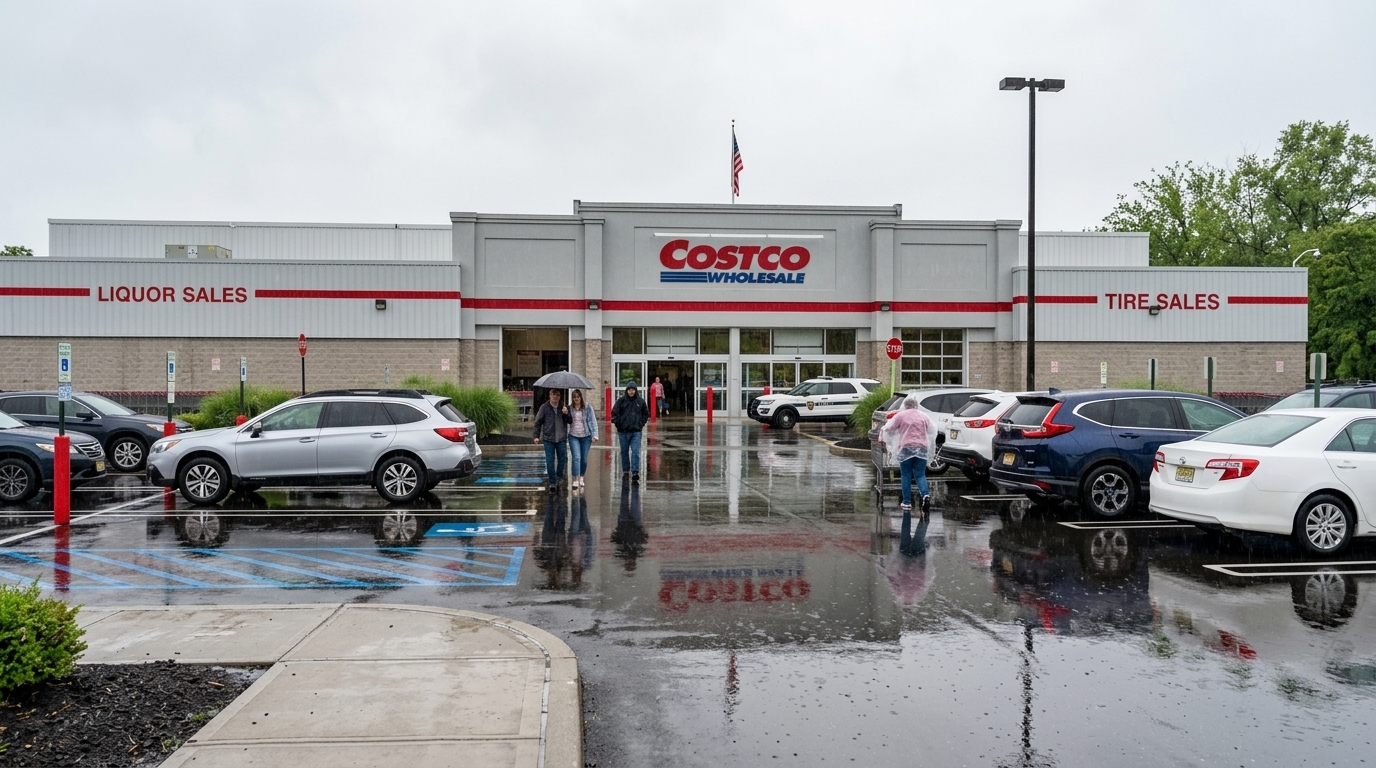
Costco Wholesale opened its first warehouse in Seattle in 1983, establishing what would become the dominant membership-based warehouse retailer in North America and beyond. Founded by Jim Sinegal and Jeffrey H. Brotman on September 15, 1983, the company pioneered a membership model designed to bring wholesale-level pricing and efficiency to individual consumers. Costco’s worldwide headquarters are in Issaquah, Washington, an eastern suburb of Seattle. The company operates a large-format warehouse model featuring limited product selection, high volume, razor-thin margins, and a focus on eliminating unnecessary retail overhead to pass savings directly to members.
A Costco store typically carries supermarket items and an ever-changing selection of other merchandise, and the stock is stacked high in a cavernous “warehouse” enclosing more than an average of 140,000 square feet of floor space. A Costco store typically stocks only about 4,000 different items at any given time—about one-tenth of the variety that is available at the average supermarket. The company has become known for offering steep discounts on bulk quantities of branded goods, fresh foods, and its own Kirkland Signature private label products, along with ancillary services like gas stations, pharmacies, and optical centers.
History
Jim Sinegal had started in wholesale distribution by working for Sol Price at FedMart; Brotman, an attorney from an old Seattle retailing family, had also been involved in retail distribution from an early age. Sinegal began his retail involvement as a grocery bagger. At its launch, Costco sold goods to small businesses at a markup of only 8 or 9 percent over the wholesale price. A second store opened in Portland, Oregon in October, and a third in Spokane in December 1983.
In December 1985, Costco went public, opening on the NASDAQ at $10 per share; at the time, the company had 17 warehouses nationally and 1,950 employees. Just five years after its start up, Costco’s annual sales reached $2 billion. The company was initially headquartered at its first warehouse in Seattle but moved its headquarters to Kirkland in 1987. Costco expanded into Canada, and became the first warehouse retailer to add fresh foods such as produce, bakery products, and meat.
Costco’s corporate lineage traces back further through an earlier competitor. Through mergers, Costco’s corporate history dates back to 1976, when its former competitor Price Club was founded in San Diego, California. Sol Price and his son Robert opened Price Club, a San Diego, California-based warehouse retail club that was initially open only to business members. By 1979, Price Club was generating profits and had expanded to include two locations, a workforce of nine hundred people, and two hundred thousand member customers.
In 1993, Price Club and Costco merged to form the present-day Costco Wholesale Corporation, which was known as PriceCostco when the merger was first completed. When Costco and Price Club merged in 1993, the combined company, operating under the name PriceCostco, had 206 locations generating $16 billion in annual sales. PriceCostco changed its name to Costco Companies, Inc. in 1997 before adopting its current name, Costco Wholesale Corporation. The merger positioned Costco as the clear leader in the warehouse club industry, ahead of rivals Sam’s Club and others.
Begun in 1995, private label Kirkland Signature products are designed to be of equal or better quality than national brands. Its Kirkland Signature house label is named after its former location in Kirkland, another eastern Seattle suburb. Unlike previous companies which changed their private label name depending on the type of product, Costco assigned “Kirkland Signature” to its private products across the board.
Operations & Footprint
By the early 21st century the company operated stores in the United States, Canada, Mexico, Europe, Asia, and Australia. Costco warehouses serve both business members and individual consumer members across a geographically diversified footprint, with particularly strong concentration in North America. The company is publicly traded and continues to operate as an independent corporation, though institutional investors hold significant stakes.
The warehouse format defines Costco’s operational model. Concrete floors, minimal signage, and high-stacked merchandise create a utilitarian aesthetic that contrasts sharply with traditional supermarkets. The company operates its own distribution network and manufacturing facilities for specialized products, including meat processing and food packaging operations under Costco Wholesale Industries. This vertical integration allows the company to maintain control over quality and cost structure.
Products, Services & Merchandising
Costco’s product assortment blends grocery staples with rotating seasonal and specialty items. Most Costco Wholesale warehouses have a discounted gas station on site for members. Pharmacy features discounted brand-name and generic prescription drugs, and optical provides discounted glasses and contacts, as well as the ability to see an optometrist. Food court provides discounted fast food, such as the $1.50 hot dog, which brings in customers even if Costco takes a loss on each hot dog sold.
Kirkland Signature has become central to Costco’s value proposition, encompassing hundreds of products from food and beverages to household goods, clothing, and electronics. The brand leverages Costco’s purchasing scale to procure high-quality goods from tier-one manufacturers and rebrand them under a single, minimalist label. This approach strengthens member loyalty while enhancing margins compared to national brands.
The membership model generates predictable recurring revenue and cash flow independent of merchandise sales margins. Costco originally began with a wholesale business model aimed at enrolling businesses as members, and later began enrolling individual consumers and selling products intended for them, including its own private-label brand. The company offers tiered membership tiers with different benefits and renewal fees, creating layered revenue streams. Digital tools and online ordering capabilities have expanded in recent years, though the in-warehouse experience remains central to the Costco brand.
Work Environment & Employment
Costco is known for a strong corporate culture which encourages and rewards loyalty and promotes from within. As of 2024, Costco claims to have a retention rate over 90% for new employees who make it to one year. Many of its senior executives started as front-line employees in its warehouses and spent many years rising through the ranks to reach their current positions. For example, Ron Vachris started in 1982 as a forklift driver at a Price Club in Arizona and became only the third chief executive officer in Costco’s history in 2024.
Costco has often been praised for providing its employees with higher pay and better benefits than were customary in the field of retailing. The company has positioned competitive compensation and benefits as a deliberate strategy to attract and retain quality employees, reduce turnover, and build a positive workplace culture. This approach has earned Costco recognition as an exemplary employer within the retail sector, though labor organizing activity has occurred at some locations in recent years.
Business Model & Financial History
Costco operates on a membership-based warehouse model fundamentally different from traditional grocery retail. Membership fees—which operate independently of merchandise sales—provide the primary profit driver, allowing the company to accept razor-thin merchandise margins that would be unsustainable for conventional retailers. This inversion of the traditional retail model creates powerful economics: high-volume turnover, low overhead, and membership-funded operations enable deep discounting while maintaining profitability.
The company’s early performance validated the model. Costco became the first company ever to grow from zero to $3 billion in sales in less than six years. By the turn of the twenty-first century, Costco was generating average sales of $100 million per warehouse location while expanding internationally and continuing to diversify its retail operations and service portfolio. The 1993 merger with Price Club doubled scale and eliminated a major competitor, solidifying Costco’s market position.
The company maintains strict discipline on cost structure, limiting product selection to the highest-velocity items and minimizing marketing expense. Costco’s ruthless focus on operational efficiency—described by co-founder Sinegal as keeping costs down and passing savings to members—shapes every element of the business: store layout, staffing, technology investments, and merchandising. This model has proven resilient through retail cycles and competitive pressures from discount chains, e-commerce, and other warehouse clubs.
Competitive Landscape
Costco competes primarily against other warehouse clubs, particularly Sam’s Club (owned by Walmart) and BJ’s Wholesale Club, as well as traditional supermarkets, discount retailers like Walmart and Target, and increasingly, e-commerce platforms including Amazon. The warehouse club category itself remains concentrated among a few large players with high barriers to entry. Costco’s membership base, scale, and brand loyalty have positioned it as the clear category leader in North America.
The company faces structural headwinds from the shift toward e-commerce and the rise of ultrasmall-format discounters targeting value-conscious consumers. The membership fee itself, while creating loyalty, excludes price-sensitive shoppers without the commitment to pay annually. Costco has responded by developing online and delivery capabilities to extend convenience, though it emphasizes that in-warehouse shopping remains core to the experience.
Recent Developments & Outlook
In recent years, Costco has expanded distribution and fulfillment infrastructure to support e-commerce and same-day delivery partnerships, particularly since the pandemic accelerated online grocery adoption. The company has opened new warehouses globally while maintaining its disciplined site-selection approach, expanding into emerging markets while densifying coverage in core regions. Strategic priorities include digital capability enhancement, international growth, and Kirkland Signature expansion to drive margin and member value.
Costco has managed founder succession with relative smoothness. Jim Sinegal, the operational visionary and longer-serving co-founder, stepped down as CEO in 2011. The company has maintained operational continuity and cultural consistency through leadership transitions, suggesting the institutional model has transcended dependence on any single executive. Profitability, growth in membership rolls, and sustained competitive advantage position Costco well amid retail consolidation and structural change.
Leave a Reply