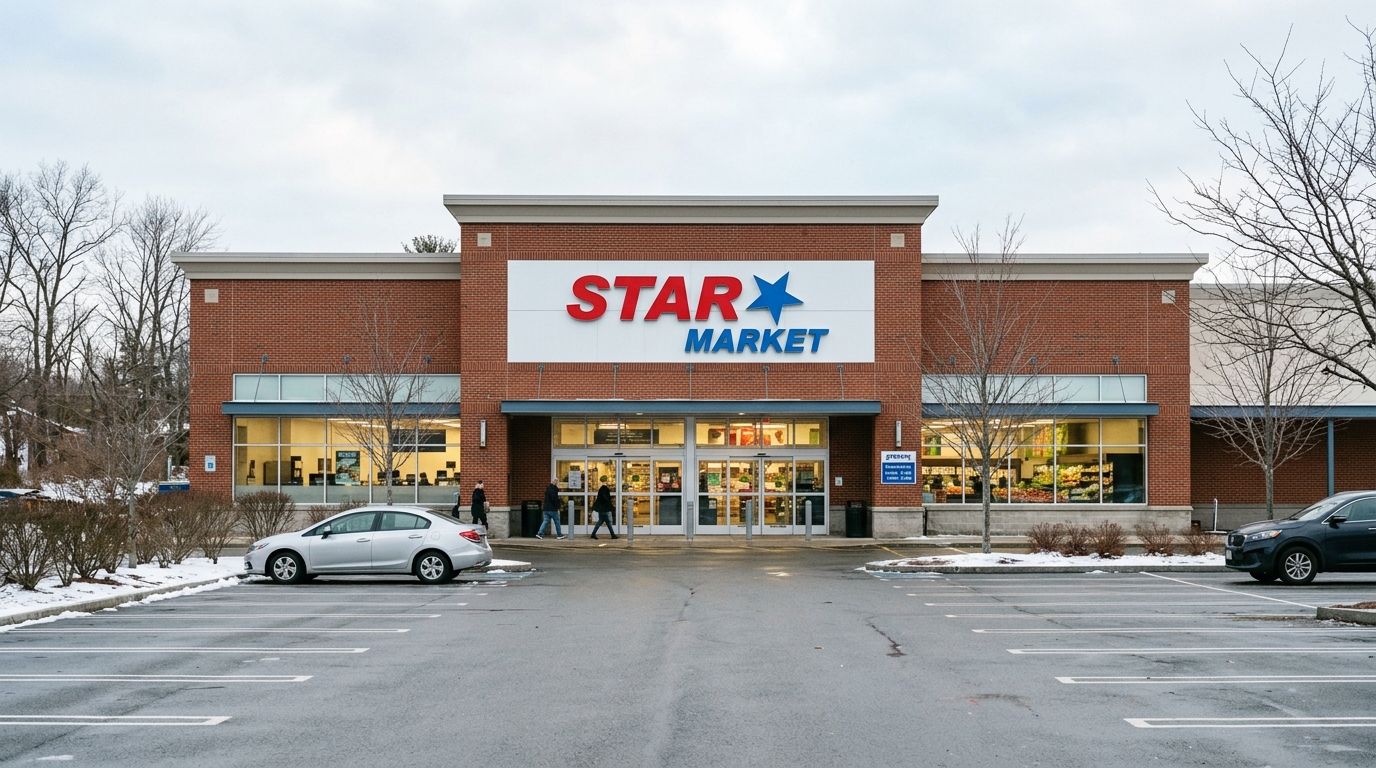
Star Market was a New England supermarket chain based in Greater Boston, founded by Armenian immigrant Sarkis Mugar in 1918. Over its nearly century-long history, the company became known for self-service innovation and regional prominence before passing through multiple corporate ownerships—Jewel Tea, American Stores, Sainsbury’s, and Albertsons—and ultimately landing under SuperValu ownership in 2006. By the early 2010s, Star Market operated as a subsidiary banner alongside Shaw’s Market under SuperValu’s regional grocery portfolio.
Star Market stores were concentrated in Massachusetts, Maine, New Hampshire, Rhode Island, and Vermont, with approximately 60 locations as of 2010. The chain positioned itself as a full-service supermarket with produce, meat, dairy, bakery, prepared foods, pharmacy, and floral departments, supported by private-label brands including Wild Harvest and Stone Ridge Creamery. Like regional grocers of its era, Star Market operated on thin margins within a consolidating industry, competing against national chains, discounters, and shifting consumer preferences toward online shopping and alternative formats.
History
Sarkis Mugar, an Armenian immigrant who arrived in the United States in 1906, purchased a small grocery store in Watertown, Massachusetts in 1918 for $800. His son Stephen P. Mugar (1901–1984) assisted in the store’s early operations and assumed full control in 1922 following his father’s death in a car accident. Stephen expanded Star Market throughout the Boston region over the following decades, building a reputation for quality and service.
In the early 1930s, Stephen hired his first cousin John M. Mugar and encouraged him to pursue higher education. John graduated magna cum laude from Tufts University in 1937 and eventually became President and Chairman of Star Market. John served in the U.S. Navy during World War II and returned to lead the company’s continued growth in the postwar period. Under John’s leadership, Star Market pioneered several retail innovations, including cellophane-wrapped meat displays and a conveyor system that moved groceries to a centralized loading point near the parking lot, features that attracted customers from across the region.
In 1964, Jewel Tea Company of Chicago acquired Star Market but retained both the Star name and John Mugar as leader. Jewel subsequently created “Star-Osco,” a combined food and drug store banner, which expanded alongside the core Star Market chain. Mugar remained Chairman until 1978.
American Stores Company acquired Jewel in 1984, consolidating Star Market and Osco Drug under unified management. Star Market was then sold to investment firm Investcorp in 1994. Under Investcorp’s ownership and the leadership of Henry Nasella (formerly president of Staples), who served as Chairman and CEO, the chain expanded its private-label offerings through the Wild Harvest brand.
Sainsbury’s purchased Star Market from Investcorp in 1999 for $490 million. This ownership proved short-lived; Albertsons acquired Sainsbury’s U.S. supermarket assets in 2004, reuniting Star Market with Osco under common ownership. In 2006, a consortium of investors including SuperValu, CVS, and Cerberus Capital orchestrated a leveraged buyout of Albertsons, with SuperValu acquiring the Shaw’s and Star Market banners for its regional portfolio.
Following the 2006 restructuring, Shaw’s became the primary banner for most locations in the Northeast, though Star Market retained brand recognition in its traditional Massachusetts stronghold. In 2008, SuperValu reopened a Shaw’s location in Allston, Massachusetts as a Star Market, signaling a selective revival of the historic banner nearly eight years after many stores had been converted to Shaw’s.
Operations & Footprint
Star Market’s footprint was concentrated in New England, with stores throughout Massachusetts, Maine, New Hampshire, Rhode Island, and Vermont. The chain operated approximately 60 locations as of 2010, making it a significant but regional player within SuperValu’s broader store portfolio.
As a SuperValu subsidiary, Star Market operated within a corporate structure that also included Shaw’s Market (headquartered in West Bridgewater, Massachusetts) and numerous other regional banners across North America. SuperValu, then the largest grocery wholesaler and retailer in the United States, managed distribution, purchasing, and back-office operations for Star and Shaw’s through centralized systems, enabling economies of scale while maintaining distinct local banners.
Star Market stores included standard supermarket departments: produce, meat and seafood, dairy, bakery, deli, frozen foods, and pharmacy. Many locations also offered floral services and prepared foods. The chain supported its merchandising through regional distribution centers and maintained relationships with national branded suppliers and private-label manufacturers.
Products, Services & Merchandising
Star Market offered a traditional full-service supermarket assortment, with emphasis on fresh departments that appealed to Northeast urban and suburban shoppers. The chain stocked national brands alongside private-label products, including Wild Harvest (organic and natural foods), Farm Stand fresh produce, and Stone Ridge Creamery ice cream.
Star Market’s historical positioning centered on customer convenience and service: the company pioneered self-service grocery shopping while maintaining sufficient staffing to assist customers. This balance—autonomy combined with available help—became a defining characteristic and a draw for customers willing to travel to Star locations in an era before standardized supermarket formats.
Like other regional supermarkets, Star Market operated pharmacy departments and, at select locations, floral and prepared-foods sections. The chain did not widely offer online ordering or delivery services as of the early 2010s, remaining primarily a destination-based physical retailer.
Work Environment & Employment
Specific documentation of Star Market’s employment practices, compensation, benefits, or workforce culture is limited in widely available records. As a supermarket chain, the company relied on hourly store workers (cashiers, stockers, produce staff, pharmacists, and department managers) and distribution center employees typical of the industry.
The Mugar family’s long stewardship of the company (1918–1964) established a reputation for operational continuity and local roots. Under subsequent corporate ownership, Star Market likely adopted standard retail grocery practices including training, advancement into management, and union representation in certain locations, though specific details are not well documented in public sources.
Business Model & Financial History
Star Market operated on the inherent economics of supermarket retail: high volume, low margins, and dependence on scale and operational efficiency. The shift from founder-family ownership (1918–1964) to large corporate ownership (1964 onward) reflected industry consolidation driven by the need for capital, purchasing power, and sophisticated supply-chain infrastructure.
The chain’s profitability was rooted in steady traffic to its stores, aided by location in densely populated New England markets and historical brand loyalty. However, Star Market faced structural headwinds common to regional grocers: pressure from national chains with larger scale, discount competitors, and rising operational costs. The multiple ownership transitions—Jewel (1964), American Stores (1984), Investcorp (1994), Sainsbury’s (1999), Albertsons (2004), and SuperValu (2006)—reflected the sector’s consolidation and the difficulty of sustaining independent or mid-sized regional chains.
By 2006, when SuperValu acquired Star Market as part of the Albertsons breakup, the chain had become a regional asset within a larger wholesale and retail enterprise. SuperValu’s model—managing multiple banners through centralized operations—aimed to preserve local brand value while capturing purchasing and distribution economies. This structure buffered Star Market from some competitive pressures but also subordinated it to corporate priorities, eventually leading to a selective retreat in store count and banner presence across New England.
Competitive Landscape
Star Market competed primarily against Shaw’s Market (its sister SuperValu banner), along with national chains including Stop & Shop, Whole Foods, and Trader Joe’s in New England urban and suburban markets. Regional discounters and specialty grocers also fragmented the market, particularly as consumer preferences shifted toward organic, natural, and specialty foods in the 2000s.
The supermarket sector experienced profound consolidation and format fragmentation in the decades following Star Market’s acquisition by Jewel (1964). Big-box formats, warehouse clubs, dollar stores, and online grocery delivery—none present in Star’s founding era—reshaped competitive dynamics. Star Market’s historical advantages (innovation, customer service, local brand recognition) became less distinctive as standardized supermarket formats became ubiquitous and new retail models emerged.
SuperValu’s decision to operate Star Market alongside Shaw’s, rather than merge the banners entirely, reflected an attempt to segment markets and preserve both the Star brand’s premium heritage and Shaw’s value positioning. However, the economics of maintaining dual banners in overlapping markets proved challenging, and Star Market gradually contracted to its strongest locations.
Recent Developments & Outlook
After SuperValu’s acquisition of Star Market in 2006, the chain experienced a period of modest revival in certain New England markets, notably the 2008 reopening of a Allston, Massachusetts location under the Star banner after nearly a decade as a Shaw’s store. This move suggested SuperValu’s recognition of Star Market’s brand equity and local customer loyalty in its core Massachusetts market.
However, broader headwinds affected SuperValu and its regional banners. SuperValu faced financial pressures, competition from Walmart and Amazon, and declining profitability in traditional grocery retail. In 2013, the company announced plans to exit most of its company-operated supermarket operations, transitioning Shaw’s and Star Market to a franchise model. This shift fundamentally altered the business: SuperValu would supply franchised stores rather than operate them directly, reducing overhead but also loosening corporate control and brand consistency.
By the mid-2010s, Star Market’s store count had declined significantly from its 2010 peak of approximately 60 locations. The chain persisted primarily in select Massachusetts markets, often in overlapping territories with Shaw’s. Store closures reflected both SuperValu’s strategic retreat and competitive pressures from larger, better-capitalized retailers. The historic Star Market brand remained in use at select locations but represented a shadow of its mid-20th-century prominence as a regional supermarket leader.
The broader outlook for Star Market reflected structural challenges facing regional supermarket banners: thin margins, competition from e-commerce, shift to discounters, and the economics of maintaining separate store operations in fragmented, overlapping markets. SuperValu’s franchising model offered a low-investment path forward but limited StarMarket’s ability to command resources, invest in stores, or drive competitive innovation. The chain’s future success depended on the profitability and growth ambitions of individual franchisees—a decentralized model that contrasted sharply with the unified, family-controlled operation that had built Star Market’s original reputation.
Leave a Reply