
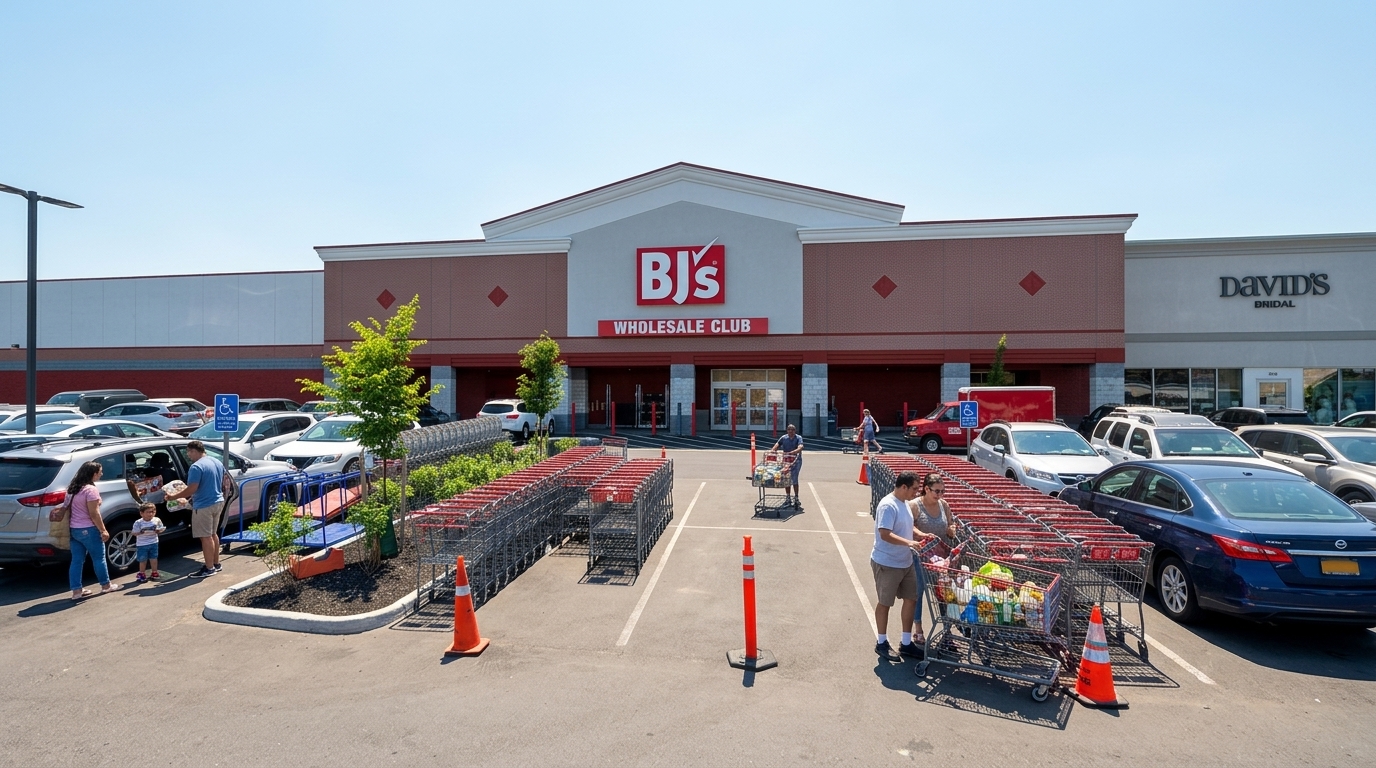
BJ’s Wholesale Club is an American regional membership-only warehouse club chain based in Marlborough, Massachusetts, operating in the eastern United States in addition to Ohio, Michigan, Louisville, Kentucky, Indiana, Tennessee, Florida, Alabama and Texas. Its major competitors are Costco Wholesale and Sam’s Club. The company operates a membership-based warehouse model focused on bulk goods, groceries, and general merchandise at discounted prices, using lean store formats and private-label brands to compete in a market dominated by larger rivals.
BJ’s offers up to 25% savings on a representative basket of manufacturer-branded groceries compared to traditional supermarket competitors. BJ’s provides a wide assortment of fresh foods, produce, a full-service deli, fresh bakery, household essentials and gas. In addition, BJ’s offers the latest technology, home decor, small appliances, apparel, seasonal items and more. The chain has built regional strength in the Northeast while expanding into adjacent markets across the East Coast and Midwest.
History
The company was started by discount department store chain Zayre in 1984, on the Medford/Malden border in Massachusetts. The company’s name was derived from the initials of Beverly Jean Weich, the daughter of Mervyn Weich, the president of the new company. BJ’s entered the market at a pivotal moment for warehouse clubs. Sam’s Club and Costco both opened in 1983, one year earlier than BJ’s.
Weich announced his resignation as president in June 1987, and left on August 1. He was replaced by John Levy. When Zayre Corporation sold the Zayre nameplate to rival discount chain Ames in October 1988, TJX was formed. In 1989, TJX spun off their warehouse division, consisting of BJ’s and now-defunct HomeClub (later known as HomeBase, then House2Home), to form Waban, Inc.
In August 1997, Waban spun off BJ’s to become an independent company, BJ’s Wholesale Club, Inc., headquartered in Natick, Massachusetts, while Waban renamed itself to HomeBase, Inc. This independence allowed BJ’s to pursue its own strategic growth, expanding into new regions and investing in fresh food departments and optical and tire services.
In 2011, BJ’s was acquired by two private equity firms, Leonard Green & Partners and CVC Capital Partners. It returned to being a public company in 2018. The shares opened at $21.25; in its IPO, BJ’s sold 37.5 million shares, raising net proceeds of $637.5 million.
In 2019, BJ’s expanded into Michigan, with a new store in Madison Heights. A second and a third Michigan location have since opened in Taylor and Chesterfield Township, respectively. BJ’s has also since opened locations in Canton and Lansing.
Operations & Footprint
BJ’s operates in the eastern United States in addition to Ohio, Michigan, Louisville, Kentucky, Indiana, Tennessee, Florida, Alabama and Texas. In its core New England market, the company operates more than three times the number of clubs compared to the next largest warehouse club competitor.
BJ’s uses three cross-dock distribution centers along with third-party warehouse space when extra storage is needed. The company operates a single banner—BJ’s Wholesale Club—across all locations, maintaining consistent membership and pricing structures throughout its footprint. As a publicly traded company listed on the New York Stock Exchange under the ticker BJ, the firm is independent and not owned by a parent holding company.
Products, Services & Merchandising
BJ’s Wholesale Club regularly markets numerous products under its own private labels. Unlike its competitors (such as Costco’s Kirkland Signature line and Sam’s Club’s Member’s Mark brand), BJ’s uses multiple private label brands depending on merchandise segment. Grocery products are primarily branded as Wellsley Farms, while general merchandise (including clothing, pharmacy, and home goods) items are sold under the Berkley-Jensen name.
Many of BJ’s clubs offer special services to members, such as car rentals, gas stations, home heating oil, an optical department, propane filling, and vacation packages. These services vary from location to location. As of 2008, BJ’s operated 104 gasoline stations at their clubs. The membership model provides recurring revenue and enables the company to maintain lower product margins than traditional supermarkets.
Work Environment & Employment
BJ’s operates as a substantial regional employer. The company emphasizes training and advancement opportunities for warehouse and store staff, competing for talent in a labor-intensive retail environment. Unionization varies by location, with some facilities represented by labor organizations. The chain has historically faced the same wage and benefit pressures common to the broader warehouse club and retail sectors.
Business Model & Financial History
BJ’s operates a classic warehouse club economics model: membership fees provide high-margin recurring revenue, while product sales run on thin margins dependent on volume and inventory turnover. The membership-only format restricts customer access but builds loyalty and predictable revenue streams. The company’s dual private-label strategy—distinct brands for grocery and general merchandise—differentiates it from competitors who rely on single umbrella brands.
The company’s ownership journey reflects the volatile nature of retail capitalism. From Zayre’s creation of the brand through multiple spinoffs and eventually private equity ownership (2011–2018), BJ’s demonstrated resilience in a consolidating sector. Its return to public markets in 2018 provided access to capital for expansion and digital investment while exposing the company to public-market scrutiny and activist pressures.
Competitive Landscape
BJ’s major competitors are Costco Wholesale and Sam’s Club. Unlike its larger rivals, BJ’s operates primarily in the Northeast and Mid-Atlantic regions, giving it regional dominance in New England while facing disadvantages in scale, brand awareness, and geographic reach. Costco and Sam’s Club operate thousands of locations each across North America; BJ’s smaller footprint constrains its buying power and supply-chain leverage.
BJ’s has differentiated itself through curated assortment sizes (fewer SKUs than Costco but more than some regional competitors), fresh-food emphasis, and multiple private-label tiers rather than a single brand. The rise of e-commerce and delivery services has pressured all warehouse clubs to invest in omnichannel capabilities. BJ’s competitive advantage rests on regional membership density, fresh-product quality, and competitive pricing in high-cost-of-living Northeast markets.
Recent Developments & Outlook
Since its 2018 IPO, BJ’s has pursued selective geographic expansion while investing in technology and digital shopping tools. The company has rolled out online ordering, curbside pickup, and delivery services to compete with broader e-commerce trends. Expansion into underserved markets—particularly the Southeast and Midwest—remains a strategic priority, balancing growth ambitions against the costs of entering competitive, lower-density regions.
BJ’s faces ongoing pressure to grow market share and member count in a mature, consolidated sector dominated by much larger competitors. The company’s focus on fresh foods, private-label penetration, and membership value delivery positions it to retain and grow its regional base. Digital transformation and localized merchandising based on regional preferences represent key differentiators as the company seeks to justify premium valuations relative to its smaller scale.
Leave a Reply