
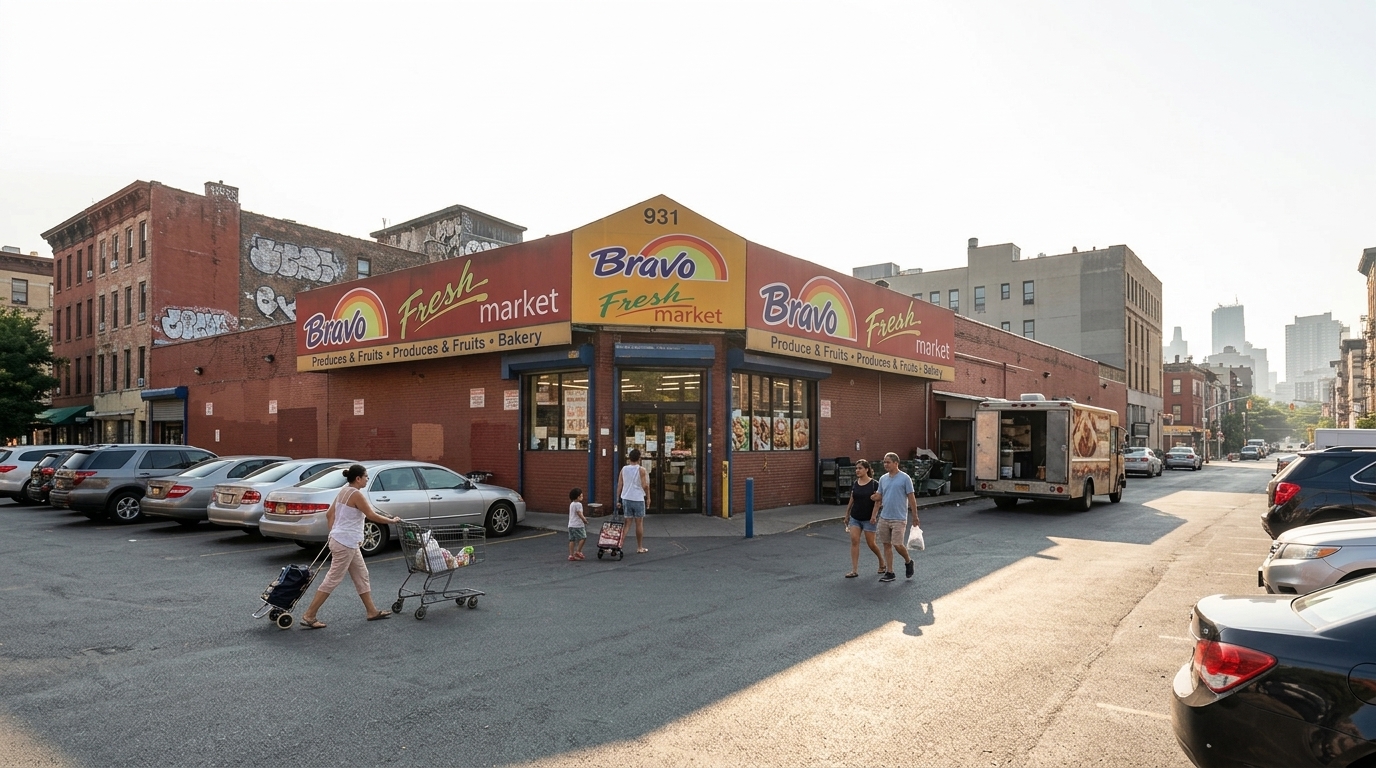
Bravo’s origins trace back to Krasdale Foods’ efforts to create a “virtual” network of stores targeting urban and ethnic markets, with the Bravo name adopted around 1990 for independent operators in New York. Bravo Supermarkets operate under a decentralized ownership model, with the majority of stores independently owned and managed by local entrepreneurs rather than a single corporate parent company. As described by Krasdale executives, “we own the name and we let the independent operators run the stores.” It operates as a chain, while not really being a chain, with all stores independently owned and voluntarily working with Krasdale.
Origins and Early Growth
Krasdale Foods was founded in 1908 by Abraham Krasne as a traditional grocery wholesaler with a strong private label offering. Through exceptional merchandising, procurement and logistics, the company grew rapidly under the leadership of second generation ownership, Charles A Krasne, and relocated to Hunts Point in 1972 to better serve local supermarkets. In response to growing demand from independent operators for consistent merchandising and market support, Krasdale launched the CTown voluntary banner in the mid-1970s.
In the early 1990s, many independently owned Bravo stores opened in New York City. The chain’s origins trace back to Krasdale Foods’ efforts to create a “virtual” network of stores targeting urban and ethnic markets, with the Bravo name adopted around 1990 for independent operators in New York. The company launched the El Sabor de tu Pais (“The Flavor of your Country”) advertising campaign.
Expansion, Acquisitions and Ownership
Bravo Supermarkets initially expanded into Florida in 2003. Cesar Ramirez, owner of three Bravo stores in the New York area and a native of the Dominican Republic, opened his fourth and fifth stores in Orlando when he and his business partner, Luis Merejo, visited the city and spotted a 3,000-square-foot grocery store for sale. Other current and former Bravo owners saw the same potential and convinced Bravo’s supplier, Krasdale Foods, to start a group in Florida. Initially hesitant about going so far from its core market, Krasdale decided to take a chance, and thus began Bravo’s first expansion beyond the New York region.
This was followed by quick additions in the Tampa and Miami areas, with six locations operational by the end of 2004, ranging from 7,000 to 25,000 square feet and focusing on urban accessibility. The National Supermarket Association (NSA) recognized Bravo Florida as Company of the Year during its 11th annual Florida Gala, held in November 2022.
Recent expansions include a 17,800-square-foot store in Ocala, which opened on March 3, 2023, and another in Sarasota on March 30, 2023, both emphasizing diverse product selections to support local communities. Further growth continued into 2024 with a new store opening in Easton, Pennsylvania, in July, and plans for a location in Clermont, Florida, by 2026. Bravo has also opened a new and larger location in Wilkes-Barre, Pennsylvania, at 402 South Main Street. The new 16,000-square-feet store held its grand opening on Friday, Sept. 1 2023.
Stores and Regional Footprint
Most of the Bravo stores in Florida are in the 15,000-25,000-square-foot range, which is described as a manageable size. Ownership diversity is a hallmark of the Bravo network, with many stores led by immigrant entrepreneurs, predominantly from Hispanic backgrounds such as the Dominican Republic and other Latin American countries. This composition strengthens community connections in multicultural neighborhoods, as owners often stock products reflecting their heritage, though it also results in variations in store layouts, product emphasis, and customer experiences across locations.
Krasdale’s Bronx-based distribution center at 400 Food Center Drive facilitates efficient logistics, serving over 2,500 independent grocery locations across seven states with consistent delivery of fresh and staple goods, thereby enabling economies of scale that independent operators like Bravo benefit from. Krasdale provides Bravo stores with comprehensive wholesale distribution services, including access to over 14,000 SKUs of national and private-label products, as well as marketing and merchandising support through Krasdale’s affiliate, Alpha 1 Marketing.
Merchandising and Own-Brand Products
Krasdale’s private-label offerings, such as its Krasdale brand items, enable Bravo to offer affordable, high-quality alternatives that align with the chain’s focus on value-driven shopping for multicultural communities. Hispanic products, representing roughly one quarter of the store’s 25,000 stockkeeping units, are the hallmark of Bravo stores. Most are integrated throughout the aisles to encourage people to walk the entire store.
Bravo’s format caters to the specific needs of the neighborhood rather than using a cookie-cutter approach. Stores provide merchandise for the ethnicity of the people in the area. Some Bravo supermarkets target a broad base of clientele, but most focus on the demographics in their areas, which in many cases is Hispanic. The company offers online grocery ordering, enabling customers to shop from home and find products for their family’s needs. Bravo Supermarkets also engages with the community through ad promotions, recipes, and local events.
Employment and Labor Relations
Hiring employees is a challenge in markets where Bravo operates, but the chain is succeeding and cultivating a workforce. Those who are interested can make a nice career in the supermarket business; many Bravo store owners began their careers bagging groceries. A notable example is Luis Merejo, owner of the Bravo Supermarket in Port St. Lucie, where the New York Mets hold spring training. Merejo has helped young Latin American ballplayers as they adjust to living in the United States. His support goes far beyond just the Hispanic-oriented food offered at his store. Merejo’s generosity was chronicled in The New York Times. He provides support to young players and coaches and even set up a batting cage in his backyard for them to use.
The Economics of the Business
Bravo Supermarkets operate under a decentralized ownership model, with the majority of stores independently owned and managed by local entrepreneurs rather than a single corporate parent company. Due to the independent status of each store, comprehensive public financial disclosures are unavailable, as owners are not required to report aggregated data.
Bravo is part of a “virtual” chain operated by New York-based Krasdale Foods and its marketing arm, Alpha 1 Marketing. Krasdale executives explain their model: “We own the name and we let the independent operators run the stores. We provide the merchandising and the store support, beginning with choosing the location and lease negotiation.” With its ongoing growth, Krasdale and Alpha 1 Marketing are always on the lookout for new retail space. The company prefers to build into existing space because building from the ground up takes more time and is more expensive. For the most part in Florida, there is a lot of empty retail space available.
Rivals and Market Pressures
The competitive grocery market is full of challenges. When a grocer is successful in a particular area, others want to jump in. Krasdale, which supplies Bravo stores, is relatively unaffected by newer competitors like Amazon and Fresh Direct because the chain generally serves a middle-class clientele. C-Town and Bravo might specialize in the basics, but they’re also the sorts of stores where folks shop for years and where staff members go the extra mile.
Industry observers note it is a struggle to make sure that delivery from Amazon won’t be nibbling away at traditional grocery chains. But people want to see the meat and produce they are putting on the table and they like the service provided by local stores.
Later Developments and Direction
Since expanding to Florida in 2003, Krasdale has worked closely with independent retailers to serve the fast growing and diverse Hispanic population in the state of Florida. Krasdale manages merchandising for its Beta II Marketing office in Miami as well as for more than 50 Bravo supermarkets in Florida. These developments reflect Bravo’s strategy of adaptive growth, leveraging demographic shifts while preserving its independent operator structure.
Leave a Reply