
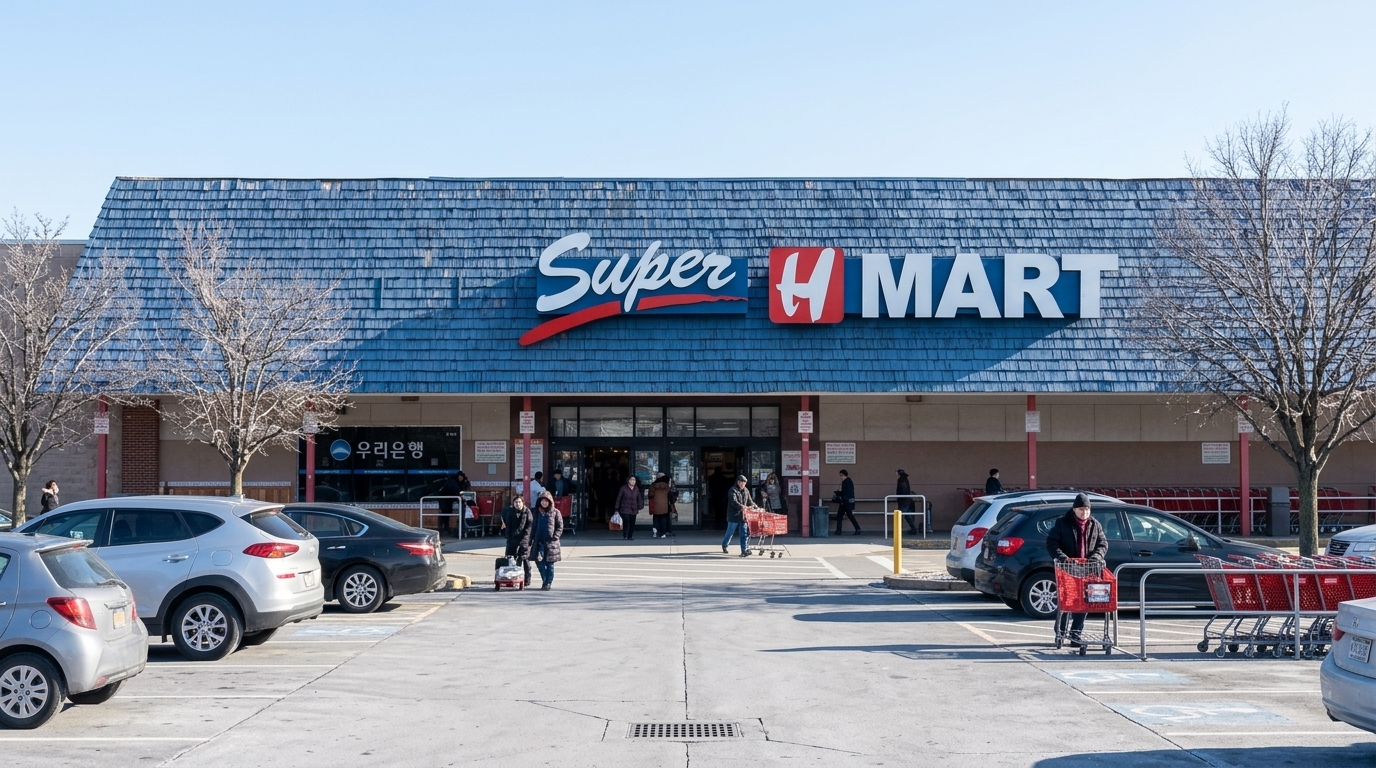
H Mart began in 1982 in Woodside, Queens, in New York City, as a small corner grocery store. The original store was opened by Il Yeon Kwon, an immigrant from South Korea, under the name Han Ah Reum. H Mart is the largest U.S.-based grocery store chain that specializes in Asian-style products and caters to Asian-American shoppers. The chain has become a defining retail destination for Asian Americans and a growing audience of multicultural shoppers across North America and Europe, serving as both a conventional supermarket and a cultural hub through its diverse merchandise, prepared-food offerings, and distinctive store environments.
H Mart stores are “clean, modern, and easy to navigate,” a choice made to “defy the stereotype of Asian grocery stores as grimy and run-down.” Rather than relegating Asian products to isolated aisles, the chain treats them as the foundation of its merchandising strategy, stocking entire sections with Korean staples, regional Asian cuisines, and hard-to-find ingredients alongside Western groceries. The store has extended its appeal beyond Asian-American shoppers, as approximately one-third of its recent customers are now non-Asian. H Mart’s growth reflects broader demographic shifts and rising mainstream interest in Asian cuisines and food culture.
History
The H Mart chain began in 1982 in Woodside, Queens, as a small corner grocery store opened by Il Yeon Kwon, an immigrant from South Korea, under the name Han Ah Reum. The name translates from Korean as “one armful of groceries” and carries connotations of warmth and abundance. The original store maintained the original name and signage until it was remodeled in 2023.
From 1982 to 1991, the company added 10 stores, mostly in the Northeastern United States. In 1997, the company opened its first store in the Washington-Baltimore metropolitan area, in Falls Church, Virginia. On October 19, 1998, the chain opened its current headquarters in Lyndhurst in Bergen County, the U.S. county with the highest Korean population percentage, at 6.9%.
In 2004, the first Super H Mart opened in Duluth, Georgia. By 2005, the chain had 17 stores; by the following March, it had 22, all on the East Coast except for two stores in Denver, Colorado. Its first West Coast location, in Federal Way, Washington, opened in April 2006. H Mart began moving into western Canada in December 2003, with its first store in Coquitlam, British Columbia, a West Coast location that opened ahead of stores in Seattle, Los Angeles, and San Francisco. H Mart Europe Limited was incorporated in 2009, and in 2011, H Mart opened its first store in Europe, in the New Malden area of London.
In June 2024, H Mart opened its first store in Utah, which at 100,000 square feet is the chain’s largest store. However, the company has since announced plans for an even larger flagship location. In January 2026, the company announced plans for an extra-large H Mart in Fremont, California, which will be the largest H Mart to date. On September 25, 2025, H Mart made its debut in Florida, having their grand opening in Orlando.
After cultural conflicts between Hispanic and Korean American employees in a northern Virginia store following its 2001 opening, the H Mart headquarters provided an intercultural training program, with translations into Spanish. More recent controversies have centered on workplace and hiring practices. In 2012, picketers gathered outside one of the Flushing stores to protest against H Mart’s hiring practices. Protest organizer Jim MacDonald said the store, and other H Marts nearby, disproportionately hired Asian people, specifically Korean-Americans. H Mart responded in a statement that the company “does not screen employees by race, but by their capabilities”; for example, the Flushing store hires many Korean speakers to better serve its many customers who do not speak English. In 2012, Korean news agencies and government agencies alleged that H Mart laundered money for former South Korean dictator Chun Doo-hwan, who was convicted of embezzling hundreds of millions of dollars during his autocratic rule, and his family. In December 2012, Korean news channel, TV Chosun reported that “South Korean prosecutors have traced Chun Doo-Hwan’s secret funding to H Mart, as they found suspicious money laundering in an account”. These allegations were later retracted; TV Chosun retracted its claims in August 2013.
Operations & Footprint
The chain has more than 97 stores throughout the United States, operated variously as H Mart, H Mart Northwest, and H Mart Colorado. There are two stores in the Pacific Northwest that operate as “G Mart” that are associated with H Mart. As of 2025, there were more than 97 H Mart stores in the United States, located in New York, New Jersey, Arizona, California, Colorado, Florida, Georgia, Hawaii, Illinois, Maryland, Massachusetts, Michigan, North Carolina, Oregon, Pennsylvania, Texas, Utah, Virginia, and Washington. California, New York, and New Jersey together account for the largest concentration of locations. H Mart also has stores in Canada and two in the United Kingdom. As of June 21, 2024 H Mart made their entry into the French Canadian province of Quebec by acquiring 3 Jang Teu grocery stores in Montreal.
H Mart is an American chain of Asian supermarkets operated by the Hanahreum Group, headquartered in Lyndhurst, Bergen County, New Jersey. The company remains family-owned. Il Yeon Kwon remains CEO of the family business, which he runs with three co-presidents: his former wife Elizabeth Kwon and their two children, Brian and Stacey.
H Mart’s supply chain network is centred in California and South Korea’s southern port city of Busan. More than 60 containers from California, and two from Korea are shipped weekly to its Toronto and Vancouver distribution facilities by air or sea. The company operates regional distribution centers and processing facilities to support its stores and wholesale operations.
Products, Services & Merchandising
H Mart stocks a comprehensive range of Asian groceries with particular depth in Korean products, alongside Western grocery staples. H Mart offers a full line of Asian foods as well as a broad range of Western groceries to complement its full scale offering to that of a traditional supermarket. H Mart offers over 29 private label brands and over 600 different items. H-Mart’s private-label products include brands such as Choripdong and Fremo. These house brands span fresh and frozen goods, seafood, prepared meals, and specialty items.
H Mart food courts offer different specialties, such as Korean jjigaes or soups, street food like steamed dumplings and tteokbokki (chewy rice cakes served in a spicy broth with fish cakes), and Korean-Chinese fusion dishes. Most H Mart locations include a food court, though the location list online specifies the ones that don’t. H Mart is known for its innovative new food halls which are an extension of over 30 years of providing eateries in its stores. Newer stores feature upgraded dining concepts in partnership with independent chefs and restaurant brands.
H Mart operates a loyalty program that offers discounts and rewards to members, and maintains an e-commerce platform for online ordering and delivery in select areas. Digital tools and mobile applications support customer engagement and promotional outreach.
Work Environment & Employment
H Mart generates employment across store, warehouse, logistics, and administrative functions. The company offers entry-level and specialized retail roles, from cashiering and stocking to produce handling and food preparation. Store openings serve as local job-creation events; the company routinely hires dozens to over a hundred employees per new location, contributing to wage growth in communities with significant immigrant populations.
The company has faced labor-related lawsuits over wage and hour compliance issues in prior years, reflecting broader challenges in the retail sector. H Mart has pursued workplace training and cultural integration initiatives, particularly as it operates in diverse communities with multilingual workforces. Language capability—especially fluency in Korean and other Asian languages—is recognized as an operational asset in serving customer bases that may have limited English proficiency.
Business Model & Financial History
H Mart operates on a conventional grocery retail model centered on merchandising depth, supply-chain efficiency, and store experience. The business generates revenue through product sales across grocery, prepared foods, and specialty services. The company has invested in vertical integration through private-label brands, wholesale distribution (Seoul Trading), and food manufacturing to control margin and supply reliability.
Profitability in grocery retail depends on high inventory turnover and cost control; H Mart’s advantage lies in direct sourcing relationships with Asian manufacturers and distributors, reducing middleman costs for specialty items. Store format innovation—such as larger Super H Mart locations and contemporary food halls—aims to increase spending per visit and extend shopping occasions beyond traditional grocery missions.
The company remains privately held under the Kwon family and Hanahreum Group structure, allowing long-term strategic planning without quarterly earnings pressure. This ownership model has enabled sustained geographic expansion and facility investment without requiring public capital markets. The business has not pursued a public listing, maintaining family control and operational autonomy.
Competitive Landscape
H Mart operates in the specialty and ethnic grocery sector, competing with regional Asian supermarket chains such as 99 Ranch (Chinese), Seafood City (Filipino), and Island Pacific (Filipino), as well as with mainstream supermarkets that have expanded their ethnic and international aisles. H Mart is the largest U.S.-based grocery store chain that specializes in Asian-style products and caters to Asian-American shoppers. Its competitive strengths include brand recognition among Asian-American communities, supply-chain integration with Korean and broader Asian sources, private-label product control, and a modern store environment that appeals to both immigrant and mainstream audiences.
The rise of Korean popular culture, food trends (including fermented and spicy items), and growing Asian-American populations have expanded H Mart’s addressable market beyond traditional ethnic enclaves. Online grocers and meal-kit services pose indirect competition for conventional shopping trips, while discount mass merchants capture price-sensitive shoppers. H Mart has responded by enhancing in-store experience through food halls, modernizing digital capabilities, and expanding into suburban and secondary markets where specialty Asian retail was previously sparse.
Recent Developments & Outlook
H Mart has announced plans to open new stores and carry out large-scale renovations in major areas, including California, Florida, Washington, and New Jersey, further reinforcing its leadership in the Asian food market. Since the beginning of 2025, H Mart has increased its pace of new store openings. In January 2025, it opened a 35,000-square-foot store in Urbana, Illinois, its first outside the Chicago area and sixth in the state. Expansion continues in underserved regions and suburban markets.
H Mart is strengthening its efforts in sustainable operations. It installed insulated glass doors and bright LED lighting in refrigerated display cases at five California stores. These improvements are expected to save approximately $300,000 annually in energy costs and have earned H Mart about $70,000 in utility incentives. Sustainability initiatives reflect broader industry trends toward operational efficiency and environmental responsibility.
H Mart’s strategic outlook centers on continued geographic expansion, modernization of store formats to blend grocery with experiential dining, and deepening penetration in existing markets as Korean and broader Asian cuisines gain mainstream acceptance. The company’s private ownership and family leadership provide flexibility for long-term investment in supply-chain infrastructure, technology, and market development, positioning it to capitalize on demographic growth and cultural trends favorable to Asian retail and cuisine.

Leave a Reply