
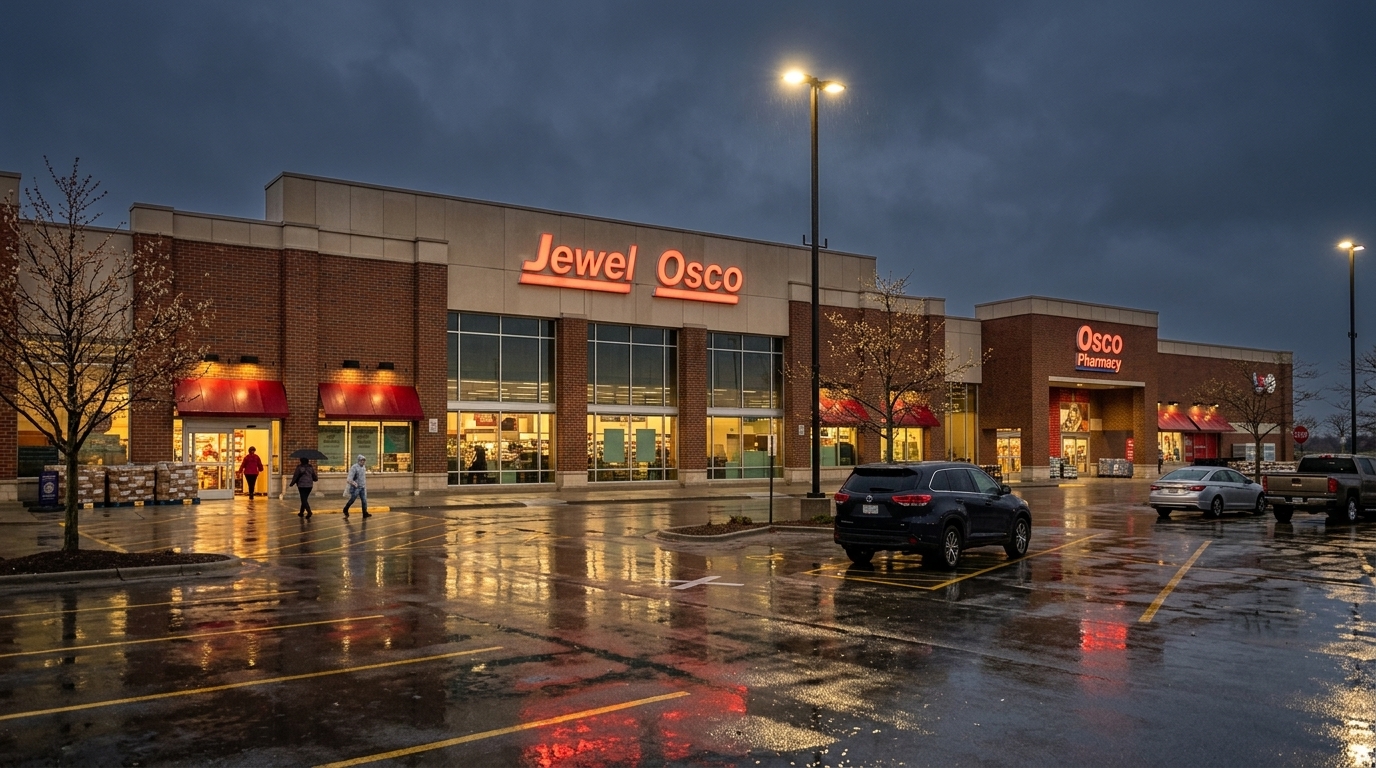
Jewel-Osco is a regional supermarket chain in the Chicago metropolitan area, headquartered in Itasca, a western suburb. In 2025, the company had 189 stores across northern, central, and western Illinois; eastern Iowa; and portions of northwest Indiana. Jewel-Osco has been a wholly owned subsidiary of Boise-based Albertsons since 1999. The company began as a door-to-door coffee delivery service before it expanded into delivering non-perishable groceries and later into grocery stores, and supermarkets. The chain combines grocery and pharmacy operations under one roof and maintains a strong presence in the Midwest, operating as a full-service supermarket offering fresh produce, packaged goods, pharmacy services, and prepared foods.
Jewel-Osco’s model of integrated food and drug retail has shaped its competitive position for decades. The company pioneered the combination grocery-pharmacy store format, creating convenience for customers seeking to complete multiple shopping needs in one visit. This strategy has remained central to the chain’s operations even as it changed ownership multiple times and adapted to shifting retail conditions. Today, Jewel-Osco stands as one of the region’s largest grocery retailers by store count, serving millions of Midwest customers annually.
Origins and Early Growth
In 1899, Frank Vernon Skiff founded Jewel in Chicago as a door-to-door coffee delivery service. In 1902, Skiff partnered with his brother-in-law Frank P. Ross, renaming the venture the Jewel Tea Company. The founders began with modest resources and expanded by recruiting local salesmen, known as “Jewel Tea Men,” who became familiar figures in their neighborhoods. By 1929, the company built a new office, warehouse, and coffee roasting facility in suburban Barrington, Illinois, creating hundreds of local jobs despite the Great Depression.
The enactment in the 1930s of the “Green River Ordinance,” which prohibited door-to-door solicitation, encouraged the company to move into the retail food business, and in 1932 it formed Jewel Food Stores, Inc., to acquire the grocery store business formerly owned by Loblaw Groceterias. In 1932, Jewel acquired 72 self-service stores and four grocery stores, and renamed them Jewel Food Stores. In 1934, Jewel Food merged with Jewel Tea. By the start of the 1940s, customers could also place their orders from a catalog, with merchandise delivered by mail. This pivot from door-to-door service to fixed retail locations set the foundation for Jewel’s expansion across the Midwest.
Expansion, Acquisitions and Ownership
In the 1950s, Jewel expanded its brick-and-mortar stores in west-central Indiana and downstate Illinois. In 1961, Jewel acquired two growing non-food related retail chains, Chicago-based Osco Drug stores, and Brighton, Massachusetts-based Turn Style discount department stores, to complement their food store division when building one-stop shopping destinations, such as the new Family Centers and Jewel-Osco (Eisner-Osco, Star-Osco, Buttrey-Osco) food-drug combinations. The Star Market acquisition in 1964 pushed their reach to New England, while Buttrey Food Stores joined the family in 1966. These acquisitions positioned Jewel as a diversified retailer operating multiple banners across several states.
The first Jewel-Osco food-drug combination stores were built in 1962. Throughout the 1960s and 1970s, Jewel built and operated many Jewel-Osco side-by-side stores, but most construction after 1983 consolidated Jewel and Osco stores together as one large store under one roof. The Jewel Grand Bazaar was their most ambitious experiment. Launched in 1973, these hypermarkets were an attempt to create today’s supercenter concept decades before it became mainstream.
Renamed Jewel Companies, Inc., the company was purchased by the drug-and-grocery retailer American Stores Company in 1984. In 1989, American Stores expanded to Florida using the Jewel-Osco name, but operating as a separate division distinct from the Midwestern Jewel-Osco operations. On April 13, 1992, the Company purchased 74 Jewel Osco combination food-drug stores, a general merchandise warehouse in Ponca City, Oklahoma and related assets, including potential store locations, from American Stores Company (the Acquisition). The Acquisition included stores located in Texas (52 stores), Oklahoma (14 stores), Florida (7 stores) and Arkansas (1 store). Albertsons acquired American Stores’ holdings, including Jewel and Jewel-Osco stores, in 1999.
On May 30, 2006, shareholders approved the break-up of Albertsons. All Jewel-Osco and Jewel Food Stores outside of Springfield, Illinois were sold to SuperValu. In 2013, our parent company—AB Acquisition LLC—acquired Jewel-Osco from SUPERVALU. In October 2022, Albertsons Companies announced a proposed $24.6 billion merger with Kroger Co., which would have integrated Jewel-Osco into a larger supermarket entity but faced intense regulatory scrutiny over antitrust concerns. Federal regulators blocked the merger, keeping Jewel-Osco within Albertsons.
Stores and Regional Footprint
Jewel-Osco serves northern, central, and western Illinois as its primary market, with meaningful presence in Iowa and northwest Indiana. The chain operates in areas ranging from urban Chicago neighborhoods to suburban communities and smaller towns across the tri-state region. Between 1970 and 1990, Jewel moved or expanded most of its stores to be freestanding buildings with ample parking. This shift away from neighborhood city locations reflected broader retail trends toward car-dependent suburban shopping.
A 2010 cost-saving measure brought both Jewel and Osco oversight under one store director for each site. Until that point, stores operated under separate management despite sharing physical space. The consolidated management structure reflected the company’s drive to improve efficiency as Jewel transitioned through multiple ownership changes. In September 2025, DeMao Retail hosted the groundbreaking ceremony for the highly anticipated Jewel-Osco grocery store in Saint John, Indiana. The more than 70,000-square-foot store will include Starbucks, Deli & Hot Foods, Sushi, Bakery, Produce, Meat & Seafood, Beer, Wine, & Liquor, Pharmacy & Drive Up and Go, serving as a one-stop shopping destination for residents.
Merchandising and Own-Brand Products
Jewel-Osco operates as a full-service grocer carrying fresh produce, meat, seafood, dairy, bakery items, prepared foods, and pharmacy services. The stores emphasize value-oriented private-label products alongside national brands. While as a subsidiary division of American Stores, Jewel-Osco began offering the Canadian staple President’s Choice branded products in 1992. The marketing agreement between Jewel and Loblaw ceased when Albertsons acquired American Stores.
In 2011, Supervalu replaced the house brand at Jewel with their own Culinary Circle and Wild Harvest private label brands. Signature SELECT, Albertsons Companies’ flagship private label brand, was introduced in 2016 following the merger of Albertsons and Safeway, evolving from Safeway’s earlier “S” brand initiatives dating back to the 1960s. Jewel-Osco pioneered sustainable store design in the Chicago area by opening its first LEED-certified supermarket in October 2008 at 370 N. Des Plaines Street in Chicago’s Fulton River District. The store featured energy-efficient refrigeration systems certified under the EPA’s GreenChill program, a vegetated LiveRoof to minimize energy use for heating and cooling, and construction with recycled materials to lower environmental impact.
Employment and Labor Relations
Jewel-Osco employs thousands of workers across stores, warehouses, and distribution centers in its operating region. The chain has a unionized workforce, with Teamsters Local 710 representing warehouse and delivery workers and Local 881 representing store-level employees. Labor relations have been an ongoing concern, with periodic contract negotiations drawing public attention.
The union, representing 850 workers at Jewel’s Melrose Park distribution hub, has a contract that expires at 11:59 p.m. Saturday. Teamsters Local 710 represents 850 warehouse workers and delivery drivers for Jewel Osco. The union representing Jewel-Osco warehouse workers and drivers reached an agreement on a new contract with the grocery chain Sunday night, minutes before a strike that could have disrupted deliveries across the Chicago area. This standoff in 2021 illustrated tensions over wages, staffing levels, and benefits. Among the issues the union said it wants addressed in the contract are improved wages and benefits, better balance between work and family and a reduced reliance on third-party workers.
On June 19th, the National Labor Relation Board issued a complaint against Jewel Osco, a subsidiary of Albertsons, after the Region found merit with the Unfair Labor Practice Charge filed by Local 727 over Osco’s blatant violation of the National Labor Relations Act. In February, fed up with Osco’s delay tactics and bad faith behavior, Osco pharmacists and technicians wore buttons in proud solidarity which read “I STAND WITH TEAMSTERS LOCAL 727 PHARMACISTS!” for their demand for a fair contract. In response, a member of Osco management forced a pharmacist to remove his Union button in direct violation of the employee’s rights which are protected under Section 7 of the National Labor Relations Act. These incidents reflected ongoing friction between management and union-represented workers across the chain.
The Economics of the Business
Grocery retail operates on thin margins, requiring high volume and operational efficiency to generate profit. Jewel-Osco’s model of combining food and drug retail under one roof has historically provided advantages, allowing the company to cross-merchandise, reduce overhead per location, and create shopping convenience that drives customer loyalty. The combination store format also spreads fixed costs such as labor and rent across both food and pharmacy sales.
The company’s financial trajectory has reflected broader industry trends and ownership changes. When operating as an independent company under various ownership structures, Jewel faced pressure from larger national competitors and changing consumer shopping patterns. The company has struggled to grow sales at Jewel-Osco and Albertsons, both acquired in 2006. As part of Albertsons Companies, Jewel benefits from scale advantages in purchasing, private-label sourcing, and technology infrastructure, though it also faces integration challenges and strategic decisions about resource allocation across multiple banners.
Rivals and Market Pressures
Jewel-Osco competes against Kroger, Dominick’s (now defunct), Mariano’s, and various independent grocers and discounters in its core Chicago market. Larger players such as Walmart and club stores like Costco pose structural competition through lower pricing and different shopping formats. Amazon and third-party delivery services like Instacart have intensified pressure on in-store traffic and margins.
During the COVID-19 pandemic, Jewel-Osco, as part of Albertsons Companies, experienced significant operational disruptions, including purchase limits on high-demand items like hand sanitizer and toilet paper to manage panic buying. The crisis accelerated the adoption of e-commerce, with Instacart deliveries surging at Jewel-Osco stores in response to customer fears and stay-at-home orders. The pandemic permanently shifted consumer expectations toward omnichannel shopping, requiring continued investment in delivery and pickup services.
Later Developments and Direction
Scheduled to open in 2026, the store will mark Jewel-Osco’s 190th opening. Jewel-Osco has announced expansion plans while maintaining its traditional core market. The Saint John, Indiana store represents an effort to penetrate underserved suburban growth areas and capitalize on foot traffic in retail corridors undergoing revitalization.
Looking forward, Jewel-Osco faces both opportunities and challenges. The chain maintains strong brand recognition and customer loyalty in its region, supported by its established network and local market knowledge. However, it must compete against well-capitalized national chains and adapt to shifting consumer preferences toward digital channels, sustainability, and value. As part of Albertsons, Jewel benefits from corporate resources and technology platforms, though integration and strategy coordination add complexity. Labor cost pressures and ongoing wage negotiations will likely remain significant operational considerations. The company’s ability to refresh its store base, expand into attractive new markets, and retain customer traffic in an increasingly competitive environment will shape its prospects through the coming years.
Leave a Reply