
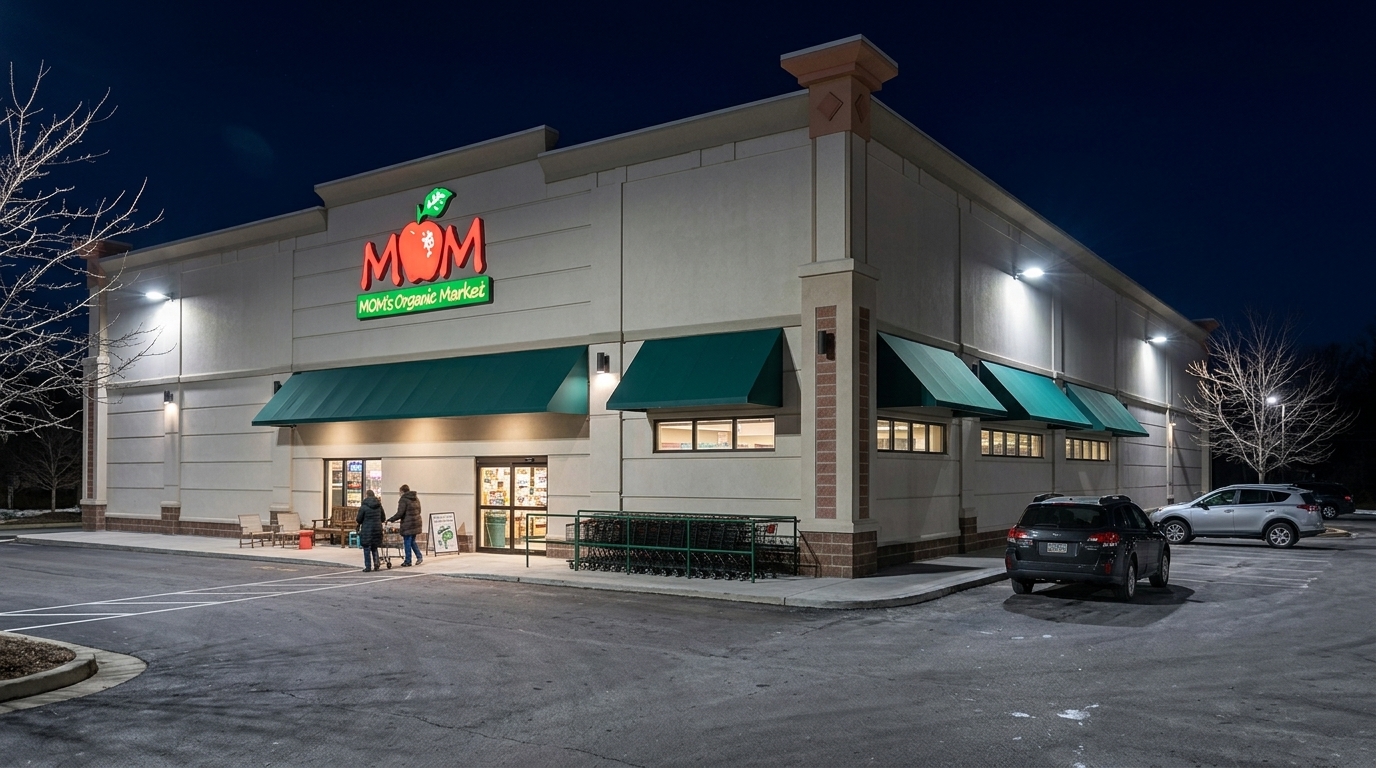
MOM’s Organic Market was founded by Scott Nash in 1987, starting as a home delivery business out of his mother’s garage with an initial investment of $100. The first sale was delivered on July 2, 1987, to a customer in Rockville, Maryland. The chain has grown to become one of the nation’s premier organic grocery stores, operating in Washington DC, Maryland, New Jersey, Pennsylvania, Virginia, New York, and Massachusetts. Centered on a commitment to certified organic produce and environmental stewardship, MOM’s distinguishes itself through an unwavering adherence to ingredient standards and a store design that prioritizes the shopping experience over aggressive promotion.
Since its beginning, MOM’s has maintained a commitment to selling only certified organic produce. In 2005, the company stopped using plastic bags. In 2010, it removed unnecessary plastic waste from its stores, beginning with a ban on bottled still water. The chain operates as a privately held, founder-led enterprise with environmental restoration as its stated purpose, reflected in practices ranging from renewable energy investments to extensive recycling and waste reduction programs across all locations.
Origins and Early Growth
Scott Nash started MOM’s at the age of 22 with an initial investment of $100 as a home delivery business out of a garage. On July 2, 1987, MOM’s made its first sale delivering to a customer who lived in Rockville, Maryland. Nash bought his sister’s Chevy Malibu station wagon for $1,000, which he used to make grocery deliveries in the middle of the night. Early success came through word-of-mouth. A big break came when Scott’s roommate, who worked at a local organic retailer that went out of business earlier that day, put a note on the door telling people to go to MOM’s instead.
Growth accelerated in 1989 following media attention to organic foods. In 1989 after a 60 Minutes report about alar on apples, NPR’s Diane Rehm did a show on organic foods. A MOM’s customer from Vienna, Virginia called in and gave a raving on-air testimony about how the vegetables “were the best I’ve ever had.” The phone rang off the hook for hours. In the early 1990s, MOM’s was sending organic produce mail order (Monday & Tuesday), doing home delivery (Wednesday & Thursday), and open to the public for walk-in retail (Friday–Sunday).
In 1990, Nash opened his first retail space in Rockville and the model for his present-day business was born. The expansion into brick-and-mortar retail marked a shift from delivery-focused operations to a store-based model that would define the company for decades. The store design reflected Nash’s belief that shopping should feel distinct from typical supermarkets, with wider aisles and minimal signage to encourage discovery rather than directed purchasing.
Expansion, Acquisitions and Ownership
MOM’s expanded steadily through the 1990s and 2000s, opening additional locations in the Mid-Atlantic region. The company operates in DC, Maryland, New Jersey, Pennsylvania, Virginia, New York, and Massachusetts. MOM’s Organic Market opened its first store in New York State on February 19 with a unique approach to produce and a commitment to natural, organic and sustainable lifestyles. The store, located in the New York City suburb of Dobbs Ferry at an exit of the key Bronx River Parkway thoroughfare, was committed to offering the highest quality certified organic produce.
In 2023 the retailer opened a 12,000-square-foot store in the Boston suburb of Burlington, Massachusetts, marking its debut in the New England market. MOM’s opened its 19th location on June 1 in Gaithersburg, Maryland. The latest store opening includes a significant test for MOM’s, as it features the retailer’s first in-store bakery. In April 2025, MOM’s opened a location in Washington, D.C.’s Van Ness neighborhood that spans around 17,000 square feet—larger than the chain’s average 12,000 to 14,000-square-foot markets.
In 2026, MOM’s announced its most significant expansion to date. MOM’s Organic Market announced plans to open locations in the Chicago area with the signing of two new leases in Naperville and Mount Prospect, Illinois. MOM’s Organic Market planned to open its first two stores in the Chicago market, marking the 27-unit chain’s expansion into the Midwest. The expected opening for Mount Prospect was in 2026 and Naperville in 2027.
MOM’s remains a privately held company under founder control. MOM’s Organic Market is a privately held company, primarily owned and operated by its founding family. The company was founded by Scott Nash in 1987, and he continues to play a pivotal role in its management and ownership structure. The company has not pursued external capital or equity investors, instead funding expansion through retained earnings and organic growth strategies aligned with its long-term sustainability philosophy.
Stores and Regional Footprint
MOM’s operates in DC, Maryland, New Jersey, Pennsylvania, Virginia, New York, and Massachusetts. The chain maintains the largest concentration of stores in the Mid-Atlantic, particularly in Maryland and the Washington, DC area. Store formats are relatively consistent, typically ranging from 12,000 to 17,000 square feet, designed to feel neighborhood-oriented rather than corporate. The aisles are twice as wide as typical supermarkets. The shelves have more breathing room, and there’s very little signage so that customers are encouraged to discover new items.
MOM’s sources produce through long-standing supplier relationships. Key produce suppliers include Four Seasons based in Ephrata, Pennsylvania, and UNFI/Albert’s Organics in Providence, Rhode Island, delivering out of New Jersey. The company also buys direct from farms in Lancaster County, Pennsylvania. Produce deliveries arrive daily to ensure stores receive products seven days a week.
In addition to grocery operations, select locations feature the Naked Lunch café serving organic prepared foods, with offerings expanding in newer stores. MOM’s Bake Shop launched with a limited offering of organic sandwich breads and other items, with a focus on products made with heirloom grains and whole grains.
Merchandising and Own-Brand Products
The chain maintains a commitment to selling only certified organic produce and stocks a higher volume of organic products than any other store, including organic produce. If organic options are not available, the company has progressive standards that include a list of 250+ banned ingredients. MOM’s does not allow products to target children with licensed cartoon characters on the package.
MOM’s product selection extends beyond produce. MOM’s is the only grocery store in the US to offer 100% sustainable seafood—right down to the canned tuna. The chain offers organic and directly traded coffee beans, grown using sustainable farming practices. Preference is given to Certified Organic, biodynamic, and sustainable wines. The chain offers a wide selection of craft beers with a focus on local breweries. All beauty and body care products are cruelty-free, and preference is given to those made with organic, fair-trade ingredients.
The store’s own brands often undercut national organic brands, delivering quality at a lower cost. The company’s private label brand for vitamins and supplements meets FDA pharmaceutical grade regulations and uses recycled plastic and glass packaging with minimal plastic. MOM’s bulk offerings allow shoppers to bring their own containers to restock a variety of foods, including spices, nuts and pasta. MOM’s keeps produce and bulk offerings together in stores because sustainability sets it apart from grocers using tons of packaging.
Employment and Labor Relations
MOM’s emphasizes culture and employee treatment as central to its mission. The company includes more than 1,000 employees. The company offers a casual work environment with opportunities for mindfulness training and meditation, and green benefits including up to $6,000 towards an electric car, a $500 e-bike reimbursement, and $5,000 reimbursement towards an electric heat pump.
In 2022 and 2023, multiple MOM’s locations voted to unionize. Employees at MOM’s Organic Market’s store in Timonium, Maryland voted to unionize with Teamsters Local 570 in November 2022, with 93% voting in favor, affecting more than 50 employees at the location. In December 2022, 80 percent of voting employees at the College Park store voted to unionize. For almost a year, MOM’s employees, represented by UFCW Local 400, have been negotiating a contract.
Union organizers cited workplace concerns and wage issues. Employees at MOM’s cited several unfair workplace practices, such as no paid time off for an employee’s first two years, limited sick time, unlivable wages, understaffing and dangerous workplace environments. The current starting salary was reported at $16, which union advocates said was insufficient. Since unionizing in 2022, MOM’s employees in College Park have been working without a contract. MOM’s workers filed multiple charges for unfair labor practice charges and bargaining in bad faith.
The Economics of the Business
MOM’s operates in the premium organic grocery segment, positioning itself as differentiated from conventional supermarkets on product quality and sourcing rather than price leadership. The company makes an extra effort to maintain relatively low price points, making a statement against whole paycheck shopping trips. The company does not use gimmicks for pricing and relies on a low-price guarantee.
The business model depends on high-velocity produce sales—the core margin driver—paired with complementary categories in health and wellness, bulk, and prepared foods. Between 15% and 20% of MOM’s sales come from the produce section alone. Profitability in organic groceries remains structurally thin due to lower yields on organic farms, higher labor costs, and premium supplier fees. MOM’s maintains margins partly through operational excellence (daily inventory turns, waste reduction) and partly through founder discipline in avoiding aggressive expansion that would strain supply chains and quality standards.
Rivals and Market Pressures
MOM’s organic-focused market dominates the industry in the mid-Atlantic alongside behemoths Whole Foods and Trader Joe’s (where only some of the products are certified organic). MOM’s distinction lies in its 100% certified organic produce and strict ingredient bans, positioning it above Trader Joe’s on certification rigor and below Whole Foods on scale and geographic reach. Natural Grocers is cited as the closest comparable model, but operates in different markets.
Structural pressures on organic grocers include margin compression from conventional supermarkets adding organic sections, rising logistics costs, and competition from e-commerce and direct-to-consumer farm delivery. MOM’s has grown into a major nationwide chain of grocery stores, with a focus on environmentalism and sustainability. The chain’s regional focus and limited scale offer insulation from some consolidation pressures that affect larger chains, but constrain access to national vendor discounts and supply economies.
Later Developments and Direction
MOM’s strategic direction remains centered on measured geographic expansion and deepening environmental commitments. MOM’s has matched its total electricity with renewable energy since 2005. The company also practices strict energy and packaging efficiency at all locations, installed on-site solar in three locations, and has a 1.5-megawatt off-site solar farm in Kingsville, Maryland, which supports approximately 25% of its total power needs.
MOM’s provides free car charging for customers and employees at almost every location. The company uses both solar from an on-site solar farm and wind power to offset its stores’ energy usage. MOM’s offers recycling for customers and employees including denim, corks, and cell phones.
As MOM’s has grown over the last three decades, founder Nash has stated that preserving corporate culture and operating standards require careful attention. Measuring delivery of brand promise through key performance indicators, or KPIs, is important, as is hiring the right people. The expansion into Illinois and plans to grow the store base signal confidence in the model, though the company appears committed to selective expansion in markets that align with customer demographics and logistics from existing supply chains rather than rapid national rollout.
Leave a Reply