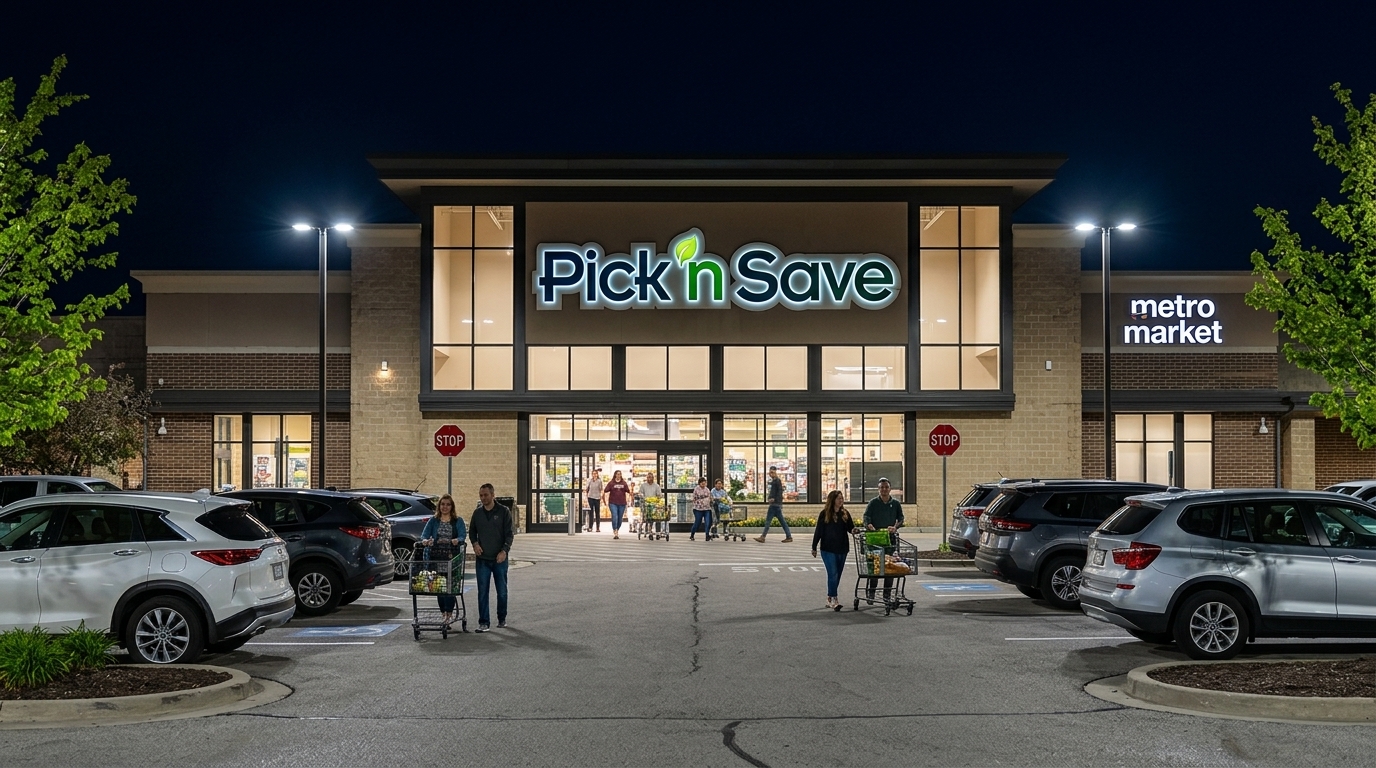
Roundy’s operates stores under the names of Pick ‘n Save, Metro Market, and Mariano’s Fresh Market. Pick ‘n Save is the standard grocery store brand for Roundy’s and Metro Market is an upscale grocery store brand for the company. The chain is a subsidiary of Kroger. These two Wisconsin-based banners serve their home state primarily, with Metro Market positioned as an upgraded format emphasizing fresh departments and prepared foods. Pick ‘n Save traces its origins to a bold warehouse-store experiment launched during the 1970s recession, while Metro Market is a more recent addition designed to compete in upscale grocery segments.
Pick ‘n Save is the standard grocery store brand focused on value pricing and efficiency, while stores have expanded produce, meat, deli, bakery and floral departments, as well as in-store specialty shops in Metro Market locations. Both banners emphasize local sourcing—for over a decade, Pick ‘n Save and Metro Market stores have worked to bring more local produce into their stores across Wisconsin—and offer digital tools including pickup and delivery services.
History
Roundy’s founder, Judson A. Roundy, came to Milwaukee from Rhode Island. In 1872 he and two partners, Sidney Hauxhurst and William E. Smith, founded a wholesale grocery company called Smith, Roundy & Co. Roundy had the food background, Hauxhurst had the legal background and Smith, who later served two terms as Wisconsin’s Governor, had the political connections. Smith, Roundy & Co. soon became one of the largest companies in the West. The company grew out of its first quarters and moved to a larger building at Milwaukee’s Broadway and Buffalo Streets in 1885. This building was destroyed by a famous Milwaukee fire—the 3rd Ward Fire—in 1892. The company reincorporated in 1902 as Roundy, Peckham & Dexter Co.
Roundy’s opened a grocery distribution center in Wauwatosa, Wisconsin, in 1955, which grew into a 450,000-square-foot complex on ten acres of land. The company began to expand rapidly around this time, becoming one of the largest grocery distributors in Wisconsin. Sales reached $50 million in 1962 and then doubled to $100 million in the next nine years. The Roundy’s private label had grown to include about 800 items, and sales in 1972 were close to $115 million.
Roundy’s rented a vacant discount store in Milwaukee on a short-term lease and opened Pick ‘n Save Warehouse Foods in March 1975. The store stood in sharp contrast to the traditional supermarket: packing crates and cases served as the main decor, and untiled floors and plywood walls emphasized the cost-cutting environment. Unique at the time, Pick ‘n Save at first drew customers curious to shop in this innovative establishment. Customers used crayons to mark prices on items because the store saved labor by not price-marking, and customers also did their own bagging. The warehouse concept proved so successful that Roundy’s opened almost 20 more such stores in the next five years, spreading from metropolitan Milwaukee across southern Wisconsin and northern Illinois.
By keeping costs down, Roundy’s warehouse stores offered consumers consistently low prices, and by 1980 a survey of Milwaukee-area stores found all the company’s major competitors losing market share, while the Roundy’s Pick ‘n Save chain gained. Roundy’s had 27 Pick ‘n Save stores in Wisconsin by 1983. With four stores in the Chicago area, Roundy’s strengthened its position in the Chicago market by purchasing Wayco Foods, a suburban grocery. The Wayco acquisition gained Roundy’s a 218,000-square-foot warehouse near Chicago’s O’Hare airport. Now with a base from which to service its Chicago stores, Roundy’s made plans to open 10 to 15 more Pick ‘n Saves in the area. Returns on sales began to slip in 1982, and in 1984 and 1985 revenues were stagnant. Profits also fell, and in those two years Roundy’s did not pay rebates (equivalent to stockholder dividends) to its member retailers.
Roundy’s had 42 stores in metropolitan Milwaukee in 1994, with a growing market share said to be between 39 and 47 percent. In 1995, Roundy’s CEO, John Dickson retired. At the time of his retirement, Roundy’s was the sixth-largest food wholesaler in the U.S. and employed 5,000. In 1994 it earned $6.5 million on sales of $2.46 billion. At that time the cooperative supplied about 1,800 grocery stores in Wisconsin and 11 other Midwestern states. Gerald (Jerry) F. Lestina succeeded Dickson as President and CEO of Roundy’s. In 1997, Roundy’s celebrated its 125th anniversary. Having achieved $2.6 billion in sales the preceding year, the company ranked as the largest food corporation in Wisconsin and remained the sixth largest grocery wholesaler in the country.
In November 1999, Roundy’s reached an agreement to purchase seven Pick ‘n Save stores in eastern Wisconsin—the supermarket assets of Ultra Mart Inc.—whose annual sales topped $150 million. Also that month, Roundy’s announced plans to buy Mega Marts, Inc., the operator of 17 Pick ‘n Saves in Wisconsin and Illinois. Together, the deals were expected to increase annual revenue from $2.58 billion to about $3.2 billion. Roundy’s made another auspicious acquisition in 2001 when it bought Copps Food Centers, then the largest family-owned supermarket chain in Wisconsin, for $95 million. While the Mega Marts and Ultra Mart acquisitions were located mainly in southeastern Wisconsin, the purchase of Copps Corporation’s 21 supermarkets significantly increased Roundy’s presence in central Wisconsin and the Upper Peninsula of Michigan.
Roundy’s was taken private in 2002 through purchase by the Chicago private-equity firm Willis Stein & Partners. Beginning in 2002, the CEO of the corporation was Robert “Chairman Bob” Mariano, who had been the CEO of Dominick’s prior to Dominick’s sale to Safeway in 1998. Mariano’s was launched in 2010. Roundy’s opened its first Metro Market store in 2004 in downtown Milwaukee and added stores in Brookfield in 2010 and Mequon in 2011.
Roundy’s took the company public via an initial public offering (IPO) in 2012, posting an initial share price of $8.50 per share. On December 2, 2013, Roundy’s and Mariano announced it would purchase 11 Dominick’s stores to rebrand them as Mariano’s, after Safeway finished closing the chain early in 2014. Kroger finally completed the rebranding of Copps locations to Pick ‘n Save in 2017.
On November 11, 2015, Roundy’s announced its sale to Kroger, a deal valued at $800 million including debt, which was completed on December 18, 2015. Following completion of the sale, Roundy’s retained its headquarters in Milwaukee. It was suggested that Kroger primarily was interested in the Mariano’s division, which allowed Kroger to enter the Chicago market for the first time. CEO Bob Mariano retired on September 1, 2016. The Kroger Co. then combines the Mariano’s banner with Roundy’s Wisconsin banners to form the Roundy’s Division, based in Milwaukee, WI under the leadership of Roundy’s President, Michael Marx.
Operations & Footprint
Roundy’s operates stores under the names of Pick ‘n Save, Metro Market, and Mariano’s Fresh Market. In Wisconsin, Roundy’s has 106 stores in Wisconsin, including 94 Pick ‘n Save stores and 12 Metro Market stores, as documented in 2021. It operates food production facilities in Kenosha and other locations and has two main distribution centers in Mazomanie and Oconomowoc, Wisconsin. Mariano’s operates in the Chicago metropolitan area with a similar footprint under the Roundy’s Kroger division.
The chain is a subsidiary of Kroger. The chain is a subsidiary of Kroger. Pick ‘n Save stores operate a traditional supermarket format with competitive pricing, while Metro Market locations emphasize specialty departments and prepared-food offerings. The store, still owned by Roundy’s, has been remodeled with larger deli, meat and bakery departments and has more of an emphasis on prepared food.
Products, Services & Merchandising
Pick ‘n Save and Metro Market stocks groceries, pharmacy services, and a variety of specialty items. Both stores are considered subsidiary chains to Kroger that sell both Kroger private label products and Roundy’s private label products. Stores have expanded produce, meat, deli, bakery and floral departments, as well as in-store specialty shops including restaurants, cheese counters, and prepared-food stations in upgraded Metro Market locations.
For over a decade, Pick ‘n Save and Metro Market stores have worked to bring more local produce into their 105 stores across Wisconsin, as well as the warehouse that supplies their Kroger Delivery service. The chains offer digital shopping options including online ordering for pickup and delivery, integrated into Kroger’s broader omnichannel platform. Pick ‘n Save is the standard grocery store brand for Roundy’s and Metro Market is an upscale grocery store brand for the company.
Work Environment & Employment
At the time of his retirement, Roundy’s was the sixth-largest food wholesaler in the U.S. and employed 5,000. This figure from 1995 reflected the company’s position as both a major wholesale distributor and a growing retailer. The company has historically operated as a cooperative structure, with some stores owned by the cooperative and others operated by member retailers. Under Kroger ownership, employment practices and benefits have been integrated with Kroger’s broader workforce policies.
Business Model & Financial History
Roundy’s is known historically as a wholesale supplier to independent retailers. Roundy’s was a major warehouse distributor to non-company supermarkets, including IGA, but it moved out of the wholesale market to focus on retail. The company’s warehouse-store innovation of the 1970s and early 1980s was built on principles of operational efficiency: Sales per employee hour at Pick ‘n Save were said to be almost triple the average at traditional supermarkets, and one Roundy’s executive claimed Pick ‘n Save could sell 100 cases of groceries for the same labor cost a traditional store would take to sell only ten.
Although roughly 90 percent of the company’s revenue came from the wholesale business, the profit margin on these sales was only about 7.5 percent in 1998, and there were few opportunities to substantially increase this percentage. By comparison, the profit margin on retail operations in 1998 was 21 percent. This margin gap drove Roundy’s strategic shift toward retail expansion during the late 1990s and 2000s. Roundy’s took the company public via an initial public offering (IPO) in 2012, posting an initial share price of $8.50 per share. The company operated as a public company for less than four years before its acquisition by Kroger.
Competitive Landscape
Pick ‘n Save and Metro Market compete in the Wisconsin grocery market against a diverse set of retailers. The Madison area is considered one of the most competitive grocery markets in the Midwest, with three Woodman’s Markets, two Walmart Super Centers, three Hy-Vees, two Costcos, two Metcalfe’s and 11 Copps stores. Regional competitors include Woodman’s Markets, Hy-Vee, and various independent operators, as well as national chains expanding into the state.
The warehouse format that Pick ‘n Save pioneered faced competition from similar low-cost concepts and later from big-box discounters. Pick ‘n Save stores are warehouse food store concept in 1975, but over time with the decline of former competitor Kohl’s Food Stores under its A&P ownership and major changes to Piggly Wiggly, now operates as a traditional supermarket chain. Metro Market’s emphasis on fresh departments and prepared foods positioned it to compete with premium-positioned retailers and specialty grocers.
Recent Developments & Outlook
Under Kroger ownership since 2015, Pick ‘n Save and Metro Market have undergone strategic rebranding and remodeling efforts. The Kroger Co. makes a substantial capital investment in Roundy’s Wisconsin and Illinois markets. Roundy’s benefits tremendously from these investments by investing in store remodels, resets, merchandising, technology, pricing, people, and fresh and friendly redefining the food and grocery customer experience in the markets Roundy’s serves. Stores have been selectively converted between banners, with some Pick ‘n Save locations rebranded to Metro Market as part of a broader portfolio optimization strategy.
Roundy’s celebrates its 150th Anniversary in 2022. The company continues to operate dual banners focused on different market segments: Pick ‘n Save as a value leader and Metro Market as an upscale option emphasizing fresh departments and specialty offerings. Both banners remain integrated into Kroger’s broader platform, leveraging shared supply-chain assets and omnichannel capabilities while maintaining distinct local brand identities in Wisconsin.
Leave a Reply