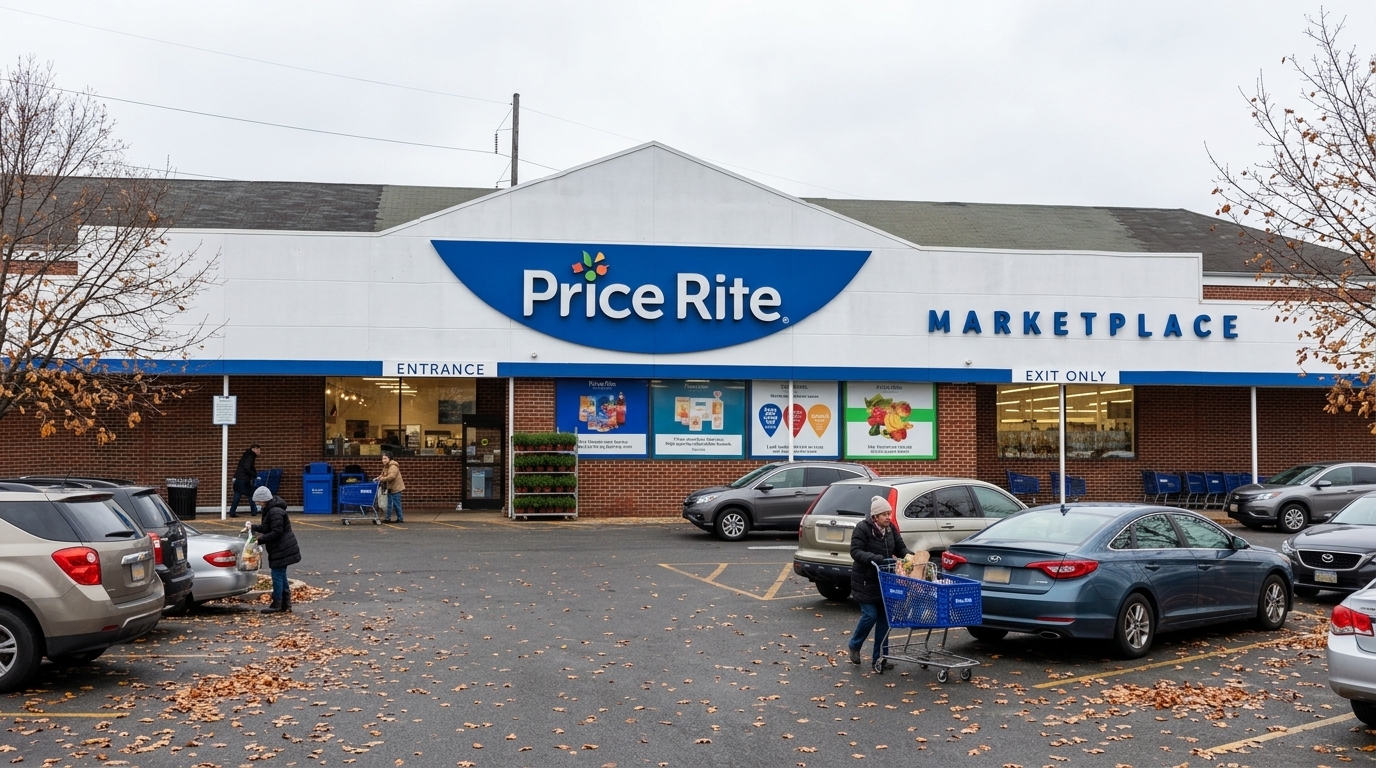
Price Rite Marketplace remains committed to its founding values: offering customers an easy and affordable shopping experience, delivering top national brands and fresh produce at exceptional prices, and strengthening local communities through hands-on service and support. Similar to other limited-assortment chains, including Aldi and Save-A-Lot, Price Rite Marketplace offers drastically fewer stock-keeping units (SKUs) than its sibling ShopRite stores, which are conventional supermarkets. The chain balances efficiency and value with selective service departments and expanded fresh offerings in newer locations to meet regional customer preferences.
History
Price Rite Marketplace opened its first store in 1995 under the name Price Rite Supermarkets. The first Price Rite grocery store opened in West Springfield, Massachusetts. Wakefern, the Keasbey, N.J.-based cooperative whose independent members operate ShopRite stores, founded Price Rite in 1995 in part to help expand distribution through company-owned stores in areas where ShopRite didn’t have presence. The new Price Rite was created to compete with growing no-frills grocery store chains such as Aldi, Food Basics, and Save-A-Lot.
Wakefern had previously used the Price Rite name for their Price Rite Warehouse Clubs, warehouse clubs meant to compete with Price Club and BJ’s Wholesale Club, with the last Price Rite Warehouse Club closing in 1994. The transition to a limited-assortment supermarket format represented a strategic pivot for the Wakefern cooperative, utilizing the established brand name to enter the discount grocery segment.
Prior to 2014, Wakefern owned and operated all Price Rite stores. The company has since allowed independent members to operate Price Rite stores; the Paterson location, which opened late last month, is operated by Inserra Supermarkets. This transition enabled Wakefern member companies to expand their retail footprint through the Price Rite banner while maintaining centralized support and supply chain coordination.
In 2018, Price Rite underwent a significant rebranding initiative, adopting the “Price Rite Marketplace” name to emphasize an enhanced shopping experience while preserving its discount grocery foundation. This transformation, piloted in select Pennsylvania locations, introduced deeper discounts on hundreds of items, expanded selections of fresh produce, organic products, and ready-to-eat options to appeal to value-conscious shoppers seeking quality variety. The rollout began in fall 2018 with three Pennsylvania locations, followed by additional sites in Connecticut and other states, featuring modernized store designs, improved signage, and dedicated sections for value deals and private-label products.
In 2007, a Price Rite store was opened in Pembroke, Bermuda, marking the first Price Rite store outside of the U.S., owned and operated by The Marketplace Group Ltd. of Bermuda. On January 20, 2016, the company opened a second, larger Price Rite store in the Bermuda parish of Warwick. The Bermuda stores operate under a franchise agreement with Wakefern, and The Marketplace Group Ltd. is not a Wakefern member.
Operations & Footprint
Price Rite Marketplace is based in Keasbey, New Jersey and owned by Wakefern Food Corporation, the cooperative behind ShopRite Supermarkets, Dearborn Market, and The Fresh Grocer. Wakefern itself corporately-owns and operates stores outside of New Jersey, while individual Wakefern members own and operate stores in New Jersey. Wakefern Food Corp. is a retailer-owned cooperative and the largest supermarket cooperative in the United States.
Price Rite stores average approximately 35,000 square feet and concentrate on offering value-oriented merchandise. Price Rite stores which opened in the 1990s or early 2000s lack the service departments found in conventional modern supermarkets, such as Deli, Bakery, Meat, and Seafood. These service departments are replaced by pre-packaged offerings prepared at centralized facilities which reduces cost for the store. More recently opened stores have started to add certain service departments, depending on both space available and on regional requirements. In 2012, a Price Rite opened in Baltimore and contained a full-service seafood department. In 2015, the Manchester, New Hampshire Price Rite opened with a deli.
In the years since the first Price Rite opened, the concept has been tweaked to emphasize the size and freshness of the perishable departments in comparison to its competition. Newer stores, such as the Price Rite of Brockton, Massachusetts, at over 40,000 square feet, are also larger than most of the earlier stores. Wakefern has also used the Price Rite concept as a replacement for under-performing ShopRite stores or in regions where the Price Rite concept was thought to be more successful.
Products, Services & Merchandising
Assortments have been curated to highlight fresh foods, Wakefern’s Wholesome Pantry line of better-for-you private label goods, and special deals on general merchandise. Due to the generic nature of the name “Price Rite”, and the unfamiliarity with the brand outside the Northeast, Wakefern has also begun distributing Price Rite-branded merchandise, such as health-and-beauty, paper products, foodstuffs, and dairy products to other retail outlets, such as dollar stores, mom-and-pop pharmacies, and corner stores, along with other supermarkets, such as Gristedes Operating Corp., which owns Gristedes Supermarkets in New York City.
Price Rite Marketplace includes rotating general merchandise buys like televisions the company said provide a better value than club stores or small box competitors. Visitors to the Secane store will find new selections of Wholesome Pantry private label organic foods, Certified Angus Beef and Perdue’s No Antibiotics Ever chicken as part of a “curated” selection designed to make the store easier to shop. Price Rite products are also sold through other supermarkets, and due to Gristedes’ partnership with Amazon, selected Price Rite-branded products also are available for sale on that website. Price Rite products are also the store brand for discount stores such as National Wholesale Liquidators.
Business Model & Financial History
As the largest retailer-owned cooperative in the country, Wakefern comprises nearly 50 independent member companies that collectively own and operate the stores, emphasizing local ownership and community focus. The cooperative traces its origins to 1946, when eight independent grocers in New Jersey formed Wakefern Food Corp. Price Rite operates within this cooperative structure as both a corporate-owned banner and as stores operated by individual Wakefern member companies, enabling flexible expansion and local adaptation.
For most of the chain’s existence, the Wakefern cooperative has been very careful not to cannibalize sales of its member-owned ShopRite stores by opening Price Rite stores in overlapping trade areas. This strategic discipline has allowed both banners to coexist without direct competition, positioning Price Rite as a complementary brand in markets where the ShopRite format is not optimal.
Work Environment & Employment
Price Rite Marketplace conducts festive in-store celebrations, including vendor demonstrations and Employee Appreciation Cookouts at all Price Rite Marketplace locations to honor team members. The chain operates as part of the larger Wakefern cooperative structure, which provides employees with training, advancement opportunities, and benefits consistent with the cooperative’s member-focused mission.
Competitive Landscape
Price Rite was created to compete with growing no-frills grocery store chains such as Aldi, Food Basics, and Save-A-Lot. The discount grocery segment has continued to grow in the Northeast, driven by consumer demand for value and the expansion of national limited-assortment operators. Price Rite Marketplace differentiates through regional focus, fresh product emphasis in newer stores, and integration with the broader Wakefern cooperative network that provides supply chain advantages.
The COVID-19 pandemic significantly boosted demand for affordable groceries at Price Rite, as consumers prioritized value-oriented retailers amid economic uncertainty and supply disruptions in 2020-2021. The pandemic validated the discount grocery model and created sustained consumer interest in value-oriented shopping that extended beyond the acute crisis period.
Recent Developments & Outlook
Price Rite Marketplace will proudly mark its 30th anniversary in June 2025 with special promotions and events celebrating three decades as a trusted neighborhood grocer known for providing quality products at unbeatable low prices and giving back to the community. Kevin McDonnell, president of Price Rite Marketplace, noted that “This anniversary is not just a celebration of our past — it’s a celebration of our future and the people who make Price Rite what it is today: our dedicated team members, loyal customers and community partners.”
Price Rite Marketplace is dedicated to fighting hunger through its annual Check-Out Hunger fundraising campaign and partnerships with Feed The Children and local food banks. The chain continues to expand its community engagement efforts while maintaining its core focus on affordable grocery access. Committed to providing the best value for customers, Price Rite Marketplace delivers a simplified shopping experience with top name brand foods and products and expanded fresh produce and organic offerings at exceptional prices.
Leave a Reply