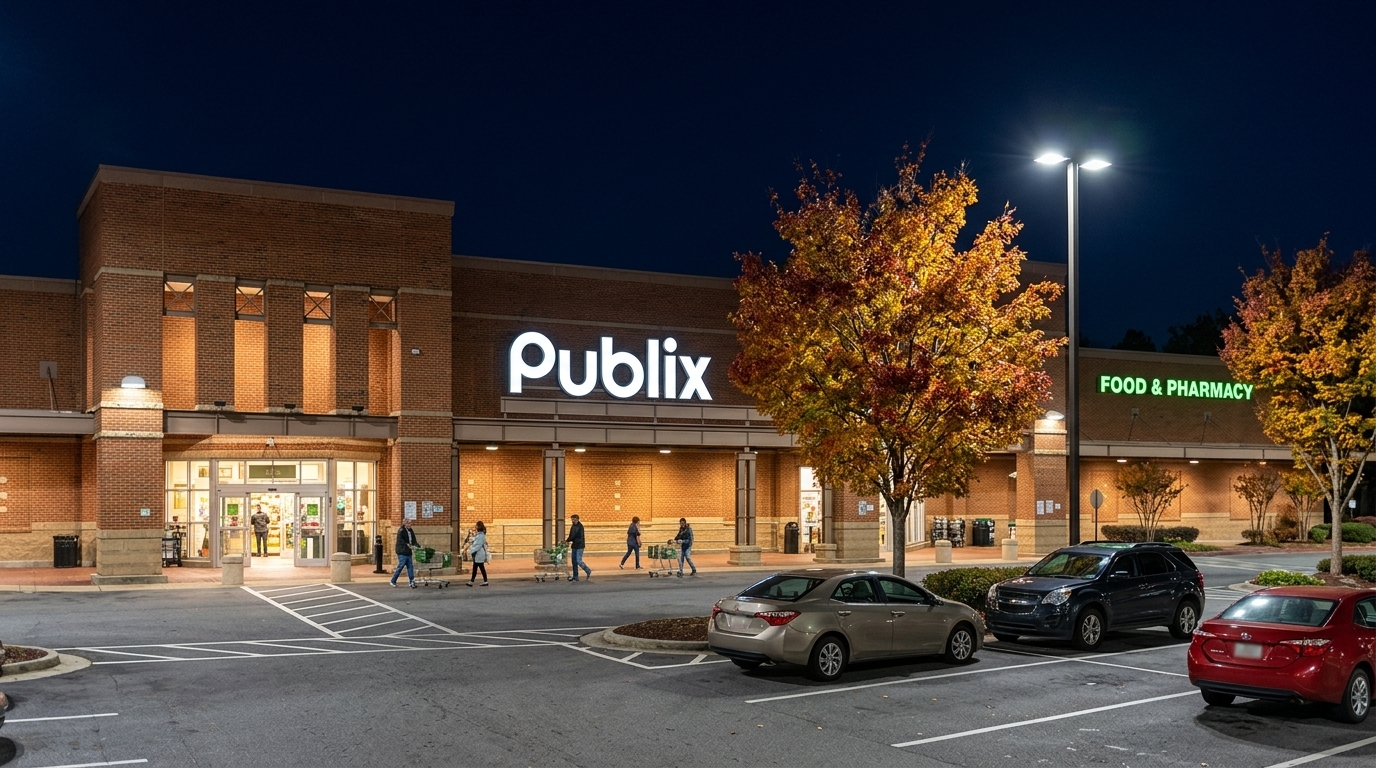
Publix Super Markets, Inc., doing business as Publix, is an employee-owned American supermarket chain headquartered in Lakeland, Florida. Founded in 1930 by George W. Jenkins, Publix is a private corporation that is wholly owned by present and past employees and members of the Jenkins family. Publix operates throughout the Southeastern United States, with locations in Florida, Georgia, Alabama, South Carolina, Tennessee, North Carolina, Virginia, and Kentucky. The chain is known for its commitment to customer service, quality products, and employee ownership, positioning itself as a premium regional grocer focused on the shopping experience rather than deep discounting.
Publix’s product strategy centers on a vast, high-quality selection, including extensive fresh produce, premium meats, and seafood, complemented by robust private label brands like Publix Premium and GreenWise. The first Publix in-store pharmacy was opened on October 30, 1986, in Altamonte Springs, Florida. By 1995, one-third of Publix stores had a pharmacy and today, approximately 90% of Publix stores include a pharmacy. The Company sells grocery (including dairy, produce, floral, deli, bakery, meat and seafood), health and beauty care, general merchandise, pharmacy and other products and services. Publix has three private label lines – regular Publix, GreenWise, and Publix Premium – and also owns its own dairy plants for producing dairy products, bottled waters, and iced teas.
Origins and Early Growth
George W. Jenkins, the late founder of Publix Super Markets Inc., was born Sept. 29, 1907. Growing up in Harris, GA, he worked in his father’s general store. In 1925, he headed to Tampa, FL at the age of 17 with hopes of making his fortune in the Florida real estate boom. Instead, he took a job as a stock clerk in a Piggly Wiggly grocery store. After only a couple of months, he was promoted to manager and was later transferred to manage the chain’s largest store in Winter Haven, a position he held from 1926 to 1930.
On Sept. 6, 1930, George Jenkins opened his first store, called Publix Food Store, in Winter Haven. In 1935, he opened a second location across town. In 1934, that store made $120,000 in sales. Despite the Great Depression, his stores were financially successful. He closed these first two stores to open his dream store, the first Publix Super Market, on Nov. 8, 1940. On November 8, 1940, his “food palace” opened at 199 West Central Avenue, having piped-in music, air conditioning, cold cases for frozen and refrigerated items, in-store doughnut and flower shops, and electric-eye automatic doors.
A pivotal moment in Publix Super Markets history occurred in 1945 when George Jenkins acquired 19 All American Markets. This single transaction transformed the chain from two stores to 21 locations, providing the critical mass needed for rapid expansion. In 1951, Publix moved its headquarters from Winter Haven to Lakeland, Florida, and built its first distribution warehouse there. The warehouse occupied a 70,000-square-foot area. In 1957, the donut shop in each store was expanded into a full-service bakery. In 1956, Publix achieved $50 million in sales and $1 million in profit.
Expansion, Acquisitions and Ownership
By 1959, Publix was the dominant supermarket chain in Central Florida, and began expansion to South Florida, opening a store in Miami and acquiring six stores from Grand U—the exact nature of this acquisition is incomplete in the source, but historical records show Publix pursued acquisitions to expand regionally. When Jenkins died in 1996, Publix was operating 541 stores in Florida, Georgia and South Carolina, with sales of $9.4 billion.
In January 1990, after suffering a stroke, George Jenkins retired as chairman and chief executive of Publix and became chairman emeritus. He was succeeded by his son, Howard M. Jenkins, who was 38 years old. As with many Publix executives, the younger Jenkins had begun at the retail level and worked his way up through the company’s ranks.
Publix Super Markets bought 49 Florida stores from Albertsons. The deal was announced on June 9, 2008, and was completed on September 9, 2008. It included 15 locations in North Florida, 30 in Central Florida, and four in South Florida. Kentucky is the most recent addition to the Publix footprint, with the company’s first store in that state having opened on January 10, 2024, in Louisville.
In 1995, Publix was sued “for sex discrimination in job assignments, promotions and allocation of hours” and settled for $81.5 million in 1997. Publix had claimed that the suit was simply an effort by the United Food and Commercial Workers to unionize the company, but the judge ruled in favor of the plaintiffs and required Publix to “correct some of its statements.” In April 2016, Ed Crenshaw, grandson of founder George Jenkins, retired from his position as CEO. President Todd Jones, a 36-year Publix employee whose first job was as a front service clerk (bagger), took on Crenshaw’s responsibilities as CEO. Jones is the first member outside of the Jenkins family to have assumed the position.
Stores and Regional Footprint
Publix operates throughout the Southeastern United States, with locations in Florida (898), Georgia (219), Alabama (96), South Carolina (74), Tennessee (62), North Carolina (62), Virginia (24), and Kentucky (7). The chain operates as a regional powerhouse concentrated in the Southeast, with Florida remaining its dominant market and core base of operations.
Publix is a private corporation that is wholly owned by present and past employees and members of the Jenkins family. Publix is owned by its current and former employees (about 80%) and the founding Jenkins family (about 20%). It is the largest employee-owned company in the United States. As of May 2026, Publix employs about 260,000 people at its retail locations, cooking schools, corporate offices, nine grocery distribution centers, and eleven manufacturing facilities. The manufacturing facilities produce its dairy, deli, bakery, and other food products.
Approximately 76% of the total cost of products purchased is delivered to the supermarkets through the Company’s distribution centers. To affirm its optimism and long-term commitment to its expansion program, Publix is building a 3 million-square-foot distribution center in Lawrenceville, Ga., north of Atlanta.
Merchandising and Own-Brand Products
Publix’s product strategy centers on a vast, high-quality selection, including extensive fresh produce, premium meats, and seafood, complemented by robust private label brands like Publix Premium and GreenWise. Publix has three private label lines – regular Publix, GreenWise, and Publix Premium – and also owns its own dairy plants for producing dairy products, bottled waters, and iced teas. The GreenWise line has become particularly significant in the chain’s merchandising strategy, reflecting consumer interest in natural and organic products.
Publix brand will be priced below the leading name brand, and often their organic Greenwise products will be the same price (or lower). In 2024, private labels represented approximately 30% of Publix’s total sales. Our GreenWise line was created for those who like to pay extra attention to the types of foods they put into their bodies and products they bring into their homes. So give them a try, and if you’re not satisfied, you’ll be happily refunded. Publix offers a variety of GreenWise organic products throughout the store—and they all meet USDA National Organic Program (NOP) standards. Our nonorganic GreenWise items are made without certain ingredients and meet strict standards. For example, our GreenWise meats and poultry are raised without antibiotics or added hormones; federal law prohibits the use of added hormones in poultry.
Publix operates both traditional supermarkets and specialty formats. Publix is transitioning the eight locations under its small-format GreenWise Market banner over to its traditional supermarket brand. The move comes after the supermarket chain found that its customers like aspects of the specialty banner but within the more traditional setting. Shoppers can partake of a smoothie, coffee, beer or wine from a POURS “bar” while they shop. The concept has been expanded at select Publix locations, typically at new stores or following a store renovation. The new department also offers kombucha teas, soft drinks and acai bowls. As of January 2025, there were 16 locations in Florida offering POURS service.
The company’s guarantee reinforces the mission directly: any purchase that fails to satisfy a customer is refunded in full, no questions asked. This unconditional satisfaction guarantee, paired with strong private-label positioning, forms the core of Publix’s customer value proposition and differentiates it from price-focused competitors.
Employment and Labor Relations
Publix has never had a layoff in its 95-year history. This long-standing commitment to job security has become central to the company’s identity and employer brand. Jenkins believed that if employees had an ownership stake in the company, everyone would benefit. Shares acquired through the PROFIT Plan (ESOP), established in 1974 · Annual company contributions of roughly 8% of employee compensation · Vesting after three years of meeting the 1,000-hour annual work threshold · Additional shares available through the employee stock purchase plan
When Robert Wegman took over in 1950, one of his first acts as president was raising employee salary.—this reference appears to be about a different company (Wegmans), so it should be disregarded. Instead, Jenkins’s approach to employee compensation and benefits distinguished Publix early on. Publix announced that effective January 1, 2015, health coverage would be available to same-sex couples regardless of place of marriage, as long as they are legally married. In early 2018, Publix came under fire by the Human Rights Campaign and other LGBT rights organizations for refusing to cover PrEP HIV prevention drugs under its employee health plans. Shortly after the furor, Publix changed its health plans to cover PrEP.
The Economics of the Business
Publix operates in the thin-margin grocery sector but has built a resilient model centered on customer loyalty, quality perception, and operational efficiency. The company’s private ownership structure, with employee ownership at its core, aligns worker incentives with long-term customer satisfaction rather than short-term shareholder returns.
Publix supermarkets have been living up to their slogan of “where shopping is a pleasure” since the chain was first established in 1930. Today, it boasts a fleet of over 1,300 stores across the Southeastern United States. The company’s scale in the Southeast provides significant competitive advantages in distribution, procurement, and brand recognition within its core markets. Owned manufacturing facilities for dairy, bakery, and deli products provide both cost control and quality assurance, reducing dependence on external suppliers for key private-label products.
Rivals and Market Pressures
Publix competes against national chains including Kroger, Walmart, and regional rivals across the Southeast. The Company’s primary competition throughout its market areas is with several national and regional supermarket chains, independent supermarkets, supercenters, membership warehouse clubs, mass merchandisers, dollar stores, drug stores, specialty food stores, restaurants and convenience stores. The rise of e-commerce and delivery services, combined with aggressive discounting by warehouse clubs and dollar retailers, presents ongoing competitive pressures. Publix has responded by investing in digital ordering and curbside pickup capabilities while maintaining its premium positioning around service and product quality rather than competing on price alone.
Later Developments and Direction
The regional powerhouse opened 45 stores and remodeled 120 locations throughout the Southeast in 2023. It then opened around a dozen more locations in the first three months of 2024. The grocer’s capital expenditures for 2023 totaled $2 billion, according to its annual Securities and Exchange Commission filing, up from $1.8 billion in 2022. This year, the chain estimates it will spend approximately $2.5 billion. This substantial capital deployment reflects Publix’s confidence in its business model and long-term regional growth prospects.
Should Publix build on its recent expansion plans—which come after a robust set of earnings for the second quarter—the company could strengthen its foothold in existing markets while attempting to break into higher-growth regions such as the Mid-Atlantic and parts of the Northeast. Strategic expansion into Virginia, North Carolina, and Kentucky in recent years signals ambitions to extend beyond its traditional Southeast base. The company’s investment in new store prototypes incorporating experiential features such as prepared-food offerings and in-store dining aligns with evolving consumer preferences for convenience and quality prepared meals.
Leave a Reply