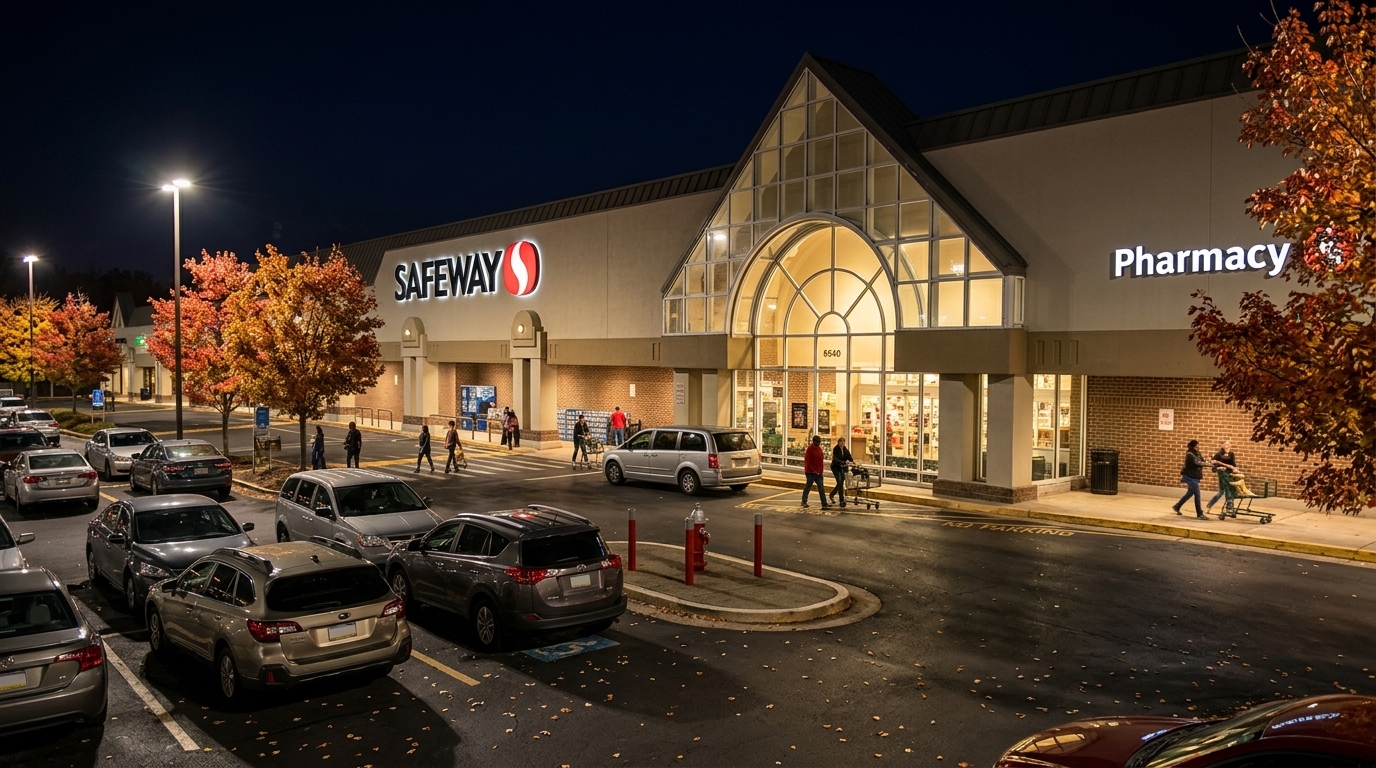
Safeway is a subsidiary of Albertsons after being acquired by private equity investors led by Cerberus Capital Management in January 2015. The subsidiary is headquartered in Pleasanton, California. Under Albertsons, Safeway operates alongside regional banners including Vons, Randalls, Tom Thumb, and Carrs, serving customers across multiple regions of the continental United States.
Retail Formats and Where It Operates
Safeway operates stores in 19 states across the Western, Southern and Mid-Atlantic regions of the United States under the Safeway banner as well as the Vons, Pavilions, Randalls, Tom Thumb and Carrs banners. Stores range widely in size and format, from conventional supermarkets to smaller neighborhood locations. Most stores offer a wide selection of food and general merchandise and feature a variety of specialty departments such as bakery, delicatessen, floral, pharmacy, Starbucks coffee shops and adjacent fuel centers. Safeway stores provide convenience to customers through a network of in-store pharmacies and adjacent fuel centers.
The company maintains an extensive distribution network to support its retail operations. Safeway has an extensive network of distribution, manufacturing and food processing facilities. This infrastructure enables the chain to manage product sourcing and supply operations across its multi-banner portfolio and diverse geographic regions.
Company Background
Marion Barton Skaggs, who already had experience in the grocery business, moved to Portland, Oregon in 1921, and established four grocery stores. This chain of stores grew quickly, and Skaggs enlisted the help of his five brothers to grow the network of stores. By 1926, he had opened 428 stores bearing the family name in 10 states. Safeway was chosen as the name because the stores operated exclusively on a cash-and-carry basis; they did not offer credit to customers, as American grocers traditionally had done.
In 1926, Skaggs merged his company with 322 Sam Seelig Company stores and incorporated as “Safeway, Inc.” because he thought a corporate chain that would outlive him should not carry his name. The merger instantly created the largest chain of grocery stores west of the Mississippi. Two years later, Skaggs listed Safeway on the New York Stock Exchange.
In the 1930s, Safeway introduced produce pricing by the pound, adding “sell by” dates on perishables, nutritional labeling, and some of the first parking lots. These innovations became industry standards and reflected the company’s forward-thinking approach to customer needs and retail operations.
The number of stores peaked at 3,400 in 1932, when expansion ground to a halt. The Great Depression had finally impacted the chain, which began to focus on cost control. Over subsequent decades, the company evolved from a high-store-count model to larger supermarket formats with expanded specialty departments.
In 1969, the Black Panther Party and the United Farm Workers launched simultaneous boycotts of Safeway grocery stores, which were the largest grocery store chain in the U.S. West at that time. The Panthers boycotted due to Safeway’s refusal to donate to their Free Breakfast for Children Program, created to serve daily hot breakfasts to underprivileged children throughout the U.S. The United Farm Workers boycotted Safeway because the chain continued to sell California grapes despite the union’s nationwide boycott.
In the 1990s, Safeway completed five acquisitions — Vons, Dominick’s, Carr-Gottstein, Randall’s, and Genuardi’s — totaling more than $6 billion and building a coast-to-coast store network. In April 1997, Safeway bought out the remaining 70% of Vons Companies for $1.37 billion. The deal added 325 stores in Southern California and Nevada under the Vons and Pavilions banners and made Safeway the second-largest grocery chain in the U.S. at the time. In November 1998, Safeway acquired Dominick’s Finer Foods from Yucaipa Companies for $1.76 billion. Dominick’s had strong recognition in Chicago, but Safeway’s management approach alienated local shoppers. Market share in Chicago fell steadily, and Safeway closed all remaining Dominick’s stores by early 2014.
Ownership, Structure and Financial History
Safeway’s capital structure and ownership have undergone significant transformation. KKR completed a friendly $5.5 billion buyout of supermarket operator, Safeway, to help management avoid hostile overtures from Herbert and Robert Haft of Dart Drug. Safeway was taken public again in 1990. This leveraged buyout in the mid-1980s restructured the company’s capital and forced operational improvements and asset sales.
Albertsons acquired the company in January 2015 for $9.4 billion, ending its 87-year run as an independent public company. In early 2014, Albertsons and Safeway announced that the private equity firm backing Albertsons, Cerberus Capital Management, was planning to buy Safeway for $9.2 billion. The Federal Trade Commission had to approve the merger to make sure the consolidation wouldn’t eliminate competition and turn the merged company into a monopoly. Ultimately, the FTC approved the merger in early 2015 on the condition that the grocery store chain sell 168 stores to its competitors in the grocery sector. Since the merger, Safeway has operated as a banner within the Albertsons Companies portfolio.
Safeway’s business model has always emphasized cost efficiency and value. The company originated as a small grocery store started by S.M. Skaggs in American Falls, Idaho, in 1915. The store was dedicated to building sales volume by taking low profit margins, an operating philosophy still followed by the company. This approach defines the chain’s competitive posture in an industry characterized by thin margins and the need for operational scale.
Product Range and Store Brands
Safeway has developed a comprehensive private-label portfolio to support both value and premium positioning. Safeway launched Open Nature, a new private-label line of 100% natural foods. The brand’s meat and poultry products are raised on an all-vegetarian diet, without the use of antibiotics or added hormones, and are processed without the use of artificial preservatives. The Open Nature brand ultimately includes more than 100 products, with Safeway planning to roll out new breads, yogurt, ice cream, salad dressings, frozen foods and other items. In 2005, the company launched its O Organics brand, which has since grown to include 470 food and beverage items.
Signature family of brands helps customers share and enjoy life’s moments with a portfolio of more than 6,500 convenient products. The company continues to expand its private-label offerings across multiple price tiers and dietary categories, responding to consumer trends toward both value and health-focused options.
Notable Developments and Recent Operations
On November 3, 2013, Safeway completed the Sale of Canadian Operations to Sobeys for CAD5.8 billion (USD 5.6 billion) in cash plus the assumption of certain liabilities. This sale marked a significant shift in Safeway’s geographic footprint and allowed the company to focus on its core U.S. operations.
Safeway announced its intention to exit the Chicago market, where it operated 72 Dominick’s stores, by early 2014. This resulted in a cash tax benefit of $400 million to $450 million which was available in the short term to partly offset other cash expenses. The exit reflected persistent operational challenges in the Chicago market and marked the end of Safeway’s efforts to maintain a national presence beyond its core western and mid-Atlantic regions.
Labor relations have been an ongoing focus for the company. UFCW Local 5 and UFCW Local 648 reached a tentative agreement with Safeway representing 16,000 Safeway workers in the immediate Bay Area, as a tentative agreement was reached with the company—just hours before a historic strike was set to begin. The agreement came after five months of determined negotiations and the growing momentum of a strike effort that would have marked the first regional labor stoppage against the company in nearly 30 years. The deal includes meaningful wage increases, improvements to retirement benefits, fairer scheduling, increased health care contributions, and stronger job protection language. This unprecedented agreement comes after five months of negotiations that brought the unions to the verge of their first strike against Safeway in 30 years. Similar labor negotiations and tentative agreements were reached with UFCW locals in other regions during 2024 and 2025.
In October 2022, Albertsons and its competitor, Kroger, announced a merger agreement. Following initial opposition, the two parent companies said they would sell 400+ stores to a competitor, C&S Wholesale Grocers. The proposed merger faced legal challenges and regulatory scrutiny, creating uncertainty around the future structure of Albertsons and its Safeway banner through 2025 and 2026.
Leave a Reply