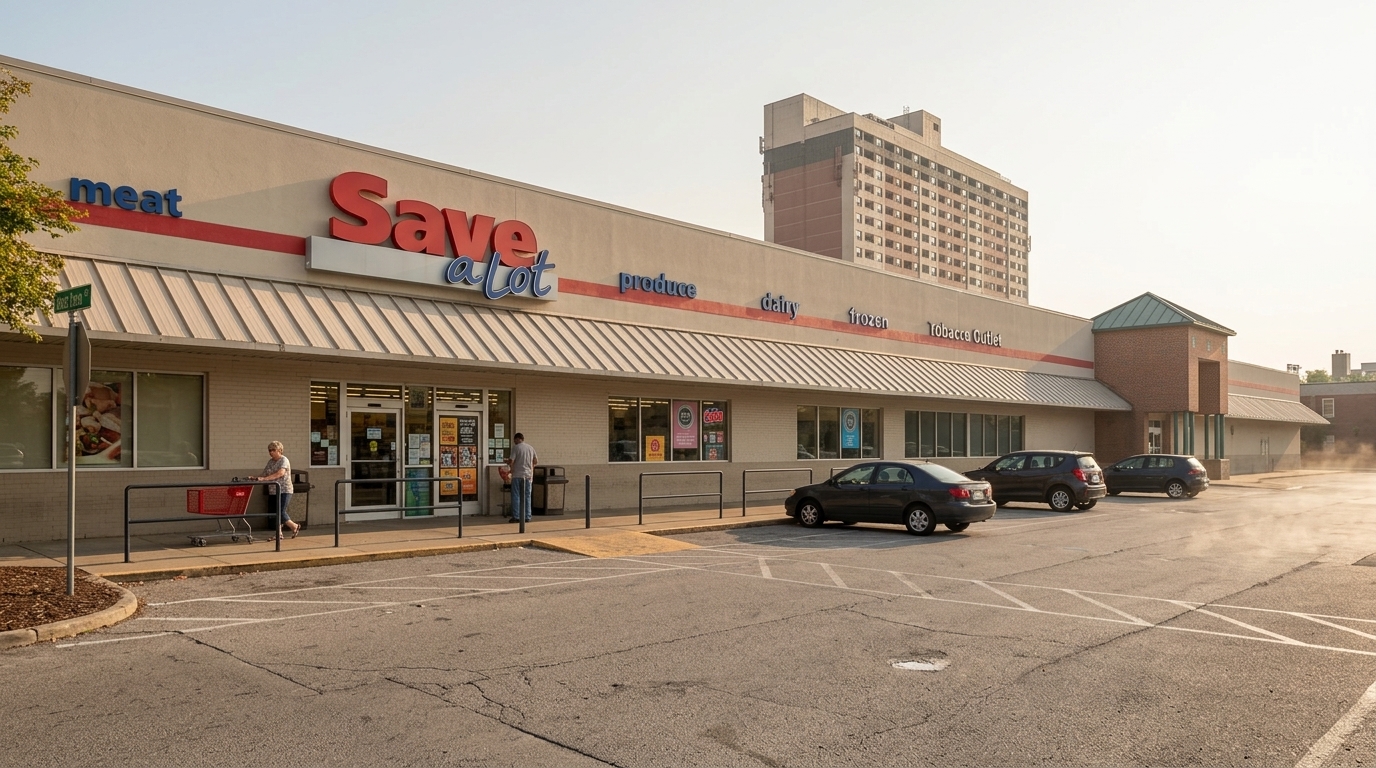
Save A Lot was founded in 1977 by Bill Moran as an alternative to larger supermarkets, with the first store opening in Cahokia, Illinois. Moran remained with the company until his retirement in 2006. The chain is headquartered in St. Ann, Missouri, in Greater St. Louis. At the root of the company’s growth strategy is its licensee relationship, in which Save A Lot acts as a wholesaler to its independent store owners as opposed to a franchisor.
Save A Lot operates as a hard-discount grocer with a limited-assortment model designed to serve value-conscious shoppers, particularly in neighborhoods overlooked by larger chains. A typical Save A Lot store is 15,000 square feet with items displayed in their cardboard shipping boxes. Stores carry most grocery products, with an assortment of fresh, canned and frozen produce, meat, meal products, household items and everyday groceries. Save A Lot grocery stores sell national brands and private label brands at a discounted price.
Retail Formats and Where It Operates
Save A Lot has about 720 independently owned and operated stores across 32 states in the United States. The stores focus on efficiency and low prices rather than broad selection. The limited assortment of 3,000 SKUs (stock-keeping units) allows the company to provide customers with better value for their money. Unlike traditional franchises, the licensing model means independent operators manage day-to-day operations while Save A Lot provides wholesaling support, supplies, and brand infrastructure.
The chain has experimented with specialized concepts. Save A Lot entered into a licensing affiliation with Hispanic grocer Rafael Ortega to rebrand six former Save A Lots in Houston, Texas, and South Texas as “El Ahorro Save A Lot,” featuring Save A Lot product offerings along with more traditional Hispanic staples. In late 2010, Rite Aid became a licensed Save A Lot operator when it converted 10 of its existing pharmacies in the Greenville, South Carolina, area to co-branded “Save A Lot/Rite Aid” units. In 2026, the discount grocery chain relaunched its private-label Hispanic brand as La Tierra de Sabores, consolidating the retailer’s Tio Santi and Caracara private-label brands.
Company Background
In 1978, General Grocer Company expanded the company’s presence in the greater St. Louis area. Eventually, the store network grew to 30 stores by the end of the decade. In 1980 alone, Save A Lot added 50 stores in the Mid-South region and a warehouse in Jackson, Tennessee. Early growth relied on the limited-assortment format as an effective strategy for independent retailers competing against larger supermarkets.
In 1984, Save A Lot purchased 75 similar format Jewel T stores and two distribution centers from Jewel in Florida and Pennsylvania. In 1987, Save A Lot was purchased by St. Louis-based food retailer and wholesaler Wetterau Inc, then owner of former sister stores Shop ‘n Save. In 1994, both the Save A Lot and Shop ‘n Save banners became wholly owned subsidiaries of Supervalu Inc, one of the largest independent grocery wholesalers, and the owners of Cub Foods and Scott’s Food & Pharmacy at the time.
Save A Lot expanded into Southern California with the purchase of 21 discount-grocery Sav U Foods stores and a distribution center from the Fleming Companies in late 1996. In 2002, Save A Lot acquired discount variety store chain Deals with 45 stores in the Midwest. The typical Deal$ store had a slightly smaller footprint than Save A Lot and carried mostly non-food merchandise at dollar-increment price points. The Deal$ concept was expanded under Save A Lot to 138 stores by 2006. In 2006, Save A Lot sold Deal$ to Dollar Tree for $30.5 million plus inventory.
In late 2009, newly hired Supervalu CEO Craig Herkert announced the goal to double the Save A Lot grocery store network to 2,400 locations within five years. The company opened nearly 100 stores in 2010 with a major focus on the Southeastern United States. In 2015, the company began expansion to California and Nevada, but by early 2017, announced it would be shuttering all of its California and Nevada locations.
Ownership, Structure and Financial History
In October 2016, Supervalu Inc. agreed to sell its Save-A-Lot grocery business to Canada’s Onex Corp. for $1.37 billion in cash. In April 2020, Save A Lot completed a recapitalization of the business with the company’s lenders that canceled approximately $500 million in debt and provided a $350 million capital infusion to the company. Save A Lot is privately held by institutional investors.
In early 2020, Save-A-Lot began a financial restructuring towards a wholesale model in order to reduce its debt load. It sought to no longer operate its locations and instead license them off to independent retailers. The discount grocer re-licensed its remaining 18 company-operated stores, finalizing its ongoing strategy to shift ownership and operations of all Save A Lot locations to independent, licensed ownership. The stores were acquired by Leevers Supermarkets, a current Save A Lot retail partner with 29 locations in markets including Denver and Philadelphia. Based in Castle Rock, Colorado, the grocer continued to operate the stores under the Save A Lot banner.
Product Range and Store Brands
Save A Lot offers more than 50 high-quality, low-priced private brands. The award-winning private label brands are part of the everyday low pricing (EDLP) strategy and low-cost service model that delivers savings over that of other supermarkets on both private label and national brand products. In many cases, private label has twice the margins as national brands.
About 70% of Save A Lot products are store brands and 30% name brands, compared to more than 90% store brands at Aldi. Notable private labels include Coburn Farms (dairy), J. Higgs (snacks), Kurtz (condiments), Ginger Evans (baked goods), and Farmington (meat products). Save A Lot launched a new label line in its pet food category with seven new SKUs of dry food for cats and dogs.
Market Position and Competition
Save A Lot competes in the hard-discount grocery segment dominated by Aldi, Lidl, and other value-focused retailers. The company’s licensee model distinguishes it from competitors that operate company-owned stores. Save-A-Lot was sold by Supervalu in late 2016 to Onex Corporation, and they brought in Kenneth McGrath, former CEO of Lidl, Aldi’s main competitor in the European market. McGrath replaced Save-A-Lot’s last CEO Eric Claus in April 2017. The limited-assortment format and focus on underserved communities remain central to the chain’s positioning.
Notable Developments and Outlook
Save A Lot reopened 27 of its branded stores in Indiana, Ohio, and Pennsylvania after a failed rebranding of the stores in 2024. The stores were rebranded in late 2024 using brands such as Value Food Market or Value Foods Market, but were returned to the Save A Lot brand. The stores once again offer customers Save A Lot’s outstanding value on an assortment of fresh, affordable, healthy foods along with 50+ high-quality, award-winning private label brands.
In its official Save A Lot 2025 Business and Social Impact Report published on May 28, 2026, the company reported operating approximately 650 stores in 29 states. The reduction reflects the challenging operating environment for independent licensees facing rising labor and rent costs, as well as intensifying competition from well-capitalized discount chains. Despite these pressures, Save A Lot continues to pursue expansion in underserved markets and remains committed to its mission as a neighborhood discount grocer serving value-conscious shoppers.
Leave a Reply