
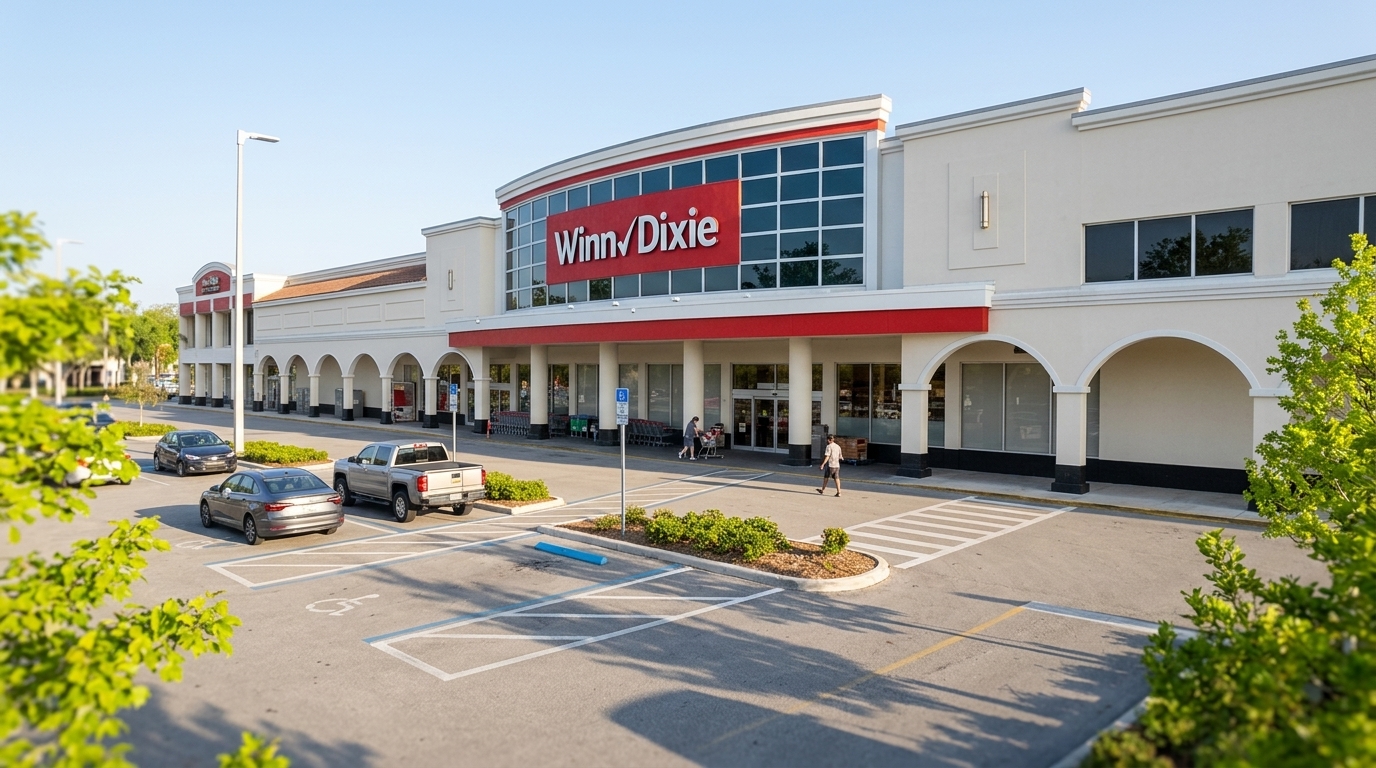
Winn-Dixie is a supermarket chain headquartered in Jacksonville, Florida, serving communities throughout five southeastern states: Alabama, Florida, Georgia, Louisiana, and Mississippi. Known as “The Beef People” throughout its history, the chain has built brand identity around its private label Chek soft drinks, offered in more than 20 flavors. Founded in 1925, the company operates both grocery stores and liquor stores and competes in a market dominated by larger national chains and discount operators, focusing on regional market presence and customer loyalty.
Winn-Dixie has undergone profound transformation since its founding. The chain was built up by William Milton Davis and his sons Artemus Darius Davis, James Elsworth Davis, Milton Austin Davis and Tine Wayne Davis. After emerging from bankruptcy and facing years of contraction through the 2000s and 2010s, the company was folded into a larger parent holding in 2012. In August 2023, Southeastern Grocers entered into an agreement to sell 400 Winn-Dixie and Harvey’s Supermarkets stores to German supermarket chain Aldi Süd, with the deal completed in March 2024. On February 7, 2025, Aldi sold the company with 170 Winn-Dixie stores and 170 liquor stores to a private consortium of investors that include C&S Wholesale Grocers. As of January 2026, Winn-Dixie lists operations in Florida, Alabama, Louisiana, Georgia, and Mississippi, though the chain is expected to fully exit markets outside of Florida and southern Georgia by 2027.
Retail Formats and Where It Operates
Winn-Dixie operates grocery stores and liquor stores across five southeastern states. The chain’s store portfolio has contracted substantially from its peak. Winn-Dixie will continue to run approximately 220 stores from the Aldi sale until each location is converted to the Aldi format with completion expected by 2027, while also operating about 170 Winn-Dixie and liquor stores following the February 2025 consortium purchase. Under the recent strategic shift, the company continues to operate stores in South Georgia locations including Brunswick, Folkston, Lake Park, St. Simons Island, and Valdosta, alongside its primary Florida footprint.
The company operates liquor stores as standalone or grocery-adjacent formats, representing a significant portion of its current footprint. The Winn-Dixie Company will operate around 130 traditional grocery stores and 140 freestanding and grocery-adjacent liquor stores across Florida and southern Georgia. Store modernization efforts have been ongoing, with dozens of store remodels and new store projects focused on modernizing stores and improving customer experience by making them “community-centered.”
Company Background
In 1925, William Davis borrowed $10,000 from his father and moved to Miami, Florida, where he purchased the Rockmoor Grocery. In 1927, the company was renamed Table Supply, and four more stores were opened. In 1931, the Davis family bought the Lively Stores chain for $10,000, to create a chain of 33 Table Supply stores across Florida from Miami to Tampa. William Milton Davis died in 1934, leaving his four sons in charge of the company.
Founded by William “Bill” Lovett in 1928, the Winn & Lovett Grocery Company had expanded to 78 stores in Florida and Georgia when Lovett convinced Table Supply to acquire 51% of his company’s stock in 1939. As a result, the Winn & Lovett became the company’s new moniker and in 1952 it became the first Florida industrial corporation to be listed on the New York Stock Exchange.
The company changed its name to Winn-Dixie Stores Inc. in 1955 after acquiring the Dixie Home Stores chain. With the 1955 merger with Dixie Home Stores of Greenville, South Carolina, which operated 117 stores, Winn-Dixie broke into the top ten supermarket chains and from the mid-1950s through to the mid-1960s was the most profitable company in the industry. The company expanded further westward in August 1976 with the purchase of Fort Worth-based Kimbell Inc., owners of the Buddies, Hagee, and Foodway chains in Texas, Oklahoma, and New Mexico.
The Federal Trade Commission forbade Winn-Dixie from acquiring any retail grocery stores in the United States for ten years, a constraint that limited growth but allowed the company to strengthen existing operations. The over-700-store Winn-Dixie operation extended its reach to the Bahamas, acquiring the eleven-store City Meat Market chain from Sir Stafford Sands in May 1967. Winn-Dixie operated 12 stores through its domestic subsidiary, W-D (Bahamas) Limited, until it sold the chain to Bahamian investors in 2006.
At its peak around 1987, the Winn-Dixie empire included almost 1,300 stores and over $9 billion in gross revenue, making it the fourth-largest grocery chain in the country. In April 2004, Winn-Dixie announced the closure of 156 stores and the elimination of 10,000 jobs, including the 21 stores that had operated under the Thriftway name in and around Cincinnati. On February 22, 2005, Winn-Dixie filed for bankruptcy. Winn-Dixie filed for bankruptcy in 2005, announcing the sale or closure of 326 stores and the reduction of more than 22,000 jobs. On November 9, 2006, Judge Jerry A. Funk approved Winn-Dixie’s plan of reorganization. Under the plan, Winn-Dixie obtained financing to support the company, as it made the changes necessary to compete effectively.
Lone Star Funds added Winn-Dixie to its BI-LO portfolio in 2012 for $560 million. The merger was completed in March 2012, making Winn-Dixie a subsidiary of Bi-Lo Holdings. The combined company operated 750 stores in seven southeastern states, employing approximately 63,000 team members. The merged company moved its headquarters from BI-LO’s base in Mauldin, South Carolina to Winn-Dixie’s former headquarters in Jacksonville. In May 2015, Bi-Lo Holdings changed its name to Southeastern Grocers.
Southeastern went through a prepackaged Chapter 11 bankruptcy reorganization in 2018, with a group of investment funds taking control of the company. In May 2018, Southeastern Grocers’ restructuring plan was confirmed by a U.S. Bankruptcy judge in Delaware. At the end of that month, Southeastern Grocers announced that it had completed its financial restructuring and was emerging from bankruptcy. Southeastern Grocers exited bankruptcy with 575 stores in seven states, down from 704 locations.
Ownership, Structure and Financial History
Winn-Dixie was listed in the S&P 500 and had been traded on the New York Stock Exchange under the ticker symbol “WIN” since February 18, 1952, prior to filing for Chapter 11 bankruptcy in 2005. The company was then traded under the symbol “WINN” on the NASDAQ before its purchase in 2012. In September 2013, Southeastern Grocers was created by Lone Star Funds as the new parent company for BI-LO, Harveys, and Winn-Dixie.
Grocery retail operates on thin margins dependent on high volume sales. The industry’s structural economics—typically 2–3% margins on regular food items—intensified competitive pressure as supercenters and discount chains expanded in the 1990s and 2000s. The eighties and nineties proved rough for the grocery industry, and Winn-Dixie was severely impacted. With their all-in-one superstores, the Wal-Marts and Costcos of the world created pressure on the top end. Convenience stores like 7–11 were eating away at the small neighborhood store model. The increasing competition was a double-whammy: it ate away at Winn-Dixie’s customer base and created a race-to-the-bottom pricing environment.
Winn-Dixie responded by closing its less profitable locations and spent $650 million consolidating others into larger Marketplace stores with more specialty foods and pre-cooked items. In 2011, Winn-Dixie embarked on a program to “transform” selected stores among the 484 it operated in the five states of Florida, Georgia, Alabama, Mississippi and Louisiana.
Product Range and Store Brands
In 1956, Winn-Dixie introduced its first private label brand, Deep South. Since then, it has run over 60 brands, including Crackin’ Good, Astor, Fisher, Superbrand, Thrifty Maid, Chek, and W-D Brand. In 2003, the company cut the number down to a three-tier system of brands: the “Prestige” brand for upscale private label products, “Winn-Dixie” for its mainstream items, and “Thrifty Maid” for its value items.
In 2007, all three brands received redesigned packaging with plans to replace the “Prestige” brand with “Winn & Lovett”. In 2010, Winn-Dixie replaced its value-centered brand Thrifty Maid with Valu Time. Valu Time was replaced with Clear Value in 2012. Beginning in 2016, SE Grocers began to transition to a unified private label brand under the “SE Grocers” brand, including SE Grocers Essentials for budget buys, SE Grocers for mid-market items, and SE Grocers Prestige for higher-end offerings. In July 2023, SE Grocers announced a new clean label called Know & Love. Other brands used by the company include TopCare, Fisherman’s Wharf, Whiskers & Tails, Chek, Tippy Toes, Hickory Sweet, and WD Brand.
Winn-Dixie launched the Customer Reward Card program in 2002. The chain has offered online ordering and delivery services through various digital initiatives, though these offerings have evolved as the company’s footprint changed.
People and Workplace
Because the Davis family believed W.M.’s death could have been prevented with better medical care, the family began a relationship with the Mayo Clinic, which continues today. After reading Booker T. Washington’s Up From Slavery, J.E. Davis began his support of black colleges, and through the subsequent years, Winn-Dixie supported Bethune-Cookman College, the National Council of Negro Women, Rust College, Florida Memorial College, the Tuskegee Institute, and many others.
The American Cancer Society/Winn-Dixie Hope Lodge opened in Gainesville, Florida in 1985, where people with cancer could stay without cost while receiving outpatient treatment. The initiative received the Presidential Award for Private Sector Initiatives the following year. Two more American Cancer Society/Winn-Dixie Hope Lodges opened in Miami (1993) and Atlanta (1998).
Market Position and Competition
Winn-Dixie has historically competed against larger national chains and regional grocers across the Southeast. By the early 2000s, competitive pressures from Walmart superstores and other discount formats had eroded the chain’s market share. The company’s contraction reflected broader industry trends affecting traditional supermarket operators in an era of consolidation and format innovation.
In 2020, Southeastern Grocers announced it would discontinue the Bi-Lo brand. The shift consolidated operations under fewer banners, reflecting the company’s efforts to streamline after its 2018 bankruptcy emergence.
Notable Developments and Outlook
In October 2025, Southeastern Grocers announced it was shedding most of its stores outside Florida to focus on its home state, having reached agreements or advanced plans with multiple grocers to take 32 Winn-Dixie stores and eight Harveys Supermarkets in Alabama, Georgia, Louisiana and Mississippi. The parent company of Jacksonville-based grocery chain Winn-Dixie announced on January 21, 2026, that its name changed to The Winn-Dixie Co.
The Jacksonville, Fla.-based grocer officially became The Winn-Dixie Company, aligning the regional grocer with its most well-known grocery banner, a move the company first signaled in October. The Winn-Dixie Company will focus on growing through targeted acquisitions and new store investments, some of which are already underway, with acquisitions playing a prominent role in this next growth period.
Southeastern Grocers finalized an agreement to acquire Hitchcock’s Markets’ three stores, located in Alachua, Keystone Heights and Williston, Florida. Those stores will be converted to the Winn-Dixie banner format, with the Williston storefront slated to reopen in December while the other two will debut by summer 2026. The company is also growing its private label assortment, testing customer convenience options such as third-party powered delivery and return kiosks, and expanding its liquor store portfolio with innovative formats.
Leave a Reply