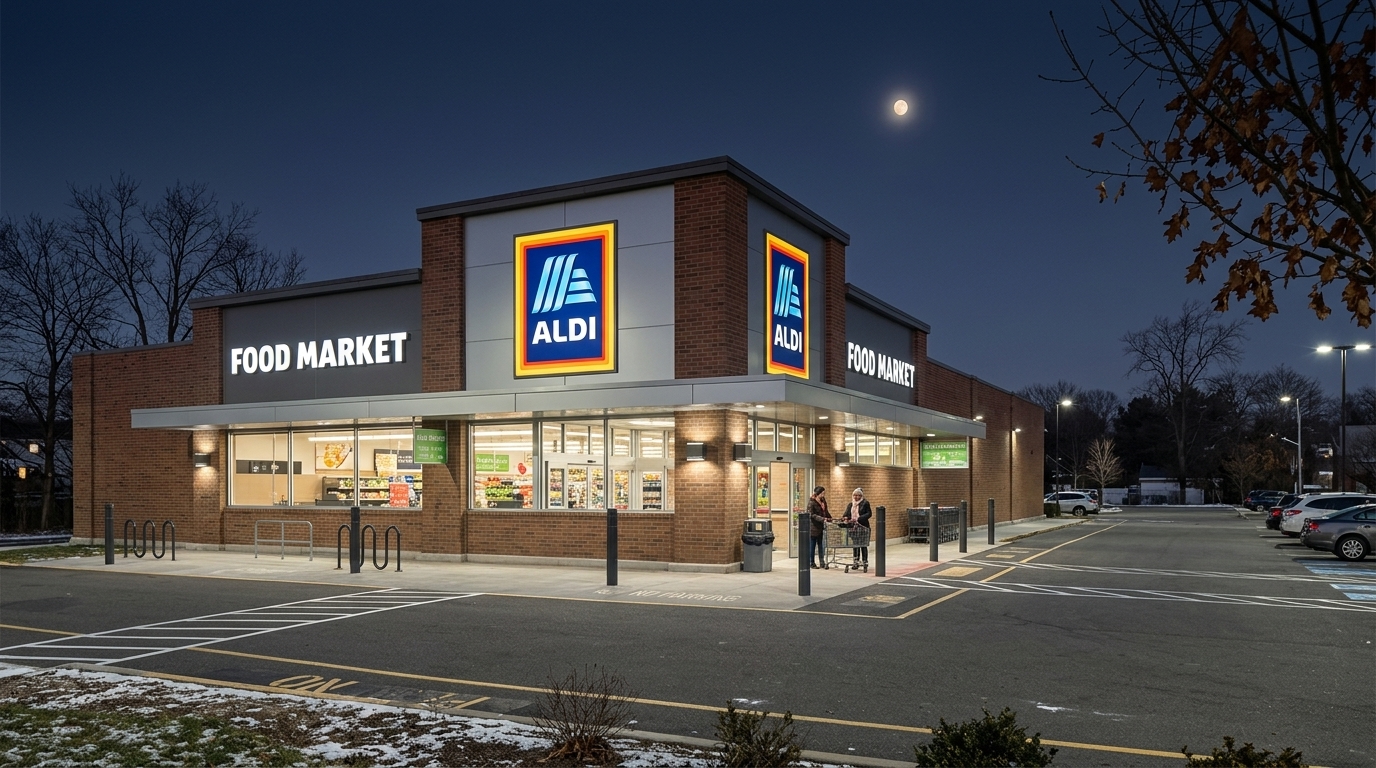
Aldi began as a small grocery store opened by Anna Albrecht in Essen, Germany, in 1913, and after World War II her sons Karl and Theo Albrecht took over the business, officially founding Albrecht KG in 1946. The brothers expanded rapidly by focusing on a no-frills, discount model—offering only essential, non-perishable goods at low prices and avoiding unnecessary expenses like advertising or store decor. Aldi entered the U.S. market with its first store in Iowa in 1976. The chain has built its American presence on a consistent discount-driven philosophy, featuring limited product selections dominated by private labels, minimal store amenities, and streamlined operations designed to keep prices exceptionally low.
Aldi USA operates as a subsidiary of Aldi Süd, the southern division of the German company that split into two independent groups in the 1960s. Aldi remains family-owned, never having gone public, and is credited with reshaping supermarket pricing and competition worldwide. Headquartered in Batavia, Illinois, the chain has become one of the fastest-growing grocery retailers in the country, known for expanding store counts rapidly while maintaining the efficiency and cost discipline that define the discount grocery model.
History
Aldi was slow to expand beyond Germany, not opening its first international store until 1968 in Austria. The company’s American debut was methodical. In late March of 1976, a Giant Food store in the Kmart Plaza in Iowa City, Iowa abruptly closed for renovation, and a little more than three weeks later, the store reopened as the first Aldi in the United States. The debut store carried just 450 items with prices for every one printed on paper sheets customers could take with them as they shopped, and included no refrigeration equipment or freezers, so perishables were limited to onions, potatoes, bread and margarine.
Theo Albrecht died in 2010 with an estimated fortune of $16.7 billion, and his brother Karl passed away in 2014 with an estimated net worth of $23.14 billion. The brothers retired as CEOs in 1993, and control of the companies was placed in the hands of private family foundations, the Siepmann Foundation (Aldi Süd), and the Markus, Jakobus, and Lukas Foundation (Aldi Nord).
Aldi Süd revealed expansion plans in 2015, and it expanded into the Southern Californian market. Reports in August 2019 stated that the company was in the process of using a $3.4 billion investment to expand to 2,500 stores in the country by the end of 2022, and also invested an extra $1.6 billion to renovate 1,300 of its US stores.
In August 2023, Aldi Süd agreed to acquire about 400 Winn-Dixie and Harveys Supermarket locations across the southeastern United States, completing the acquisition on 7 March 2024. In February 2025, Aldi sold 170 of the stores back to Southeastern Grocers in a deal involving its former leadership and C&S Wholesale Grocers, and at the same time said it would still convert around 220 Winn-Dixie and Harveys locations to its own format by 2027.
Operations & Footprint
Aldi Süd expanded to the United States under the Aldi banner, having expanded throughout the Eastern and Midwestern US. In 2024, Aldi opened nearly 120 stores, which increased its US store count to more than 2,400. By October 2024, 2,428 Aldi Süd stores were in 39 US states. In 2026, Aldi will enter Maine as its 40th state in the U.S., opening in the city of Portland, and is announcing expansion plans into the state of Colorado within the next five years, with more than 50 stores planned for Denver and Colorado Springs markets.
The company operates a lean, efficient structure. Aldi differentiates itself with roughly 10,000-square-foot stores — compared with Walmart supercenters averaging 178,000 square feet — and a limited assortment dominated by private labels, which account for more than 90% of its products and sales. Groceries ordered online could be delivered to homes in the areas covered by 95% of stores in the US, provided in conjunction with Instacart.
Products, Services & Merchandising
Stores feature a small and functional layout with zero-frills attached – there is no background music, no major promotions, and no coupons, and Aldi stores do not offer meat counters, bakeries, pharmacies, or liquor. Their focus is to offer a limited selection of products, 90% of which are private labels, which allows them to keep prices very low for the consumer.
In September 2024, ALDI unveiled its largest packaging refresh to date, putting its name on every product and launching its first-ever namesake brand to make its trusted private labels even more recognizable for shoppers, in direct response to customer feedback. Several brands were replaced with the ALDI name, while iconic brands like Clancy’s, Simply Nature and Specially Selected remained on shelves with modernized branding and the bold “an ALDI Original” endorsement.
Another quirk of Aldi stores is the coin customers have to pay to get a cart, though they get it back when they return it, and customers also bag their own groceries. These practices reduce operational costs and are passed on to customers through lower prices.
Work Environment & Employment
Aldi’s company-wide minimum wage is $18 per hour for store associates as of 2024, making it one of the highest minimums in the grocery sector. In September 2024, Aldi said the new starting wage for store employees would be $18 an hour, and the new starting wage for warehouse workers would be $23 an hour. Aldi’s staffing model is deliberately lean — stores run with fewer employees than comparable grocery chains, which means each associate handles more responsibilities, and this structure drives both the higher pay and the physically demanding nature of the work.
Aldi employees who work at least 30 hours a week have access to benefits like health insurance and paid time off. Full-time employees receive up to six weeks of 100% paid parental leave, and can benefit from up to ten days of 100% paid caregiver leave to tend to the serious medical needs of a family member. 70% of assistant store managers and over 30% of store managers started as store associates at ALDI, and all executive leaders started their careers in an ALDI store.
Business Model & Financial History
Aldi’s competitive strategy is cost leadership, which entails low business costs and the ability to offer low and competitive selling prices. It improves operations and reduces overhead by offering a limited selection of top-quality private-label products, and aims to pass savings directly to its customers through minimal staffing, small store sizes, efficient supply chains, and more. Aldi displays products in their original cardboard shipping boxes, rather than stacking them individually, to save employees time stocking shelves.
The business model relies on inventory efficiency and rapid turnover. By stocking only a curated selection of essential items rather than thousands of SKUs, Aldi minimizes waste, simplifies logistics, and negotiates more favorable pricing with suppliers. This approach creates a profitable discount model despite razor-thin margins on individual transactions. Aldi remains family-owned, never having gone public.
Competitive Landscape
Walmart is the nation’s largest grocer by market share with 21%, according to market researcher Numerator, followed by Kroger, Costco, Albertsons and Publix to round out the top five. Aldi has 2.8% of U.S. market share, according to Numerator data. Despite its smaller overall market share, the chain has gained outsized competitive influence by forcing price competition across the industry.
Aldi’s store visits rose 8% year over year in 2025 from the prior year, compared with Costco’s 5.9% growth, Albertsons’ 1.6% increase, Kroger’s 0.8% rise and Walmart’s 0.5% growth. A September survey of 1,635 shoppers by AlixPartners found that the share of grocery spending going to traditional supermarkets declined across all key groups compared to 2024, with sharper decreases among households earning more than $100,000 annually and shoppers aged 25 to 34.
Aldi and Trader Joe’s are named as competitors, with stores that look similar in being private-brand-focused businesses, and Aldi and Lidl share similarities in being discount-focused retailers with a heavy focus on private brands.
Recent Developments & Outlook
In March 2024, Aldi said that it is planning to invest over $9 billion and open 800 new stores in the United States by the end of 2028. By the end of 2026, ALDI will operate a total store count of nearly 2,800, pushing it closer to its goal of 3,200 stores by the end of 2028.
In 2026, Aldi will continue its Southeast expansion by converting close to 80 Southeastern Grocers locations to the ALDI format, and in the Phoenix market the grocer will open 10 new stores in 2026, with plans to add a total of 40 new stores in the market by the end of 2030. Aldi will strengthen its already strong presence in the Northeast and Midwest, adding nearly 330 stores across both regions by the end of 2028.
The growth plans are the company’s answer to sustained demand for its simple, affordable shopping experience, with 17 million new customers visiting stores in 2025. Customers line up hours before grand openings, fans proudly wear head-to-toe ALDI gear, and loyal shoppers share product recommendations in dedicated Facebook groups, some with more than 3.8 million members.
Leave a Reply