
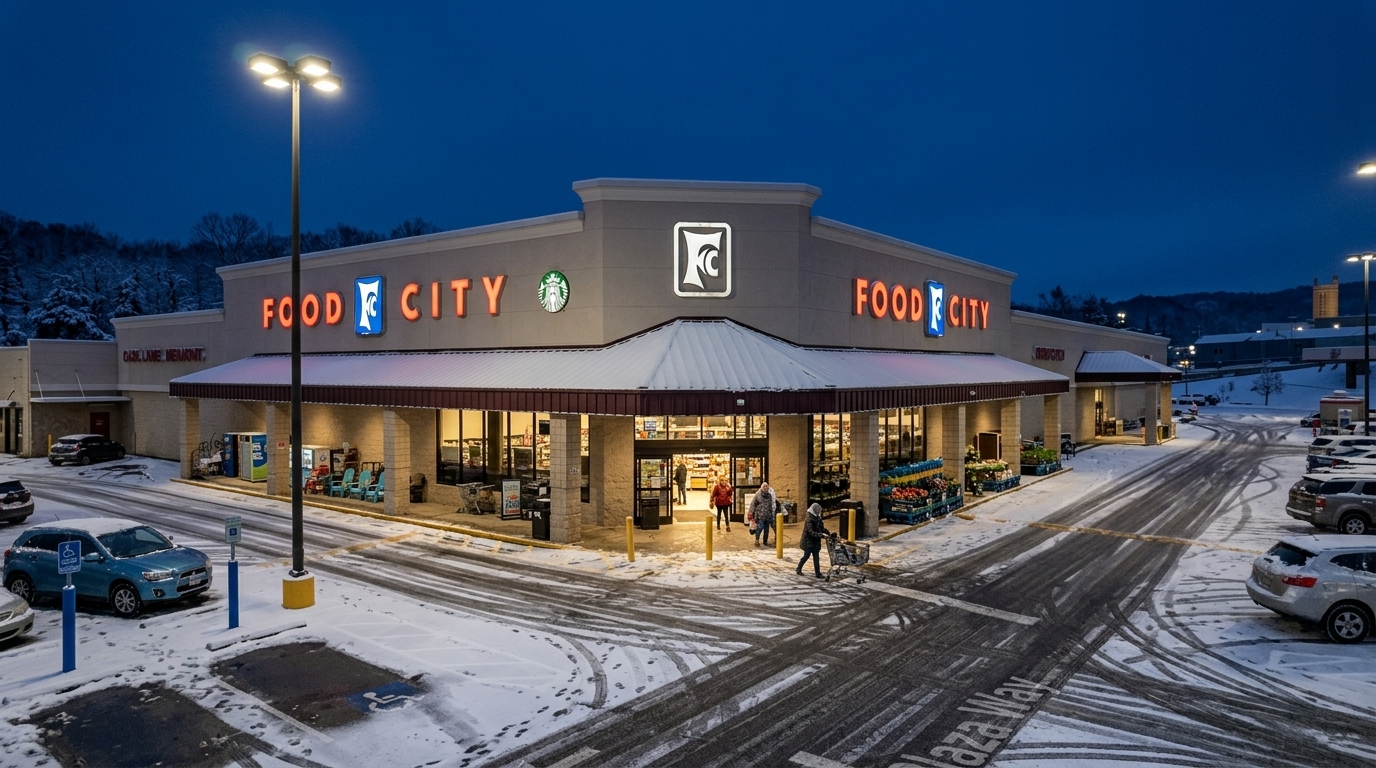
Food City traces its banner back to 1918, when a store opened in Greeneville, Tennessee, but K-VA-T Food Stores was founded in 1955 when Jack Smith opened his first Piggly Wiggly store in Grundy, Virginia, accompanied by his father Curtis, cousin Ernest, and uncle Earl. The company’s name derives from its original service area of Kentucky, Virginia, and Tennessee. In 1984, Jack Smith purchased Quality Foods, a 19-store chain operating under the Food City banner, which doubled the company’s size and led the Smiths to adopt Food City as the company banner for all stores going forward. K-VA-T Food Stores, Inc. is a privately held family and employee-owned corporation, with approximately 13% held via an employee stock ownership plan, and is headquartered in Abingdon, Virginia. Steven C. Smith, son of founder Jack C. Smith, serves as President and CEO, having joined the company in 1979 and assumed the CEO role in 2001. The company remains independent and debt-light, relying on internal reinvestment and its employee ownership structure to support growth rather than external equity financing.
Retail Formats and Where It Operates
Food City operates across five states in the Appalachian and Southeastern United States: Alabama, Georgia, Kentucky, Tennessee, and Virginia. The chain concentrates its presence in rural and mid-sized markets across the region. The company operates 18 locations in southeastern Kentucky, 28 in southwest Virginia, 98 in east Tennessee, 10 in north Georgia, and 4 in Alabama as of its last-reported store breakdown.
K-VA-T Food Stores owns the Food City Distribution Center, a facility K-VA-T helped form in 1974 and acquired full control of in 1998, as well as Misty Mountain Spring Water, LLC, a producer of bottled water. The distribution center supports efficient delivery to remote mountain communities. The broader K-VA-T portfolio totals 161 retail units, including 141 Food City supermarkets, along with pharmacies, fuel centers, and other formats as of November 2025.
Beyond the flagship Food City supermarkets, K-VA-T operates limited-assortment grocery stores named Super Dollar Food Center, Food City Express convenience stores, and Gas’N Go fuel-focused convenience stores, as well as Food City Wine and Spirits liquor stores. In April 2022, K-VA-T announced plans to join the Ace Hardware family of stores by launching Curt’s Ace Hardware locations, with the first opening in Bristol, Virginia in June 2022. K-VA-T operates approximately 12 Curt’s Ace Hardware stores, often co-located or adjacent to Food City supermarkets.
Company Background
In 1963, Jack Smith added a second Piggly Wiggly store in South Williamson, Kentucky, followed by a third location in Pikeville, Kentucky in 1965, and a store in Prestonsburg, Kentucky in 1967. During the late 1950s and 1960s, the company pursued organic expansion by opening additional stores in Virginia and eastern Tennessee, transitioning away from the Piggly Wiggly banner toward independent full-service grocery operations that prioritized comprehensive selections of fresh produce, meats, and household staples, often incorporating locally sourced items.
By the 1970s, the company had reached approximately 11 stores through new openings and modest acquisitions of local Piggly Wiggly sites in southwest Virginia and eastern Kentucky. When Jack Smith purchased Quality Foods in 1984, he needed to build significant infrastructure after more than doubling store count from about 4 to 14 stores and later beyond, adding management and back office support.
In 1989, K-VA-T significantly expanded by acquiring 43 White Stores locations primarily in the Knoxville, Tennessee market, more than doubling the company’s size from approximately 40 stores to over 80 and enhancing distribution efficiency through the existing Mid-Mountain Foods center. In 1998, Food City acquired the 11-store Kennedy Piggly Wiggly chain as well as full control of Mid-Mountain Foods. In 1999, Winn-Dixie pulled out of the Knoxville market and sold seven stores to Food City.
In February 2006, Food City announced the purchase of eight BI-LO locations in Knoxville, Maryville, and Oak Ridge, Tennessee. In July 2015, Food City announced the purchase of 21 BI-LO locations in the Chattanooga, Tennessee market and eight BI-LO stores in Northern Georgia from Southeastern Grocers, with plans to invest over $40 million in capital improvements during the first year and install Gas’N Go fuel stations in as many locations as possible. An expansion into Alabama was marked in 2021 when a 54,000 square foot supermarket opened in Albertville on April 14.
In August 2022, K-VA-T announced plans to acquire the Cooke’s family of stores in the Greater Cleveland, Tennessee market area, including four Fresh n’ Low locations and the Cooke’s Food Store and Pharmacy in Tennessee along with one Fresh n’ Low location in Georgia. By January 2025, Food City had consolidated all of the Fresh n’ Low and Cookes stores into nearby, newly expanded Food City locations or had built larger Food City replacement stores. In October 2025, K-VA-T agreed to acquire three Winn-Dixie locations in the Birmingham, Alabama market, with plans to convert the stores located in Fultondale, Trussville, and Jasper to the Food City banner in early November 2025.
Ownership, Structure and Financial History
K-VA-T Food Stores, Inc. is a privately held family and employee-owned corporation headquartered in Abingdon, Virginia. The ownership of K-VA-T Food Stores has primarily remained within the Smith family since its inception, with the most significant shift occurring following the passing of Jack C. Smith, when his son Steven C. Smith took over leadership, ensuring continuation of the family’s control and vision.
The Smith family maintains majority voting control and strategic direction, while the ESOP Trust holds direct ownership for approximately 18,000 associates with an estimated stake of 12 to 18 percent, and there are no material institutional or private equity holders. Food City began offering an employee stock ownership plan nearly 40 years before 2023, and more than 12 percent of the company was owned by associates through the profit-sharing program. This hybrid ownership model has enabled the company to fund expansion through internal cash flow and reinvestment while maintaining family stewardship.
Grocery retail operates on thin margins, and Food City has historically competed by emphasizing value and service in underserved rural markets rather than pursuing scale-driven growth typical of national chains. Roughly 13 percent of the nearly $3 billion company is owned by employees, a fact that management attributes to the principle that “if you own something, you take a little better care of it”. This structure aligns employee interests with long-term sustainability and community commitment rather than quarterly earnings targets.
Product Range and Store Brands
Food City offers a wide variety of services ranging from in-store fresh baked goods, deli meats, cheeses, salads, and hot foods with large café seating areas to floral boutiques staffed with trained designers seven days per week, and full-service meat and seafood departments with hand-cut steaks, chops, and roasts. Gas N’ Go fuel centers at many locations offer competitive prices on top quality fuel and diesel.
Food City offers a full line of private label products, including Food Club, Food City Fresh, Full Circle Market, Wide Awake Coffee Co., Tippy Toes, Harvest Club, Paws Happy Life, Evolve, Over the Top, Nostimo, Crav’n, CharKing, Misty Mountain, Flock’s Finest, b-lieve, Simply Done, TopCare, Culinary Tours, That’s Smart, Pure Harmony, and more. Food City also carries a line of exclusive regional brand products, including Kern’s Bread, Kay’s Ice Cream, Lay Meats, Terry’s Snack Foods, and Moore’s Potato Chips.
A number of stores include national or local branch banks, offering ATMs and a full range of financial services. The company offers online shopping with curbside pickup in many locations, with orders filled by professional shoppers and loaded into vehicles upon arrival, food delivery powered by Instacart available at most locations for same-day delivery, and a partnership with DoorDash that offers on-demand grocery delivery and fresh floral arrangement delivery in participating stores. In November 2017, Food City opened its first in-store Starbucks in a newly built location in Athens, Tennessee, and as of April 2024, the company operates 60 Starbucks in-store locations.
People and Workplace
Approximately 11 to 12 percent of the company is owned by associates through their employee profit-sharing plan. The employee stock ownership plan represents a long-standing commitment to worker participation in company success, distinguishing Food City from many larger retail chains.
Workforce stability and community ties remain central to company culture. Katie Penny, granddaughter of Jack C. Smith and a third-generation grocer, holds the position of Executive Vice President of Store Operations for the Knoxville division, overseeing a substantial portion of the chain’s stores in east Tennessee, with prior roles as district manager in Chattanooga and recognitions such as Knox News 40 Under 40. Family leadership across generations reflects the succession strategy and commitment to long-term stewardship.
Market Position and Competition
Food City competes in highly fragmented rural and secondary market segments where national chains have limited penetration. The company initially targeted the rural Appalachian market by emphasizing low everyday prices on essential groceries to build loyalty in regions with limited retail options, establishing a reputation for affordability and convenience in underserved communities. This positioning remains central to the chain’s identity decades later.
The company faces structural pressures common to regional grocers: consolidation among national competitors, growth of e-commerce and discounters, and wage and supply-chain inflation. However, K-VA-T’s geographic focus on tight-knit communities with few competing supermarkets, its employee ownership structure, and its family ownership provide insulation from some competitive forces. The chain’s steady acquisition of distressed banners (White Stores, BI-LO, Winn-Dixie) demonstrates a capacity to integrate and stabilize underperforming assets in its core region.
Notable Developments and Outlook
In October 2008, K-VA-T opened its 100th store in Rogersville, Tennessee, commemorating the milestone by sending a special commemorative I-beam to every store in the company where employees signed it as a goodwill gesture, with the beam sitting above the entrance way in the 100th store. In October 2013, K-VA-T officially consolidated its corporate operations into a new headquarters building in downtown Abingdon, Virginia at 1 Food City Circle, a four-story, 140,000 square feet facility on 17 acres that incorporated parts of the old building.
In February 2020, The National Grocers Association named K-VA-T Food Stores and Food City as Outstanding Marketer at the 2020 NGA Creative Choice Awards. In June 2020, K-VA-T announced plans to expand into its fifth state with a 54,000 square feet supermarket in Albertville, Alabama, which opened on April 14, 2021.
Food City’s charitable initiatives have collectively returned over $107 million to local communities in the past decade through collaborations with nonprofits, including an annual School Bucks program that has awarded over $22.9 million to more than 1,000 participating schools, with the 2024-2025 school year distributing $800,000 and a similar amount pledged for 2025-2026. Community investment remains a defining strategic priority alongside retail operations.
Looking forward, Food City remains focused on geographic expansion within its core Appalachian region and measured modernization of the store base. Renovation efforts target approximately 20 percent of the fleet by 2026, incorporating modern delis, expanded fresh food sections, and digital technologies like enhanced curbside pickup systems. The chain’s growth strategy balances organic expansion, opportunistic acquisitions of distressed competitors, and digital service enhancement to compete with national players while preserving its identity as a locally rooted regional grocer.
Leave a Reply