
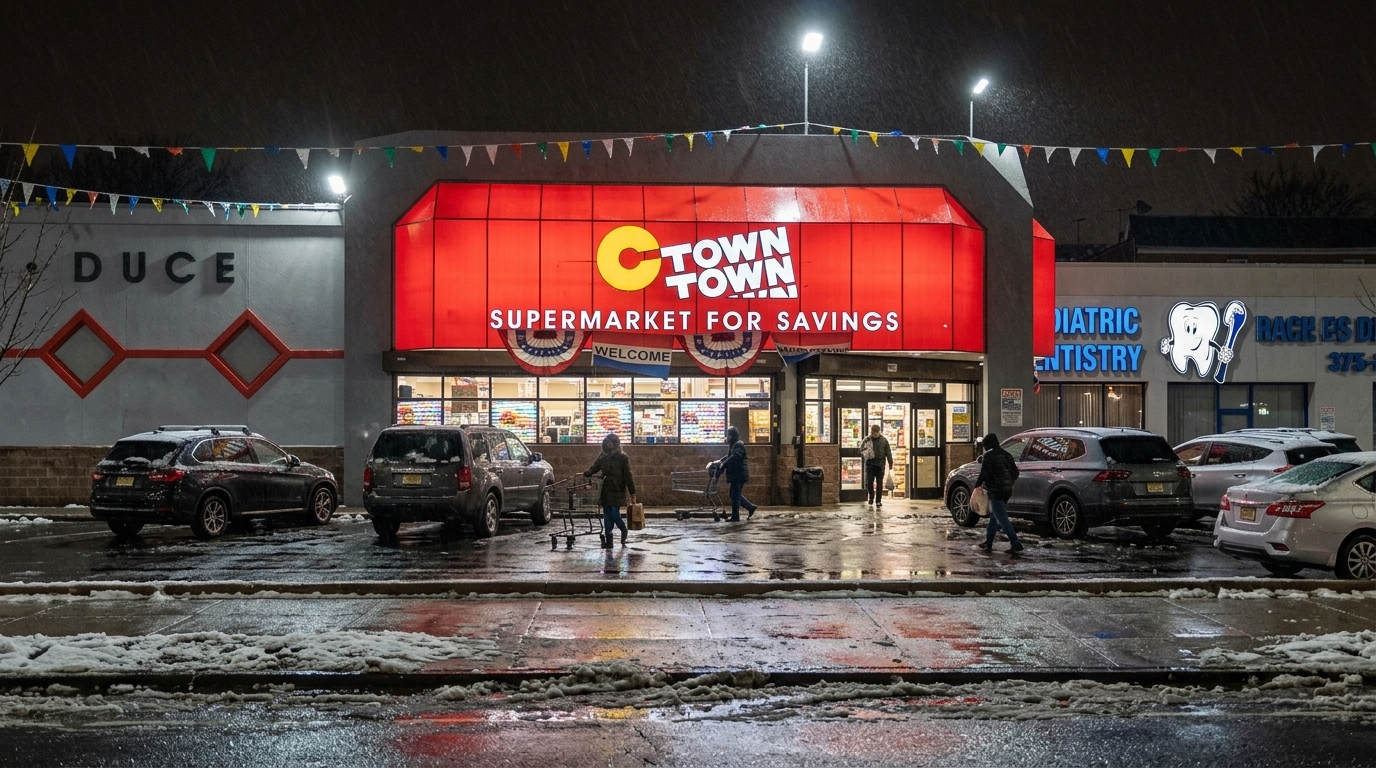
CTown Supermarkets is a chain of independently owned and operated supermarkets operating in the northeastern United States and in Amman, Jordan. The banner occupies a distinctive position in urban grocery retail, tending to open supermarkets in locations that suburban stores have abandoned, and depending heavily on customers who are pedestrians and fewer who drive, as shown by their smaller parking lots. CTown uses economies of scale so its small member stores can pool their resources for purchasing and advertising. CTown is the fifth-largest food retailer in the New York City metropolitan area.
The chain operates as a voluntary cooperative banner under the ownership and operational framework of Krasdale Foods, a wholesale grocer with deep roots in the region. There are approximately 200 stores in Connecticut, Massachusetts, New Jersey, New York, and Pennsylvania and 5 stores in Amman, Jordan. Individual CTown locations are independently owned and operated, allowing proprietors to customize merchandise to reflect their communities while benefiting from centralized purchasing, marketing, and distribution services.
Retail Formats and Where It Operates
CTown stores operate as neighborhood supermarkets in urban and inner-city areas, typically ranging from 16,000 to 27,000 square feet. The typical format includes produce and seafood sections, deli and bakery departments, meat counters, and frozen and grocery sections. Some locations feature prepared-foods bars, in-store cafes, and on-site bakeries. Most stores do not maintain expansive parking facilities, reflecting their pedestrian-oriented customer base.
The chain operates approximately 200 stores in Connecticut, Massachusetts, New Jersey, New York, and Pennsylvania and 5 stores in Amman, Jordan. New York represents the largest concentration, with the majority of locations in New York City’s five boroughs, particularly in Manhattan, the Bronx, and Brooklyn. A notable development occurred in September 2022 with the opening of the chain’s largest location in Scranton, Pennsylvania, a 27,000-square-foot facility featuring expanded departments for produce, bakery, and international foods to serve the local community more comprehensively. This growth continued in 2024 when CTown debuted Coatesville, Pennsylvania’s first full-service grocery store at 245 East Lincoln Highway, addressing long-standing food desert challenges in the city by providing fresh produce, a butcher counter, deli, bakery, and seafood sections tailored to residents’ needs.
Company Background
CTown was founded in 1975 as KTown as a move by Krasdale into retail operations, with the K standing for “Krasdale.” Under threat from Kmart, the company changed the store name to CTown. Krasdale Foods was founded by Abraham Krasne as a grocery business in 1908, and adopted its current company name in 1972, the same year it moved to its current location in Hunts Point, Bronx. In response to growing demand from independent operators for consistent merchandising and market support, Krasdale launched the CTown voluntary banner in the mid-1970s.
The early growth of CTown coincided with significant demographic shifts in New York’s urban neighborhoods. By 1992, approximately half of the chain’s 167 stores, primarily in the New York area, were owned by Dominican immigrants, reflecting the influx of first-wave migrants from the Dominican Republic during the 1980s who capitalized on opportunities in underserved urban neighborhoods. Ownership diversity mirrors the multiculturalism of New York City and surrounding regions, encompassing not only Dominicans but also individuals from Puerto Rican, Chinese, and Arab backgrounds.
From the 2000s onward, CTown consolidated its presence in urban and underserved markets as national chains retreated from inner-city locations due to profitability challenges. The banner expanded modestly beyond its traditional New York base, opening stores in New Jersey, Connecticut, Massachusetts, and Pennsylvania. In 2022, the opening of a 27,000-square-foot Scranton supermarket marked the chain’s most significant expansion into Pennsylvania. A year later, a Coatesville location addressed a local food desert.
Ownership, Structure and Financial History
CTown stores operate in partnership with Krasdale Foods, functioning as independently owned franchises within a cooperative structure. Individual store proprietors maintain operational autonomy while accessing Krasdale’s wholesale operations, purchasing power, and marketing support. Marketing and advertising for CTown are handled by Alpha-I Marketing Corp.
Krasdale Foods remains a family business; under second-generation leadership from Charles A. Krasne, who served as CEO for over 50 years until his death in March 2024, the company relocated its operations to Hunts Point in 1972, evolving from a traditional wholesaler into a comprehensive service provider that handles merchandising, procurement, logistics, and retail support for its customers. The cooperative model allows small independent grocers to compete with larger chains by pooling resources for purchasing and advertising while maintaining local control over product assortment and store operations.
Product Range and Store Brands
CTown is supplied by Krasdale Foods; many products sold in CTown stores are labeled Krasdale Foods. The company owns private label foods and items such as frozen pizza, ice cream, ice cream pops, napkins, cream cheese, bagels, and milk. CTown stores stock a broad range of national brands alongside Krasdale private-label products. Most locations emphasize fresh produce, meat, deli items, and bakery goods, with many featuring international and ethnic food selections tailored to neighborhood demographics.
The CTown format is particularly known for serving immigrant and minority communities with products reflecting local food traditions. Many stores carry extensive selections of Latin American, Caribbean, Asian, and Middle Eastern items, positioning them as important retail anchors in diverse urban neighborhoods. Stores typically offer online ordering and delivery options through partnerships with third-party platforms, though specific services vary by location.
Market Position and Competition
CTown is the fifth-largest food retailer in the New York City metropolitan area. The chain competes directly with other independent supermarket networks such as Key Food and Bravo, also supplied by Krasdale Foods, as well as regional and national chains including Stop & Shop, ShopRite, and discount retailers. CTown’s competitive advantage lies in its presence in urban neighborhoods where larger suburban-oriented chains have limited or no operations.
The banner differentiates itself through local ownership, community focus, and merchandise assortment customized to neighborhood demographics. Most CTown stores occupy former locations abandoned by larger chains, particularly in lower-income urban areas. This strategy has proven resilient; even as national retailers have consolidated, CTown has maintained its footprint by addressing the grocery needs of pedestrian-oriented, density-dependent communities.
Notable Developments and Outlook
CTown celebrated its 50th anniversary in 2025. Recent years have seen selective expansion beyond the traditional New York metro base, particularly in Pennsylvania. The Scranton location opened in 2022 as the chain’s largest facility, and Coatesville, Pennsylvania, received its first CTown supermarket in 2024, filling a documented food desert and offering comprehensive grocery services. These expansions reflect Krasdale’s strategy of scaling the CTown banner into secondary markets where independent grocers serve underserved populations.
The banner continues to face structural pressures common to independent grocery networks, including supply-chain complexity and competition from larger consolidated chains and e-commerce platforms. However, CTown’s focus on dense urban neighborhoods with high foot traffic and limited car ownership provides a defensible market position. The model remains relevant for independent entrepreneurs seeking to operate supermarkets under a recognized banner with centralized support, particularly in communities where corporate chains have determined the economics do not support investment.
Leave a Reply