
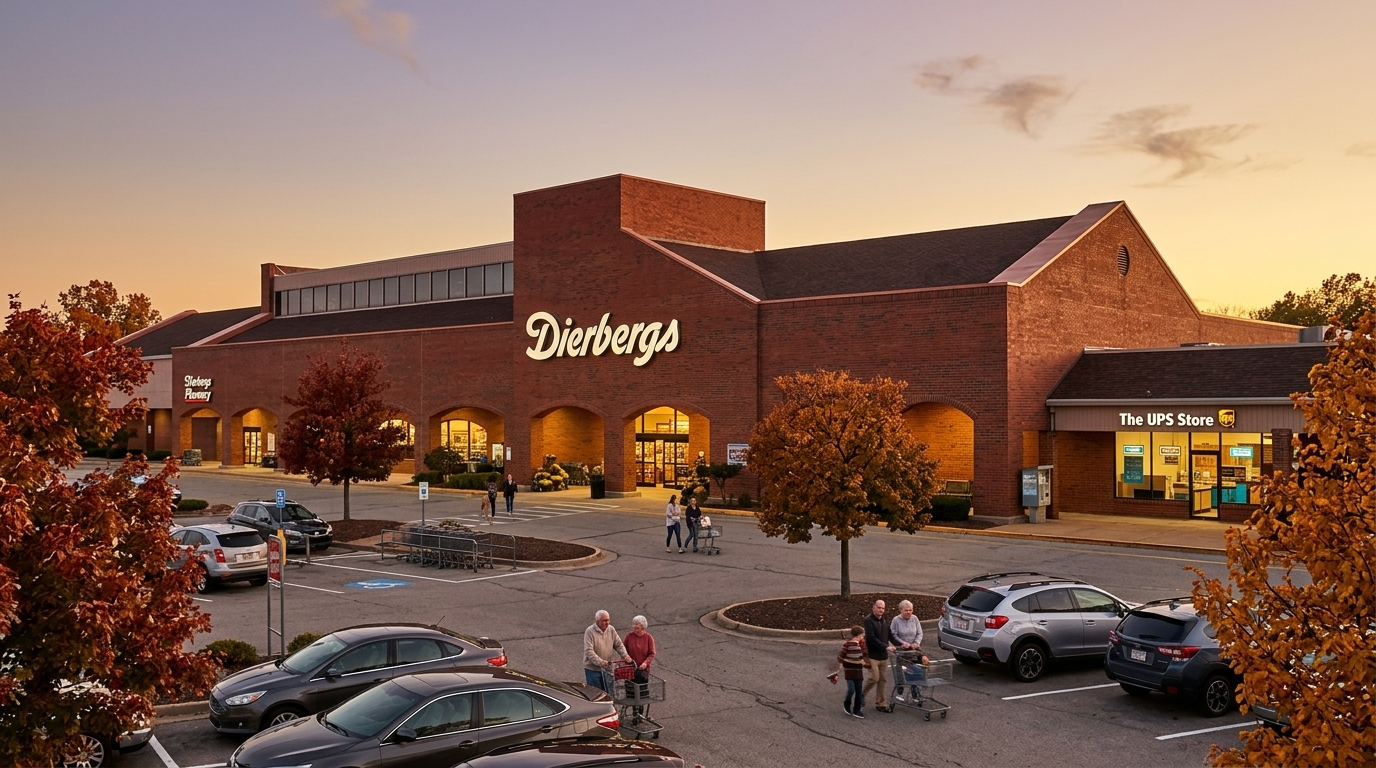
Dierbergs Markets is a supermarket chain based in Chesterfield, Missouri. It effectively splits the Greater St. Louis grocery market with Schnucks among locally based retailers. The chain operates upscale supermarkets, typically measuring about 70,000 square feet, known for their expansive produce sections and wide range of prepared foods. Stores are known for their expansive produce displays and wide selection of prepared foods made in the company’s 95,000-square-foot central kitchen and bakery. As a family-owned grocer concentrated in the St. Louis region with locations also in Illinois and Missouri’s Lake of the Ozarks, Dierbergs has maintained steady operations for over 170 years by emphasizing service, quality perishables, and merchandising innovation rather than rapid expansion.
The chain is family-owned by the Dierbergs, with a third generation now in charge and a fourth generation assuming leadership positions. Based in Chesterfield, Missouri, the company serves the greater St. Louis metropolitan area and surrounding regions through a careful, deliberate growth strategy focused on building customer loyalty and store excellence. The business model emphasizes prepared foods, specialty departments, and community engagement, setting it apart from larger national competitors.
Retail Formats and Where It Operates
Dierbergs operates standard supermarket formats in the St. Louis metropolitan area and beyond. Dierbergs operates 26 stores in both Missouri and Illinois. In 2013, the chain opened its first location outside of the St. Louis metro when it expanded to Osage Beach, Missouri, near the Lake of the Ozarks. The company also maintains production and distribution infrastructure; there are two plant facilities; a Central Bakery, Central Kitchen, and a Produce Row warehouse which supports the store operations.
Store layouts emphasize specialty departments and services. Dierbergs has food shopping & a pharmacy, bakery, florist, & deli. The deli and prepared foods department at Dierbergs has it all from hand-sliced meats and cheeses to slow-smoked Bob’s BBQ to cheese and charcuterie boards and more. The company built its reputation on feature departments and in-store services rather than on discount positioning or convenience-only formats.
Company Background
In 1854, H.M. Koch opened a general store on Olive Street Road in Creve Coeur, MO, east of present-day Highway 270. William F. Dierberg Sr. purchased the store in 1914. Dierberg’s founder, William F. Dierberg Sr., began his career as a blacksmith at the age of fourteen. When Zierenberg decided to return to his native Germany for a year-long visit in 1910, Dierberg left the blacksmith business to manage the general store. Upon Zierenberg’s return the following year, William moved his family to Creve Coeur and entered the retail merchandising business with H.M. Koch.
In 1929, William turned the business over to his three sons, Bill, Fred & Vallie (Butch). The following year, the company moved into a new building on Olive Street Road. The company continued to operate from that location until 1960, when it moved to a new location in Creve Coeur, at the corner of Craig and Olive. The store remained a single-unit operation for decades, reflecting the family’s cautious approach to expansion.
In 1967, Bill’s son Bob Dierberg opened a second location four miles west of the Creve Coeur store. The national trade magazine Progressive Grocer named the new location “Store of the Month,” praising its modern design. In 1969, Roger Dierberg, Bob’s cousin, left behind an engineering career at McDonnell Douglas to join the family business. Roger and Bob expanded the chain to 20 locations during Roger’s time with the company.
The 1970s and 1980s marked a period of significant modernization and expansion. Dierbergs opened its third store in 1976, a 51,000-square-foot unit in Oakville, south of St. Louis. At the time, it was regarded as one of the finest supermarkets in the United States, and would usher in a decade of rapid growth for Dierbergs, which expanded its offerings as well as the number of locations. In 1978 Dierbergs opened its first in-store cooking school at the Manchester site. The concept proved so popular that the company expanded it into a multimedia operation over the years. Eventually there would be four strategically located in-store cooking schools. In 1978, its new Lafayette Center store in Manchester boasted the first in-store FTD florist in St. Louis and the nation’s first in-store cooking school. In 1980 the company introduced an in-store bank, the first of its kind locally and possibly nationally.
In November 1987, Dierbergs opened its 11th store, a 74,000-square-foot unit located in north St. Louis County. According to Progressive Grocer, the new store featured “painted walls, neon lights and modern spotlight fixtures that create a look Miami Vice would be proud of.” By adding an 11th store Dierbergs now qualified as a chain.
In 1993, the Dierberg family was faced with a difficult problem when it had to bring an outside executive into the family-owned grocery chain for the first time. The younger generation was not ready to take on the task of running the company, and the older generation wanted a capable executive to ease the generational transfer. In August 1993 Dierbergs hired 43-year-old Darryl Wikoff to succeed Robert Dierberg as president of the chain.
The chain sold its traditional and specialty pharmacies to St. Louis-based health system Mercy in 2021 for an undisclosed amount. Mercy continues to operate the former Dierbergs pharmacies under a long-term lease. In 2017, Dierbergs partnered with Shipt to provide grocery delivery service to St. Louis-area residents. In 2022, Dierbergs introduced a free rewards program, known as Dierbergs Rewards, and a mobile app.
In January 2022, Dierbergs purchased the western half of the former Crestwood Plaza mall site in south St. Louis County. The company built a 70,000 square foot store, along with an additional 30,000 square feet of restaurants and retail on multiple out lots, an open-space plaza, and green space. In April 2022, the St. Louis County NAACP filed a lawsuit against the city of Crestwood, challenging the legality of tax-increment financing for the retail development and the need to subsidize a new grocery store in Crestwood. In the lawsuit, the NAACP argues that Dierbergs already has 12 stores within 10 miles of Crestwood’s two ZIP codes, but only has three stores in Ferguson and Spanish Lake, areas that the USDA classifies as food deserts.
Ownership, Structure and Financial History
The chain is family-owned by the Dierbergs, with a third generation now in charge and a fourth generation assuming leadership positions. Today, fourth-generation members hold key executive roles, including Greg Dierberg as president and CEO since 2006, and his sister Laura Dierberg Padousis as vice president and secretary. The company has remained privately held throughout its history, allowing the family to maintain strategic control and long-term planning without pressure from public shareholders.
As of 2002, the company was estimated to generate $575 million in sales with 4,700 employees. The business model reflects grocery economics generally: thin margins offset by high volume, with scale advantages accruing to chains that control their own production and distribution. Dierbergs’ central bakery, central kitchen, and produce warehouse provide in-house economies and quality control that distinguish it from retailers reliant entirely on supplier-produced items.
The company’s financial strategy has favored reinvestment in stores, facilities, and workforce development over external financing or expansion beyond the core market. This approach has allowed Dierbergs to maintain strong customer service and product quality while remaining independent.
Product Range and Store Brands
The Company retails pet foods and accessories, dairy products, gift cards, prepared foods, produce products, cookbooks, seafood, wines, bakery products, meat products, and specialty products. The company’s stores offer natural and organic grocery products, such as organic produce products; bulk food and private label products; dry, frozen, and canned groceries; meat and seafood products; dairy products and dairy substitutes; prepared foods; bread and baked products; seafood; and beverages.
Dierbergs Kitchen represents the chain’s primary prepared-foods brand, encompassing hot case items, deli meats, cheeses, and ready-to-eat meals prepared fresh daily in the central kitchen and individual store locations. Dierbergs Markets and Wisconsin Milk Marketing Board (WMMB) have launched a new private label program — Dierbergs Signature Selections — that brands a collection of 18 premium, handcrafted cheeses from Wisconsin. Bob’s BBQ, a smoked-meat brand, also appears throughout stores for takeout and party catering.
In 2022, Dierbergs introduced a free rewards program, known as Dierbergs Rewards, and a mobile app. The Dierbergs’ app, powered by Swiftly’s innovative platform, is transforming the digital shopping experience. Launched this month, the app introduces a range of exciting features that cater to modern shopper needs. Customers love the new personalized ‘on-sale-for-you’ feature, which highlights personalized recommendations of items that are on sale or have a coupon available based on individual purchasing history. Shoppers can explore aisle locations for products, create personalized shopping lists, and seamlessly navigate the weekly flyer, enhancing their pre-trip preparation.
People and Workplace
Local 655, which represents over 1,800 Dierbergs employees in the St. Louis region, covers most store-level and warehouse workers at Dierbergs. The current union contract expires in May of 2025. Dierbergs employees voted to approve a new three-year union agreement with the grocery store chain. Officials with United Food and Commercial Workers Local 655 said the contract includes improved health care benefits and an identical wage scale to the contract Local 655 workers approved with Schnucks last month. The new contract includes a $1-per-hour pay increase annually, effective last month through May 2024; increases pay for workers while training other employees by $1 per hour; and increases the hourly premium paid for overnight hours worked to 75 cents. “This is arguably the best contract in our history,” UFCW Local 655 President David Cook said in a press release. “We are pleased we could work together to finalize an agreement that demonstrates our investment in the long term career of our Associates,” Greg Dierberg, CEO of Dierbergs Markets, stated in the press release.
In 2006 it employed more than 5,000 employees, making it one of the top 25 largest employers in the St. Louis metro area. The company has built a culture emphasizing career development and long-term employment relationships; new employees work through training and advancement pathways into supervisory and management roles. Store leadership takes local hiring and promotion seriously as part of community engagement.
Market Position and Competition
Dierbergs effectively splits the Greater St. Louis grocery market with Schnucks among locally based retailers. Of the three major chains in the market — the other two are Schnucks and Shop n’ Save, a banner owned by Supervalu, Minneapolis — Dierbergs is the most upscale in its merchandising. The company competes on product quality, prepared foods, customer service, and store experience rather than on low prices or convenience-only models. Its niche is the quality-conscious, service-oriented shopper willing to pay a slight premium for superior perishables and prepared-foods selection.
Roger Dierberg, Bob Dierberg’s cousin and now a semi-retired vice chairman of the company, said Dierbergs has always been a leader in the market. “I feel that what we did was to raise the overall level of the shopping experience in St. Louis because our competitors had to start building stores like ours to remain competitive,” he said. The chain’s 1970s and 1980s expansion, including the first in-store cooking school, FTD florist, and bank in the region, set standards that regional competitors emulated.
Since the company expanded to a two-store operation in 1967, it has gradually added, on average, about one store every two years. This measured pace reflects deliberate site selection and design process. Dierberg himself is closely involved in the design process, helping draft store layouts in his office using the AutoCad software favored by professional architects. It generally takes about 2 1/2 years from the time a site is selected until a new store is completed. The company faces ongoing competition from national supermarket chains, e-commerce retailers, and discount formats, but has successfully defended its market position through differentiation and loyalty.
Notable Developments and Outlook
Dierbergs has adapted to changing retail conditions through selective investment in technology and market expansion while maintaining operational focus on its core strengths. In 2017, Dierbergs partnered with Shipt to provide grocery delivery service to St. Louis-area residents. Earlier this year, Instacart added family-owned independent grocer Dierbergs Markets to its growing roster of smaller grocers that use its services. These partnerships extend the company’s reach without requiring internal investment in complex logistics infrastructure.
The chain’s expansion to the Lake of the Ozarks market in 2013 represented a strategic test of Dierbergs’ model outside the St. Louis core. In January 2022, Dierbergs purchased the western half of the former Crestwood Plaza mall site in south St. Louis County. The company built a 70,000 square foot store, along with an additional 30,000 square feet of restaurants and retail on multiple out lots, an open-space plaza, and green space. This real-estate development signaled a willingness to invest in mixed-use retail rather than stand-alone supermarkets.
Looking forward, Dierbergs remains focused on prepared-foods innovation, customer service, and community presence as core differentiation in an increasingly competitive environment. The company’s strategic advantages include prepared foods, service, and variety. The chain’s fourth-generation leadership, family ownership, and employee relationships provide structural stability in an industry marked by consolidation and operational pressure. Ongoing negotiation with UFCW Local 655 and commitment to competitive wages and benefits position the company as a stable, local employer in the St. Louis region.
Leave a Reply