
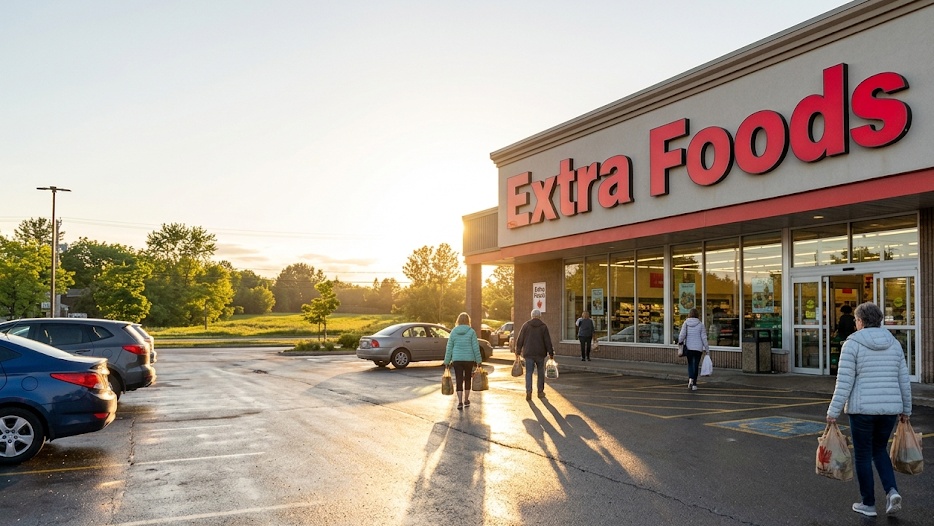
Extra Foods is a Canadian grocery store banner that is part of the Loblaw Companies Limited retail network. It is best known in Western Canada as a smaller-format supermarket chain serving towns and communities where a full-size superstore is not the best fit.
For many shoppers, Extra Foods represents a practical community grocery option with a more compact footprint, everyday essentials, and a strong local presence. It has historically played a supporting role in Loblaw’s regional strategy in smaller markets.
History
Extra Foods was founded in 1982 and is headquartered in Brampton, Ontario under the Loblaw Companies Limited umbrella. The chain emerged as a mid‑sized grocery format designed to fill gaps between large superstores and very small neighborhood grocers.
At its peak, Extra Foods operated around 100 stores across much of Western Canada, with a particular focus on smaller towns and rural communities. Over time, Loblaw has consolidated, rebranded, or closed some locations as part of broader store optimization and banner‑standardization efforts.
Operations & Footprint
As of 2026, Extra Foods operates only a small number of stores in Canada, mostly concentrated in Saskatchewan and a few other Western locations. The banner is not as widespread as Loblaw’s major chains, but it remains a recognizable name in the markets where it continues to operate.
Stores are typically smaller than Loblaw’s superstores such as Real Canadian Superstore. That format allows Extra Foods to serve communities that benefit from a manageable, neighborhood‑style grocery store rather than a large one‑stop supercenter.
Products, Services & Merchandising
Extra Foods stores usually offer produce, meat, dairy, bakery, frozen foods, pantry staples, and basic household essentials. The merchandising mix is practical and oriented toward everyday grocery needs rather than extensive non‑food or departmental departments.
The banner is positioned in the mainstream grocery segment, with a focus on convenience and familiarity rather than ultra‑discount or premium positioning. That makes it useful for shoppers who want a straightforward local grocery shop.
Work Environment & Employment
Extra Foods employs staff in grocery, produce, bakery, cashier, and store-management roles, with staffing levels matching the modest size of most locations. Because many stores are in smaller communities, employees often interact frequently with the same regular customers.
The work environment is generally community‑oriented and operationally focused. Employees may be responsible for multiple tasks across the store, which can make the experience more hands‑on than in larger corporate supermarkets.
Financial Profile
Extra Foods is not a separately publicly traded company; it is a banner within Loblaw Companies Limited, which is listed on the TSX under the symbol L. Its financial performance is therefore not reported independently.
Its financial value comes from serving regional and smaller‑market grocery needs efficiently. The banner helps Loblaw maintain a presence in places where a full‑size store would be less viable, supporting steady, routine sales and household shopping.
Competitive Landscape
Extra Foods competes primarily with local independent grocers, Sobeys banners, No Frills, Walmart Canada, and other regional grocery chains in the communities where it operates. Its main advantage is its neighborhood focus and manageable store size.
The banner appeals most to shoppers who want a convenient, no‑frills grocery experience in smaller towns. It sits between discount and mainstream formats, offering a balance of price, assortment, and local service.
Current Status & Outlook
As of 2026, Extra Foods continues to operate only a limited number of stores in Canada, mainly in Saskatchewan and a few other Western locations. The banner is much smaller in scale than it was in its earlier years but still retains a niche in specific markets.
Its future will likely depend on how well Loblaw can keep the remaining Extra Foods locations relevant through competitive pricing, store standards, and local service. Even as store counts shrink, the banner remains a recognizable symbol of community‑oriented grocery retail in parts of Western Canada.
Leave a Reply