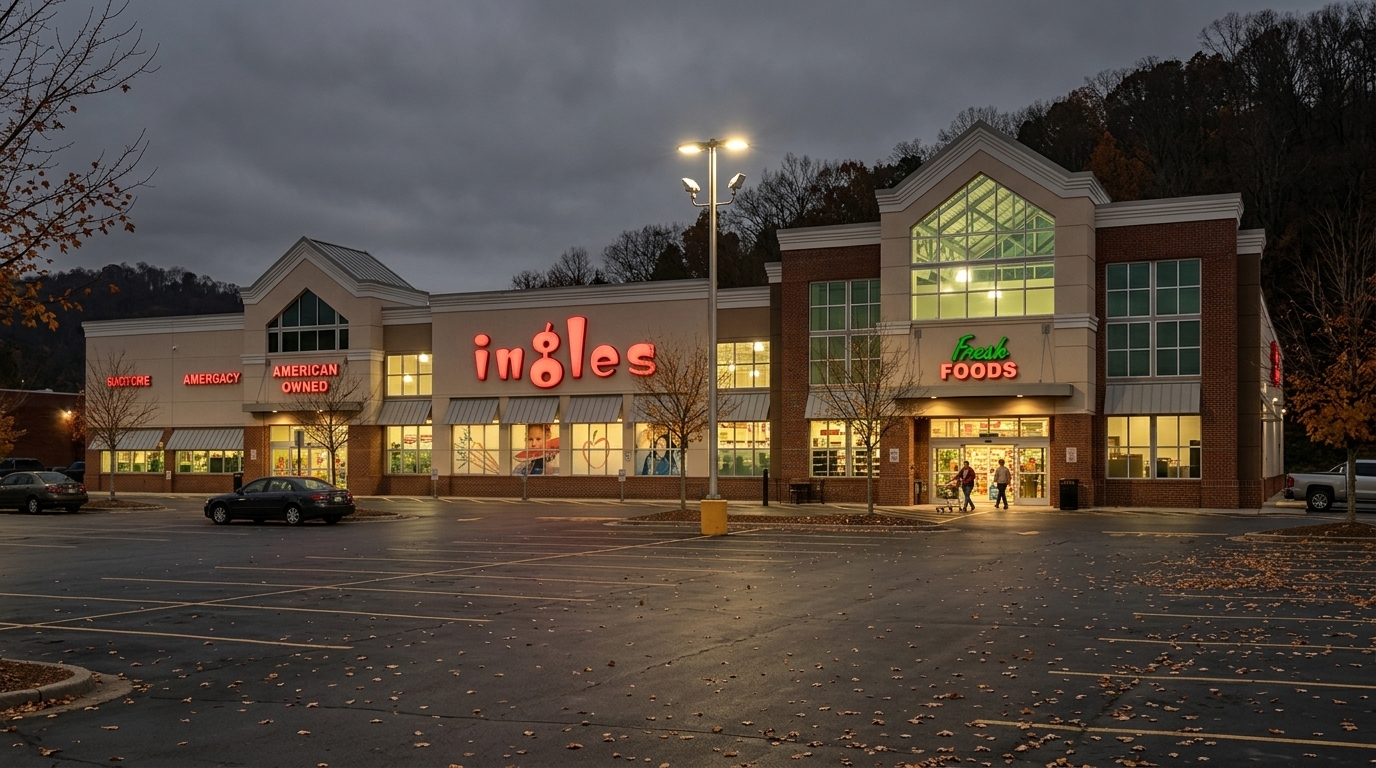
Ingles Markets opened its first supermarket in Asheville, North Carolina in 1963, founded by Robert Ingle, a member of a third generation grocery family. The chain targeted underserved smaller towns and rural communities throughout North and South Carolina that were being underserved by large grocery chains. A largely family-controlled regional operator focused on the Southeast, Ingles operates more than 190 stores across six states while managing its own distribution, dairy processing, real estate holdings, and fuel networks—a vertically integrated model that distinguishes it from most peers and underpins its long-term competitiveness in consolidated markets.
As of September 2021, the company operates 198 supermarkets in the Appalachian region of the Southeastern United States, with stores concentrated in North Carolina, Georgia, South Carolina, Tennessee, Alabama, and Virginia. Ingles owns and operates shopping centers, gas stations and a milk processing plant as adjuncts to its supermarket business. The chain competes primarily on value and service quality in lower-density markets where its regional scale and real estate ownership create cost advantages. Local and regional competitors include Food City, Food Lion, Harris Teeter, Harveys, Target, Aldi, Lidl, Walmart, Kroger, Lowes Foods, Publix, and United Grocery Outlet.
Retail Formats and Where It Operates
Ingles operates nine supermarkets under the name “Sav-Mor” with the other 189 locations being Ingles Markets. The Sav-Mor store concept accommodates smaller shopping areas and carries dry groceries, dairy, fresh meat and produce, all of which are displayed in a modern, readily accessible environment. The main Ingles banner emphasizes breadth and convenience, while Sav-Mor serves tighter footprints with a streamlined format.
Substantially all of Ingles’ stores are located within 280 miles (450 km) of its warehouse and distribution facilities, near Asheville, North Carolina. Ingles self-distributes its stores’ merchandise from its distribution center on the outskirts of Asheville, North Carolina, where its headquarters is also located. The distribution center is strategically located adjacent to Interstate 40 and in close proximity to Interstate 26. To facilitate its high standards of quality and freshness, the company’s highly efficient warehouse and distribution center is within 250 miles of Ingles’ 200+ retail stores. The company operates 1.65 million square feet of warehouse and distribution facilities. These facilities supply the company’s supermarkets with approximately 62% of the goods the company sells. The remaining 38% is purchased from third parties and is generally delivered directly to the stores.
Company Background
Robert Ingle came from a family with a long history in grocery retail. His grandfather had opened a store in Asheville that Robert’s father, Elmer Ingle, operated. Elmer Ingle closed the family store in 1956, and young Robert attended the University of Miami. From 1961 to 1963 he was back in the Carolinas working for the chain of Colonial Stores until he secured financing to open his first Ingles store in Asheville in 1963.
By 1964, a second store opened, and the company strategically acquired six Colonial supermarkets in 1967, marking a key step in its early development. Gradually Ingles opened new stores in the 1960s and 1970s. To support its expanded operations, Ingles Markets in 1978 built a new warehouse/distribution center in Asheville, North Carolina. From this 450,000-square-foot facility, the company shipped various items to its retail stores in North Carolina and neighboring states.
In 1982, Ingles found a strategic partner by purchasing a milk processing facility. Milkco, Inc., a wholly owned subsidiary, not only supplies Ingles stores with the freshest dairy products, fruit juices and bottled waters, but also sells its products to other retailers, wholesalers and food service distributors. Two-thirds of Milkco’s business, which was later expanded beyond dairy to include products such as citrus, tea, and bottled water, is from food service distributors, grocery warehouses, and independent specialty retailers located in 17 states as of 2010.
In 1987, the Company became publicly traded on the Nasdaq Stock Markets’s National Market under the symbol IMKTA. Only Class A stock was offered to the public. Robert Ingle maintained control over the company by holding almost 75 percent of its Class B stock, which controlled company voting rights. In the summer of 1996, the chain debuted its modern large-format store design, starting with its location in Dacula, Georgia.
In February 2005, Ingles Markets announced it would restate financial statements for fiscal years 2002 and 2003 and the first three quarters of 2004, to correct the accounting for vendor allowances and certain other items. The restatement was a significant factor in the U.S. Securities and Exchange Commission (SEC) issuing a Wells notice to the firm in January 2006, indicating that it might bring an enforcement action against it. A settlement was reached with the SEC in April 2006 that did not require payment of a monetary penalty.
Ingles became a publicly traded company in 1987. Ingles Markets, Incorporated reported the death on March 6, 2011, of its Founder and Chief Executive Officer, Mr. Robert P. Ingle. The Board of Directors of the Company elected Robert P. Ingle II to succeed his father as Chief Executive Officer.
The September 27 storm brought catastrophic flooding, cutting off power, communications, and water services, and rendering key roads impassable. The immediate aftermath strained Ingles Markets, headquartered in Asheville, N.C., as it addressed widespread damage to its operations. Ingles estimated that the financial impact of inventory and property loss would be between $35 and $55 million, for which it expected between $10 to $15 million of insurance reimbursement, and such impact was included in its results of operations for its fiscal quarter and year ended September 28, 2024. Four of Ingles’ stores sustained damage due to flooding and winds and were temporarily closed. The company expected all four to reopen over the next three to nine months.
Ownership, Structure and Financial History
Ingles is not a widely held, managerially detached public company; it remains a family-controlled public company with a long-term orientation. When Ingles went public in September 1987, it established a dual-class share structure, a key element in its ownership history, with Class A shares offered to the public while the founder’s family maintained control through Class B shares with superior voting rights. Robert “Bobby” Ingle II, chairman of the board and Ingles’ largest single stockholder, holds 72 percent of the voting power.
Ingles maintains a dual-class capital structure with publicly traded Class A shares and family-held Class B super-voting shares; Class B shares carry enhanced voting power, typically 10 votes per share, which consolidates control with the Ingles family despite a smaller economic stake. The super-vote Class B shares enable family control disproportionate to ownership percentage, while independent directors chair key committees to safeguard minority shareholders. Family-held Class B carries 10 votes per share versus one-vote Class A.
Ingles operates in the thin-margin grocery business where scale, operational efficiency, and supply-chain control determine competitive sustainability. Ingles owns 84% of its supermarkets and possesses a significant land reserve of over 3,700 acres, a notable distinction from many industry peers who opt to lease properties. This real estate ownership model reduces lease exposure, supports long-term capital flexibility, and anchors the company’s regional market position. The combination of company-owned stores, self-distribution, and vertically integrated dairy processing creates structural cost advantages and insulates the chain from disruptions affecting competitors dependent on external supply partners. Like all grocery retailers, Ingles operates with low net margins (in the 1.5–2.0% range), requiring high inventory turns, disciplined labor management, and strong procurement discipline to sustain profitability.
Product Range and Store Brands
Ingles sells products with the Laura Lynn brand, named for Ingle’s daughter Laura Lynn, now Laura Ingle Sharp. She worked in advertising for the chain starting in the 1970s and has been a member of the board of directors since 1997. The chain sells natural and organic products under the Harvest Farms label. A few other products are sold with the Ingles Best label. Laura Lynn encompasses a broad range of everyday staples—canned goods, frozen foods, dairy, bakery items, and household products—at prices positioned below national brands. Harvest Farms targets health-conscious consumers seeking organic and natural options.
Ingles supermarkets offer customers a wide variety of nationally advertised food products, including grocery, meat, produce, deli and bakery departments. In addition, the company offers pharmacies and fuel at the majority of its 200 plus locations. Ingles also operates 111 pharmacies and 107 gas stations at select retail locations. In the 2000s, the chain started building “Ingles Gas Express” gas stations with many of its newer stores, bundling fuel discounts with loyalty card purchases to strengthen customer frequency and basket size.
Ingles supports a loyalty program through its Ingles Advantage Card, which offers discounts on select items and fuel rewards. The company operates online order fulfillment to support curbside pickup. These tools remain secondary to the chain’s core positioning: a full-service, value-oriented regional grocer where fresh departments, private label offerings, and convenience drive traffic and household penetration in smaller towns and suburban markets where Ingles maintains strong local presence.
People and Workplace
As of 2023, Ingles had a workforce of approximately 25,000 associates. The company operates stores seven days a week, with many locations open 24 hours. Ingles emphasizes internal promotion and long-service recognition; the company has highlighted employee tenure and advancement opportunities in internal communications, underscoring a culture oriented toward stability and community embedding. The company does not disclose union presence by location, but like most grocery chains, Ingles negotiates with unions in certain regional markets.
Ingles operates an employee-focused culture consistent with its family-controlled ownership. Management commentary has emphasized associate contributions during operational challenges, including the recovery from Hurricane Helene in 2024. The company maintains a relatively stable workforce for a regional grocer, with limited public disclosure of turnover or detailed compensation data beyond executive compensation required in proxy filings.
Market Position and Competition
Ingles holds a leading position in the Appalachian Southeast, with heavy concentration in Western North Carolina, where it is the dominant grocery chain. The company competes against large national discounters (Walmart, Aldi, Lidl), regional chains (Food Lion, Harris Teeter, Publix in adjacent markets), and independent/cooperative grocers. Ingles’ competitive advantage rests on three pillars: local market intimacy and store density, which support frequent shopper traffic and efficient delivery; owned real estate and self-distribution, which reduce structural costs; and private-label penetration, which strengthens gross margins and customer loyalty through value positioning.
The grocery sector has undergone consolidation and margin pressure from e-commerce and discount formats since 2000. Ingles has resisted national roll-ups, maintained family control, and prioritized incremental modernization and supply-chain efficiency over transformational acquisitions. This strategy has supported sustainable cash flow and modest organic growth but has also constrained scale relative to national competitors. The company’s regional focus limits exposure to oversaturated national markets while exposing it to localized supply-chain disruptions and weather events, as evidenced by Hurricane Helene’s impact in 2024.
Notable Developments and Outlook
Ingles Markets lost between $55 million and $65 million in revenues during the first three weeks alone after Hurricane Helene swept through western North Carolina on Sept. 27, 2024. For the quarter and year ended September 28, 2024, the Company recognized an impairment loss of $30.4 million related to inventory damaged or destroyed by Hurricane Helene. Additionally, the Company recognized a property and equipment impairment loss of $4.5 million for the quarter and year ended September 28, 2024. The company began recovery efforts immediately, with one store reopening by late 2024 and three others expected to reopen during 2026 and 2027.
For the 2025 fiscal year ended September 27, 2025, the Company reported net sales of $5.33 billion. Headquartered in Asheville, North Carolina, the Company operates 197 supermarkets. At September 27, 2025, three of the four stores temporarily closed due to damage sustained in Hurricane Helene remained closed but are expected to reopen at various times in 2026 or in 2027. Since 2023 the company prioritized modernization across its 198 stores and investments in the Milkco dairy facility over acquisitions.
Summer Road LLC announced that it has issued an open letter to shareholders of Ingles Markets, Incorporated seeking their support for the election of Rory A. Held. Rory A. Held was elected to Ingles’ Board of Directors with resounding support from approximately 62% of the shares outstanding, which represented approximately 70% of the total votes cast in 2026. This board appointment marked the first material shareholder activism campaign at Ingles in years, reflecting investor pressure to strengthen independent governance and capital deployment as the company navigates post-hurricane recovery and evolving competitive dynamics.
Ingles’ strategic priorities center on store modernization, margin optimization through private-label growth, supply-chain efficiency, and digital capability enhancement. The company operates in a structurally challenged industry where regional players face secular headwinds from e-commerce, labor cost inflation, and consolidation among competitors. However, Ingles’ real-estate ownership, operational integration, and local market strength provide defensive qualities. Long-term growth will depend on maintaining regional relevance through convenience, value, and community engagement while selectively investing in store formats, technology, and fresh offerings to compete against online grocers and format-shifting competitors.
Leave a Reply