
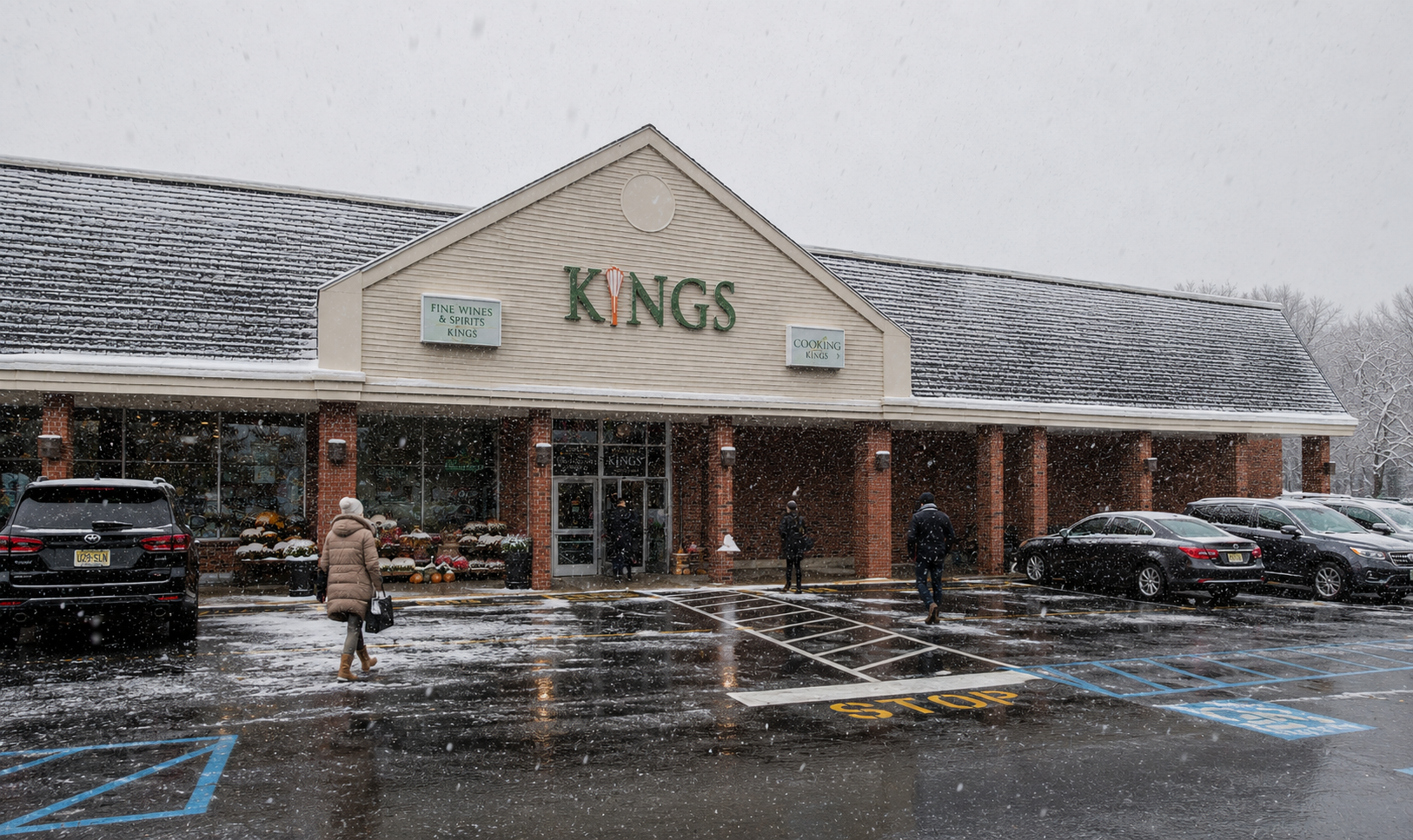
Kings Food Markets was founded in 1936 with the opening of its first store in Summit, New Jersey. Operating as an upscale grocery chain, it specializes in curated selections of premium foods rather than volume merchandising. The chain is headquartered in Parsippany, New Jersey, with stores in northern New Jersey, New York, and Connecticut. Kings distinguishes itself through quality-focused sourcing: the company commits to locally-grown produce, prime cut meats, the freshest fish, imported cheeses, international products, and chef-prepared foods. The brand positions itself as a destination for home cooks and entertaining, emphasizing specialty gourmet items over the discount positioning typical of conventional supermarkets.
The chain’s footprint contracted significantly following bankruptcy and acquisition in 2020. On August 23, 2020, Kings filed for bankruptcy and on October 14, 2020, it was announced that Albertsons submitted a winning $96M bid for the company. The stores became part of the Mid-Atlantic division of Albertsons, which operates Acme and Safeway stores on the East Coast. Following the acquisition, multiple locations were closed, including stores that had been long-established community anchors.
History
Kings Food Markets was founded in 1936 by Joe Bildner and his family, opening its first store in Summit, New Jersey, as a conventional supermarket emphasizing value pricing under the slogan “Never Undersold.” The Bildner family, with prior experience in the grocery trade on Long Island, New York, expanded the chain gradually in northern New Jersey, transitioning from a discount format to an upscale grocery model focused on higher-quality products and customer service by the mid-20th century. Under family ownership, Kings grew to operate multiple locations, establishing a reputation for gourmet offerings while remaining independent until the late 1980s.
In 1988, the Bildner family sold Kings to British retailer Marks & Spencer for $110 million, marking the chain’s first major corporate acquisition and integration into an international portfolio. From 1988 to 2006, it was owned by British retailer Marks & Spencer. The sale represented a major transition for the regional operator, bringing international ownership and capital but also subjecting the chain to strategic shifts by a non-grocery-focused parent.
Following Marks & Spencer’s exit from the U.S. grocery business, Kings changed hands multiple times. In 2009, Kings acquired Balducci’s, a gourmet specialty chain with deep roots in New York City food culture, significantly expanding its premium product portfolio. In 2016, Kings and Balducci’s were sold by Angelo, Gordon & Co. and MTN Capital Partners to GSSG Capital. The upscale market branded private label products under the Kings Own brand name.
The chain faced severe challenges during the COVID-19 pandemic. During the COVID-19 pandemic in 2020, the market drew national attention for its policy on mask-wearing: when a customer entered the store without wearing a mask, they were given a mask and the CEO’s phone number. This unconventional approach reflected both the chain’s commitment to health protocols and its willingness to engage customers directly on policy matters. However, operational and financial pressures proved insurmountable.
On August 23, 2020, KB Holdings LLC, the parent company of Kings Food Markets and Balducci’s Food Lover’s Market, filed for Chapter 11 bankruptcy protection in the U.S. Bankruptcy Court for the Southern District of New York, citing challenges from the COVID-19 pandemic, including reduced customer traffic and increased operational costs. The filing aimed to facilitate an orderly sale of assets while allowing stores to continue operations without interruption.
On October 14, 2020, Acme Markets, a subsidiary of Albertsons Companies, Inc., submitted the winning bid of $96.4 million in cash for the 27 stores. Kings and Balducci’s were expected to keep their own names after the sale closed. ACME officially took possession of 19 of the 25 stores in January 2021, completing the transition.
Operations & Footprint
Albertsons said it plans to operate Kings and Balducci’s as standalone banners in its mid-Atlantic division, which runs stores under the Safeway and Acme brands on the East Coast. Kings operates stores in New Jersey, New York and Connecticut and prides itself for being “Jersey born and bred,” and focuses on a specialty assortment that includes items like grass-fed beef and private-label organic popping corn. New Jersey remains the chain’s primary market, with concentrated presence in the northern part of the state.
Post-acquisition closures significantly reduced Kings’ footprint. Since acquiring the chain, several Kings locations have closed, including Maplewood, Long Hill, Hoboken, Bernardsville and Warren. On December 7, 2020, Kings closed their location in Maplewood, New Jersey, after being in Maplewood since 1942, ending an operation spanning nearly eight decades in that community. Additional closures continued in subsequent years as Albertsons rationalized the portfolio.
Under Albertsons ownership, Kings operates as a subsidiary of a major national grocery holding company. This integration provides access to supply-chain infrastructure and financing while allowing the Kings brand to maintain its distinct upscale positioning. The chain sources products through Albertsons’ distribution network while managing its own merchandising and marketing strategy.
Products, Services & Merchandising
Kings’ merchandising strategy centers on premium fresh foods and specialty items. The chain emphasizes locally-sourced produce, prime-cut meats, fresh seafood, imported cheeses, and chef-prepared foods. The upscale market branded private label products under the Kings Own brand name, allowing the chain to offer proprietary high-quality items that reinforce its differentiation from mainstream competitors.
The grocery offering extends to international and gourmet products, with particular attention to grass-fed and organic selections, appealing to affluent shoppers and home entertainers. In-store prepared foods and catering services complement the fresh-foods focus. Many locations include pharmacy and floral departments.
Kings offers digital services including online ordering for delivery and curbside pickup, managed through its website and mobile channels. A loyalty program, Kings for U, provides personalized deals and customer engagement tools. These digital capabilities place the chain in line with industry-standard omnichannel offerings while maintaining focus on in-store shopping experiences.
Work Environment & Employment
The stores Albertsons acquired collectively employ more than 2,000 workers as of the 2020 transaction. Employment levels have fluctuated with store closures and operational adjustments since the acquisition. The chain has historically offered opportunities for entry-level retail positions, particularly in customer service and merchandising roles.
Union representation and labor conditions have reflected broader supermarket industry patterns. Post-acquisition, Kings stores have undergone operational standardization, including updating service departments, fixture replacements, and organizational restructuring to align with Albertsons’ operational standards. Store closures have resulted in workforce reductions in affected markets.
Business Model & Financial History
Kings operates under the classic grocery economics of thin margins, high volume, and efficient logistics. The upscale positioning allows for higher product margins than discount-focused competitors, but the assortment-heavy, quality-focused strategy requires higher labor costs for skilled butchers, produce specialists, and prepared-foods personnel. This premium model proved challenging during periods of competitive intensity and economic uncertainty.
The 1988 sale to Marks & Spencer for $110 million reflected the chain’s value at that time as a regional player with strong brand equity. However, under Marks & Spencer’s ownership, the chain struggled to grow significantly, as the British retailer lacked deep expertise in the American grocery market. Following the chain’s sale by M&S in 2006, subsequent owners—Angelo, Gordon & Co. and MTN Capital Partners—sought to enhance profitability through acquisitions such as Balducci’s and private-label expansion.
The 2020 bankruptcy reflected broader industry pressures: rising competition from e-commerce, discount grocers, and upscale competitors such as Whole Foods; pandemic-driven operational costs; and reduced foot traffic in some markets. The Albertsons acquisition for $96.4 million in 2020 provided capital and operational support but at a valuation substantially lower than the Marks & Spencer transaction decades earlier.
Competitive Landscape
Kings operates in a highly competitive regional market dominated by larger national chains and specialized competitors. The Morristown store underwent $3 million of renovations in 2015, amid growing local competition that now includes ShopRite, Whole Foods and Wegmans. In many of its markets, Kings competes against conventional supermarket chains, premium organic chains, warehouse clubs, and e-commerce grocers. Its upscale positioning creates a differentiated niche, but one vulnerable to competition from both premium chains and discount operators expanding their quality offerings.
The specialty grocery category itself has faced structural challenges in recent years, as consumers increasingly shop across formats and as e-commerce and direct-to-consumer brands fragment the market for premium foods. Whole Foods’ expansion and acquisition by Amazon, as well as the growth of ethnic and international grocers, have shifted competitive dynamics. Kings’ survival depends on its ability to defend a local, relationship-based shopping experience that larger platforms cannot replicate, while maintaining operational efficiency.
Recent Developments & Outlook
Since the Albertsons acquisition in 2020, Kings has focused on stabilizing operations rather than aggressive expansion. When Albertsons Cos bought the chain, there was a quick focus on fixing up the stores — and, necessarily, cleaning them, addressing deferred maintenance and operational deficiencies that accumulated during the bankruptcy period. Incremental improvements in lighting, fixtures, and merchandising have followed.
Store closures have continued into 2024 as Albertsons rationalizes the portfolio based on profitability and real-estate economics. The chain retains a presence in core New Jersey markets but operates a significantly smaller footprint than in prior decades. The integration into Albertsons’ mid-Atlantic operations provides stability and access to corporate resources, but the banner faces ongoing pressure from market saturation and the need to justify upscale positioning in an increasingly price-sensitive consumer environment.
The outlook for Kings remains tied to Albertsons’ strategic commitment to maintaining the brand as a distinct upscale banner within its portfolio. Success depends on defending premium positioning against both national upscale chains and the value-oriented competition that dominates most grocery markets. As of the 2020 acquisition, Kings continues operations under Albertsons ownership as a regional specialty grocer focused on its core markets in the Northeast.
Leave a Reply