
Overview
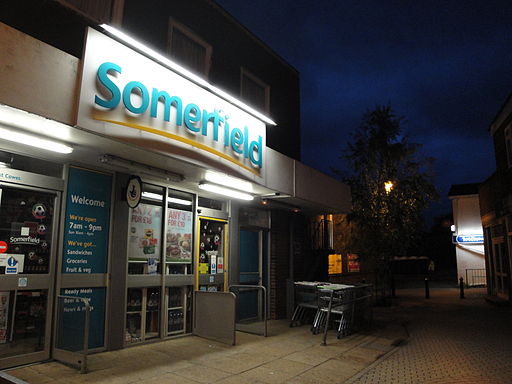
Somerfield was a UK supermarket chain best known for serving local and neighborhood shopping needs across England, Wales, Scotland, and Northern Ireland. The business began in Bristol in 1875 as a family grocery store and later evolved into a nationwide convenience-focused supermarket brand. It became especially associated with mid-market grocery retailing, smaller stores, and an emphasis on everyday shopping rather than large hypermarket-style formats.
The chain is now defunct. As of 2009, Somerfield was no longer operating as an independent company after being acquired by the Co-operative Group, and its stores were gradually rebranded or sold off in the years that followed.
History
Somerfield traces its roots to J.H. Mills, a Bristol grocer founded in 1875. By 1900, the business had expanded into a small store network, and in 1950 a Bristol-based finance house, Tyndall, gained majority control and renamed both the company and its stores Gateway. The name was chosen because Bristol was seen as the “gateway” to the West Country.
The Gateway brand later evolved into Somerfield in 1990, after a pilot rebrand proved successful. A major turning point came in 1998, when Somerfield merged with Kwik Save, expanding its store base but also creating operational complexity. By the late 1990s and early 2000s, the company was under pressure from larger supermarket groups and discount competitors, leading to store disposals and a narrower strategic focus.
In 2005, Somerfield was taken private by a consortium of investors, and in 2008 it was sold to the Co-operative Group for £1.57 billion. The Co-op completed the acquisition in March 2009, and the Somerfield brand was then phased out as stores were converted to Co-op outlets or divested.
Operations & Footprint
Before its sale, Somerfield operated roughly 880 stores across the UK, including about 150 forecourts, and employed around 42,000 people. Its network was concentrated in local high street and neighborhood locations rather than out-of-town superstores, which made it a familiar convenience option in many towns.
The company’s headquarters were in Bristol, reflecting its long-standing connection to the city. After the Co-op takeover, Bristol’s role as the center of the business ended, and the headquarters was later closed with operations moved to Manchester.
Somerfield was a privately owned supermarket business during its final years. Its footprint shrank after the Co-op acquisition because regulators required divestments, and many stores were sold to other retailers or converted under the Co-op brand.
Products, Services & Merchandising
Somerfield positioned itself as a local grocery retailer with a strong emphasis on fresh food, convenience, and neighborhood shopping. Its stores typically carried standard grocery lines, chilled and frozen foods, household essentials, and a mix of own-label and branded products.
The chain also experimented with discount and convenience formats, including Kwik Save and later smaller local-store concepts. In the mid-2000s, management reduced product ranges and focused more tightly on being a “local grocery store” rather than a broad-format supermarket chain.
Its merchandising strategy aimed to balance value with convenience, but it struggled to compete consistently against the scale, pricing, and operational efficiency of larger rivals. Information on modern digital tools, loyalty programs, or e-commerce is limited because the brand was absorbed before those features became central to UK grocery retail.
Work Environment & Employment
Somerfield was a major employer in the UK grocery sector, especially in the South West and in smaller-town retail markets. Its workforce included store staff, logistics workers, and head-office employees in Bristol, where the company had deep local roots.
The business underwent repeated restructuring, especially after the Kwik Save merger and again before the Co-op acquisition. These changes likely created a mixed employment experience, with some staff benefiting from scale and career opportunities while others faced uncertainty from store closures, disposals, and brand consolidation.
Financial Profile
Detailed standalone financial reporting became less relevant after Somerfield was taken private in 2005, but the company reported sales of about £4.2 billion in the year ending 26 April 2008, with EBITDA of £233 million. That same period reflected a relatively large but pressured business operating in a highly competitive grocery market.
Financially, Somerfield’s strengths were its store network and local presence, while its weaknesses included overlap from acquisitions, limited scale versus Tesco and Asda, and the challenge of integrating Kwik Save. By the time of the Co-op acquisition, the business had become more attractive as a strategic retail footprint than as a standalone growth story.
Competitive Landscape
Somerfield competed against Tesco, Sainsbury’s, Asda, Morrisons, Aldi, Lidl, and convenience-focused Co-op stores. Its own identity sat somewhere between a neighborhood grocer and a mid-market supermarket, which gave it a clear local role but not always a strong competitive moat.
Its main differentiators were convenience locations, a local-store feel, and familiarity in regional UK towns. However, the chain faced pressure from larger supermarkets on price and range, and from discounters on value, making long-term independence difficult
Current Status & Outlook
Somerfield is no longer in operation as an independent supermarket chain. The Co-operative Group completed its acquisition in 2009, and store conversions continued into 2011, ending the brand’s presence on the UK high street.
In retrospect, Somerfield’s legacy is that of a long-running Bristol-born grocer that adapted repeatedly for more than a century before consolidation in UK food retail finally absorbed it. The former brand remains a notable example of how regional chains were reshaped by national competition, private equity ownership, and sector consolidation.


Leave a Reply to Indrouti Devi (joanie) Martin Cancel reply