
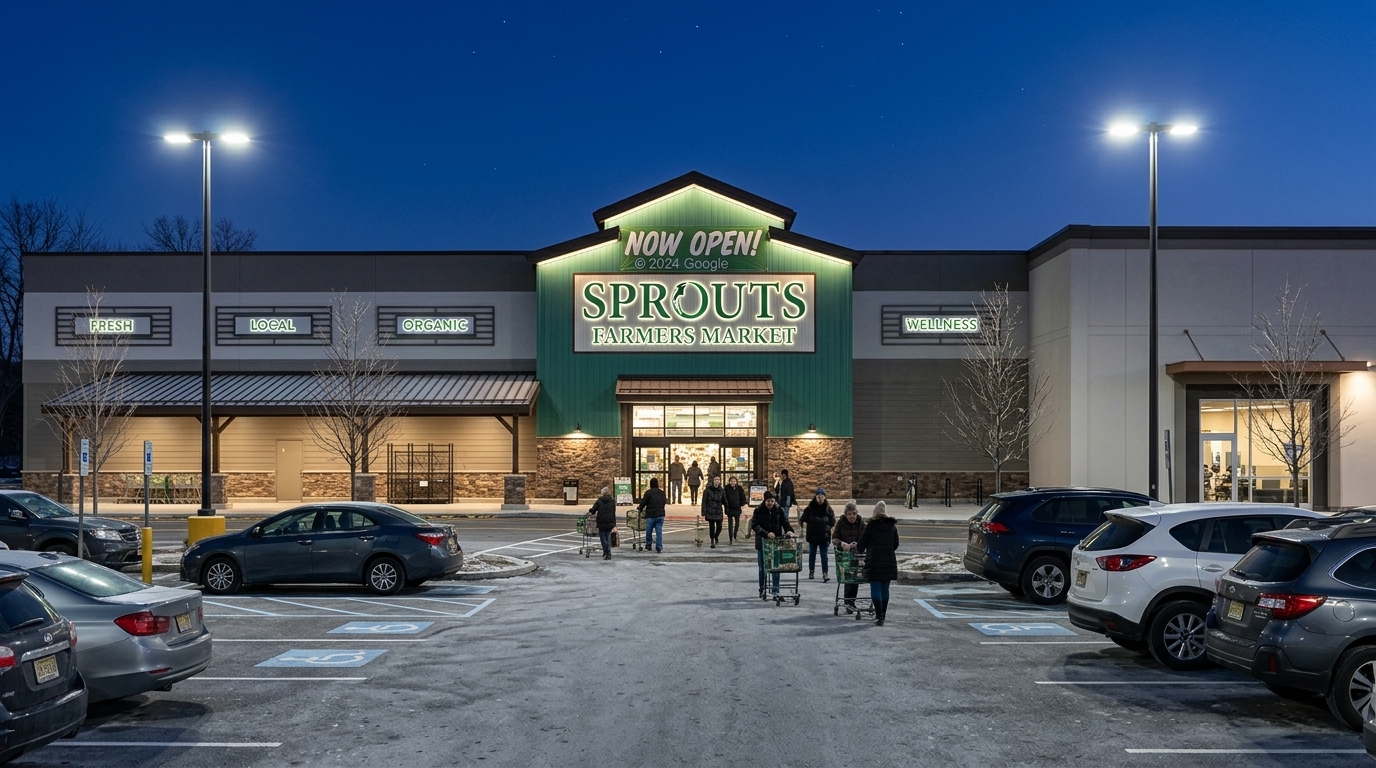
Sprouts Farmers Market was founded in 2002 in Chandler, Arizona by members of the Boney family. The chain represents the latest chapter of a multi-generational grocery legacy. In 1943, Henry Boney opened a fresh-fruit stand in San Diego, California, which grew into a handful of open-air farmers markets. In 1969, his sons developed Boney’s Market, which grew into a community grocery store. By 1997, the family’s small-box farmers-market grocery stores were renamed Henry’s Farmers Market after their father. Henry’s Farmers Market was sold in 1999 for $46 million.
Sprouts offers a selection of products that are minimally processed and free of artificial flavors, food coloring, preservatives, and synthetic ingredients. The company says that 90% of its products meet this standard. The chain targets health-conscious shoppers seeking affordable access to natural and organic groceries through a smaller-format store emphasizing produce, bulk items, vitamins, and supplements. Produce makes up about a quarter of the business for Sprouts, and the stores carry around 200 varieties of organic produce. One-third of the store stock is always on promotion.
Origins and Early Growth
Sprouts Farmers Market was founded on July 11, 2002, by the Boney family—Stan, Shon, Scott—and Kevin Easley, to fill a market gap for affordable natural and organic foods blending farmers market pricing with supermarket convenience. The first store opened in Chandler, Arizona, with an open-floor plan with fresh produce occupying ~25% of store space and a focus on high-volume, low-margin produce. By 2005 the chain expanded regionally; by 2013 Sprouts accelerated growth through new-store openings and by 2019 reported over 320 stores nationally.
Expansion, Acquisitions and Ownership
Apollo Management LP, a major New York private equity firm, bought a majority stake (58.5%) in Sprouts Farmers Market for $214 million in February 2011. In 2011, Henry’s, Sun Harvest, and Sprouts came together again under Apollo Global Management, and all were rebranded as Sprouts stores. The 2012 purchase of Sunflower Farmers Market reinforced Sprouts’ presence in the Southwest and Rocky Mountain regions, expanding store count and regional distribution reach. By the 2013 IPO Sprouts operated over 150 stores; analysts highlighted superior sales-per-square-foot versus traditional grocers, driven by private-label growth and optimized supply chains.
Sprouts became a public company traded on NASDAQ in 2013. In 2015, Apollo Global Management exited its position in the company by selling off 10.4% of Sprout’s overall stock, or about 15.8 million shares. Since its public debut, Sprouts has pursued an aggressive expansion strategy focused on disciplined site selection and supply-chain optimization.
Stores and Regional Footprint
Sprouts operates across a broad footprint of the United States. Sprouts maintains locations in Alabama, Arizona, California, Colorado, Delaware, Florida, Georgia, Kansas and additional states including Louisiana, Maryland, Missouri, Nevada, New Jersey, New Mexico, New York, North Carolina, Oklahoma, Pennsylvania, Tennessee, Texas, Utah, and other markets. California represents the chain’s largest concentration, followed by Arizona and Texas. The company has also undertaken strategic expansion into the Midwest and Northeast in recent years.
Sprouts is delivering unique smaller stores with expectations of stronger returns, while maintaining the approachable, fresh-focused farmer’s market heritage Sprouts is known for. From 2021 through March 29, 2026, Sprouts has opened 118 new stores and remodeled one store featuring its updated format. In 2025 Sprouts began the transition to a self-distribution model for meat and seafood through its fresh distribution centers. The company operates as a publicly traded entity headquartered in Phoenix, Arizona.
Merchandising and Own-Brand Products
Sprouts has its own private-label brand of products that includes more than 2,400 items. Sprouts’ private brands accounted for more than 20% of the grocer’s annual revenue in fiscal year 2023, nearly double its sales share in 2017. Private label products continue to grow at Sprouts Farmers Market, with the grocer’s own brand assortment now accounting for more than 25% of sales. The consolidation to one “Sprouts Brand” aims to establish a more recognizable and trusted brand for its shoppers to gravitate towards.
Stores offer beef products that range from choice cuts to grass-fed. Each store’s vitamins and supplements department typically includes about 7,500 products. The launch of the health and wellness line Real Root marks the completion of phase two of the specialty grocer’s private brand revamp. The new health and wellness brand consists of more than 130 body care, personal care and home fragrance items like shampoo and conditioner, Epsom salt with fragrance, bar soap, body wash and bath fizz.
In 2021, Sprouts Farmers Market partnered with MyFitnessPal to provide food-related content support to the app, which included a library of healthy recipes, health and fitness challenges, and food- and health-related articles. E-commerce grew to 12.5% of total revenue by the end of 2024 through integrations with third-party delivery platforms and the company’s own digital channels.
Employment and Labor Relations
Sprouts is not unionized, and the company has faced sustained criticism regarding employee compensation and scheduling practices. With the larger grocers, employees are protected by unions and practices that ensure a better working atmosphere and better hours. Better wages, better hours, less under-staffing, less turnover, less reliance on calling people in, 8 hour shifts for the store management. On average, a Sprouts Farmers Market employee lasts less than a year and a half on the job, before moving on.
While there are opportunities for employees to take advantage of health insurance as part-time workers, very few are given the hours to pay for health benefits, much less pay their bills. There are employees that have worked for Sprouts Farmers Market for two years or more that are scheduled 8 hours a week. According to anonymously submitted Glassdoor reviews, Sprouts Farmers Market employees rate their compensation and benefits as 2.9 out of 5. California law recognizes and protects the right of workers to unionize, yet many grocery workers, including those at Sprouts, are not unionized and lack the collective power needed to advocate for fair wages, benefits, and working conditions.
The Economics of the Business
Sprouts operates on a specialty grocery model leveraging higher sales per square foot than traditional supermarkets through focused assortment and produce-driven traffic. In 2025 the company reported net sales of approximately $7.8 billion, driven by same-store sales gains and new store openings; margins benefit from high-turn produce and lower-cost private labels. The chain benefits from a relatively smaller store footprint requiring lower development and occupancy costs while maintaining operational flexibility to densify existing markets.
Gross margins improved significantly over time, supported by the expansion of higher-margin private-label products and the vitamins-and-supplements category. The shift toward unified branding under “Sprouts Brand” has strengthened customer recognition and penetration rates. Supply-chain efficiency, driven by distribution-center consolidation and fresh-product self-distribution initiatives, has enhanced profitability and reduced dependency on third-party logistics.
Rivals and Market Pressures
Main competitors of Sprouts Farmers Market include Whole Foods Market, Trader Joe’s, Kroger, Albertsons, Publix, H-E-B, and Walmart. Whole Foods Market wins prestige and trust. Trader Joe’s wins value and discovery. Kroger and Albertsons win breadth. Walmart and Costco win price. Sprouts Farmers Market market position is strongest where customers want health-led groceries without paying luxury-level prices. That puts it in direct grocery retail competition with stores that sell on scale, but not always on specialty credibility.
The specialty natural-and-organic segment has attracted competitive pressure from established mass-market grocers expanding their organic and private-label offerings, as well as from e-commerce platforms and subscription-based alternatives. Advantages are defensible through sourcing relationships, curated assortment and format economics, but price pressure from big‑box and digital convenience requires continuous innovation in private label, experiential differentiation, and supply chain efficiency. Sprouts has differentiated itself through emphasis on fresh produce breadth, high-velocity inventory turnover, and a curated selection aligned with health-conscious consumers unwilling to pay premium prices.
Later Developments and Direction
Sprouts’ geographic store expansion and new store placement will intersect where target customers live, in markets with growth potential and supply chain support, which it believes will provide a long runway of approximately 10% annual unit growth. Sprouts expects to open more than 40 new stores in 2026. Sprouts is increasing its use of data analytics and insights, including through the nationwide launch of its Sprouts Rewards loyalty program in 2025. From 2021 through 2025, Sprouts has opened 112 new stores and remodeled one store featuring its updated format.
The company has emphasized supply-chain modernization, particularly the shift to self-distribution for fresh proteins beginning in 2025. Expansion into underserved Midwest and Northeast markets represents a longer-term growth avenue, building on successful penetration of established Western and Southern markets. Private-label innovation, loyalty-program personalization, and omnichannel service integration remain strategic priorities to sustain competitive position and margin improvement in an increasingly crowded natural-and-organic grocery landscape.


Leave a Reply