
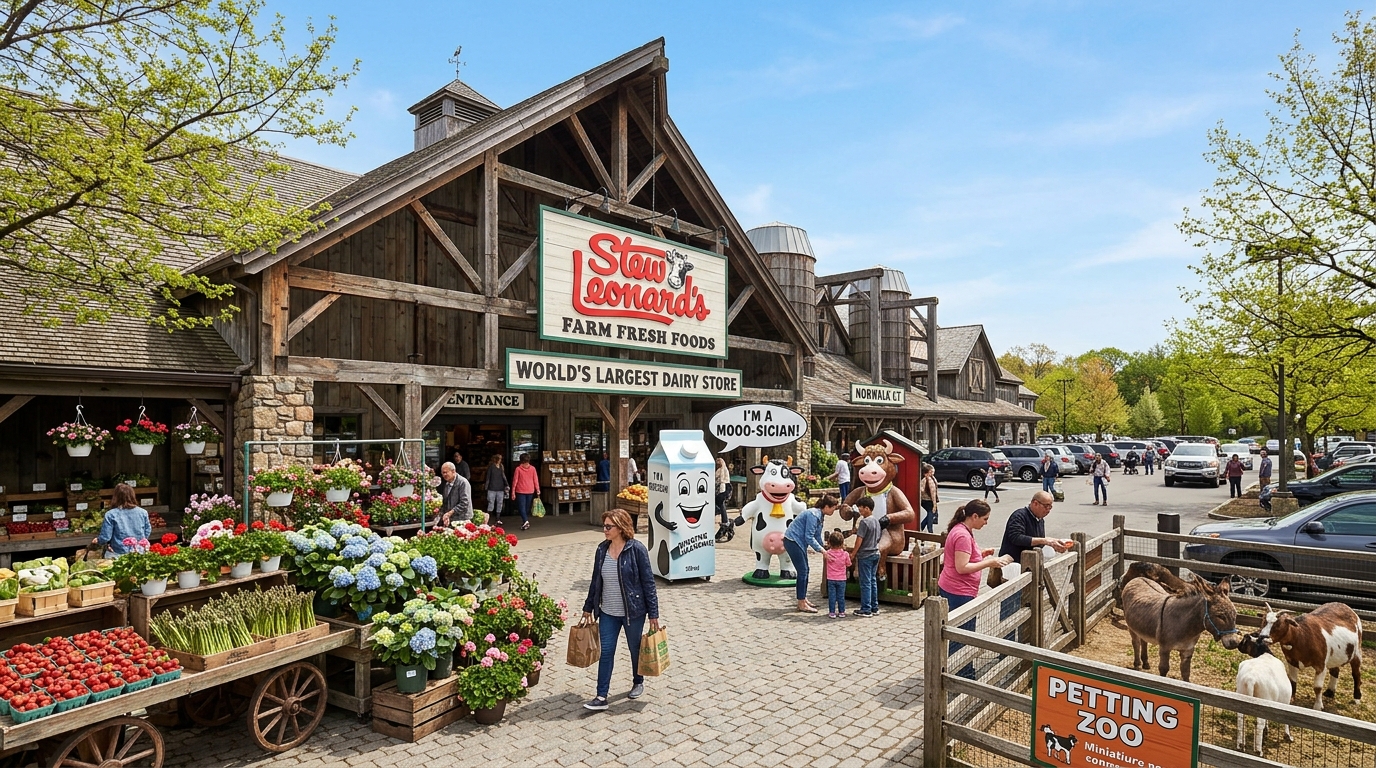
Stew Leonard’s opened in 1969 with seven employees in Norwalk, Connecticut, and now operates eight stores across Connecticut, New York, and New Jersey. The family-owned retailer’s reputation for top-quality fresh food, unique private-brand products and a “Disney-esque” shopping experience have fueled devotion from shoppers. The chain has become an outlier in an increasingly consolidated grocery industry, building a distinctive identity around entertainment, fresh merchandise, and service rather than scale or discounting.
Founded as a small dairy store with annual sales exceeding $500 million and more than 2,500 team members, Stew Leonard’s remains privately held and family-operated. The New York Times called Stew Leonard’s the “Disneyland of Dairy Stores.” Unlike traditional supermarkets, the stores are set in a maze and customers walk through entire stores guided by aisles, greeting employees in costumes and animatronic characters that sing songs. The stores feature agritourism attractions such as soft serve ice cream, petting zoos and outdoor cafes in the warmer months.
History
Charles Leonard, a hatter in a sweatshop, founded Clover Farms Dairy in Norwalk, Connecticut, in the early 1920s. It was a state-of-the-art dairy by the standards of the time with a pasteurizing and bottling plant, and fresh milk delivered daily by trucks that had plastic cows on the front. In the late 1960s, Stew Leonard, Charles’s son, realized the milk delivery business was declining when the state informed him that Clover Farms Dairy was in the path of a new highway.
In December 1969, Stew Leonard’s opened its doors as a 17,000 square foot store carrying just eight items. By the end of the first year, the store had 10,000 weekly customers. The store soon expanded beyond dairy to include general grocery items. A second store opened in Danbury, Connecticut, in 1991. A third store opened in Yonkers, New York, in September 1999. A store in Newington, Connecticut, was announced in February 2006 and opened in April 2007. A store in Farmingdale, New York, opened in January 2016. The seventh location opened in Paramus, New Jersey, in 2019 and the eighth on May 17, 2024, in Clifton, New Jersey.
Stew Leonard Jr. took over as CEO of Stew Leonard’s in 1991, after his father, Stew Leonard Sr., was charged with a $17 million tax fraud by the IRS. In 1993, Stew Leonard Sr. was convicted of tax fraud via an elaborate scheme involving a computer program designed to skim off sales, directed by Stew Leonard Sr. in concert with the company’s CFO and store manager. Leonard Sr. was caught in June 1991 while he was carrying $80,000 cash to the Caribbean island of Saint Martin. The scandal emerged alongside operational controversies: the Connecticut Department of Consumer Protection cited Stew Leonard’s for underweight products and labeling violations, with 1,232 violations on 2,658 items examined, resulting in a violation rate of 46 percent compared to a statewide average of 7.2 percent. Despite these challenges, the company recovered under Stew Leonard Jr.’s leadership. Stew Leonard Sr. died on April 26, 2023, at the age of 93.
In 2024, the company faced renewed legal exposure. On January 11, 2024, New York City resident Órla Baxendale died from anaphylactic shock shortly after eating a mislabeled cookie product sold under Stew Leonard’s brand name, with the label not showing that peanuts were a key ingredient in the recipe. The complaint alleges the supermarket defendants failed to update the cookie’s packaging to reflect the inclusion of peanuts despite being notified of the ingredient change in July 2023 by Cookies United LLC, which directly led to the fatal incident on January 11, 2024.
Operations & Footprint
Stew Leonard’s has stores in Danbury and Newington, Connecticut; Yonkers, Farmingdale, and East Meadow, New York; and in Clifton and Paramus, New Jersey, with the headquarters store in Norwalk, Connecticut. The chain operates a tight geographic footprint in the Northeast, primarily serving suburban areas within driving distance of major metros in Connecticut, New York, and New Jersey.
The company does not operate a centralized warehouse. All products come directly to each store. Many Stew Leonard’s stores span more than 100,000 square feet, but beginning in 2017, the company decided to “downsize” to a format of about 80,000 square feet. The company is privately held and family-owned, with no public shareholders.
Products, Services & Merchandising
Stew Leonard’s expanded the fresh dairy concept to include meats, fish, produce, bakery, cheese and wine. Unlike traditional grocery stores that sell an average 30,000 items, each Stew Leonard’s store carries only 2,200 items, chosen specifically for their freshness, quality and value. 80% of the assortment in each Stew Leonard’s store is fresh food.
Overall, the chain’s private brand penetration is 60%, with the combination of fresh food that’s also private branded proving attractive to modern shoppers who depend on private brands for quality and value. The company emphasizes clean-label formulations and local sourcing where possible, reflecting evolving consumer preferences for ingredient transparency and regional producers.
Stew’s offers tasting booths and a variety of prepared meals year round. The stores feature prominent prepared-foods and service counters, including hot foods, bakery items, and specialty prepared meals. The Stew Leonard’s Loyalty App rewards customers for every purchase with exclusive savings and perks. The company doesn’t have a central warehouse, so all products come directly to each store. Online ordering and delivery have become standard offerings, though the core draw remains the in-store experience.
Work Environment & Employment
Stew Leonard’s is recognized for their management philosophy: “Take good care of your people and they in turn will take good care of your customers.” In 2002, Fortune Magazine ranked Stew Leonard’s in its 100 Best Companies to Work For in America for 10 consecutive years. Under Stew Leonard Jr., the grocery store chain has been recognized as one of the best places to work in the nation, with 82% of all managers promoted from within, and the company frequently applying positive reinforcement to boost employee morale.
The company has cultivated a distinctive culture emphasizing training and advancement. By 2002, Leonard had helped increase sales to $300 million with 3 stores, from less than $100 million in 1991. The company has faced unionization efforts over the decades but has remained non-union. Employment grew alongside expansion, though the company maintains a tight operating model built around high throughput and labor efficiency tied to fresh-food production and customer service on the sales floor.
Business Model & Financial History
Stew Leonard’s operates on a high-turnover, low-margin model centered on limited assortment and fresh food. Stew Leonard’s sells an extremely limited list of products but moves staggering quantities, including 13 million cookies, eight million ears of corn, and ten million quarts of milk per year. Profitability depends on volume, fast inventory turns, private-label penetration, and tight operational control rather than premium pricing.
The chain has remained family-owned and private throughout its history, avoiding the discipline and transparency of public markets. Stew Leonard Jr. first took over the helm of Stew Leonard’s in 1991, after his father Stew Leonard Sr. was charged with a $17 million tax fraud by the IRS. The first few years were turbulent under Stew Leonard Jr., but he quickly turned it around, with the store in Norwalk earning less than $100 million in 1991, but by 2002, Leonard had helped increase sales to $300 million with 3 stores. Ownership and decision-making remain consolidated in the Leonard family.
Competitive Landscape
Stew Leonard’s occupies a narrow competitive niche. It does not compete directly on price with national discounters like Aldi or Trader Joe’s, nor does it have the scale or assortment of regional chains like Wegmans or Stop & Shop. Instead, it competes on experience, freshness, and theatricality—dimensions that appeal to affluent suburban consumers willing to drive distances and pay a premium for a distinctive shopping environment.
The company faces structural headwinds from e-commerce, consolidation in grocery retail, and the rise of delivery platforms. Larger chains and discounters have invested heavily in technology, supply-chain optimization, and private labels. However, Stew Leonard’s small footprint and deliberate growth strategy insulate it from some competitive pressures. By creating this theatrical fresh food value proposition, Stew Leonard’s believes that it’s ahead of consumer trends, giving it more than a fighting chance to win the battle against discounters, ecommerce giants and even the big grocery chains.
Recent Developments & Outlook
The retailer has accelerated its expansion aspirations and opened new stores in 2016, 2017 and, in conjunction with the 50th anniversary of the company, its seventh and first New Jersey location in 2019. The eighth store opened on May 17, 2024, in Clifton, New Jersey. Growth remains measured; the company doesn’t have aggressive expansion plans, but if something exciting comes its way, will probably go with it.
The chain has begun adopting digital capabilities. Beyond Stew Leonard’s animatronic puppet shows, fresh food and private brands, the company has finally embraced big data and delivery. A second location of Stewie the Duck Swim School opened in November of 2025 in Clifton, New Jersey, reflecting the family’s community reinvestment initiatives tied to water safety and education.
The 2024 product-labeling incident and resulting wrongful death lawsuit represent the most serious reputational challenge in years. The company moved to address the incident through operational review and quality control. Looking forward, Stew Leonard’s faces the persistent challenge of remaining relevant in a shifting food-retail landscape while protecting the premium positioning and operational culture that have defined it. Fresh-food mastery, private-label expansion, and theatrical in-store experience remain its primary competitive advantages against both conventional chains and emerging models.
Leave a Reply