
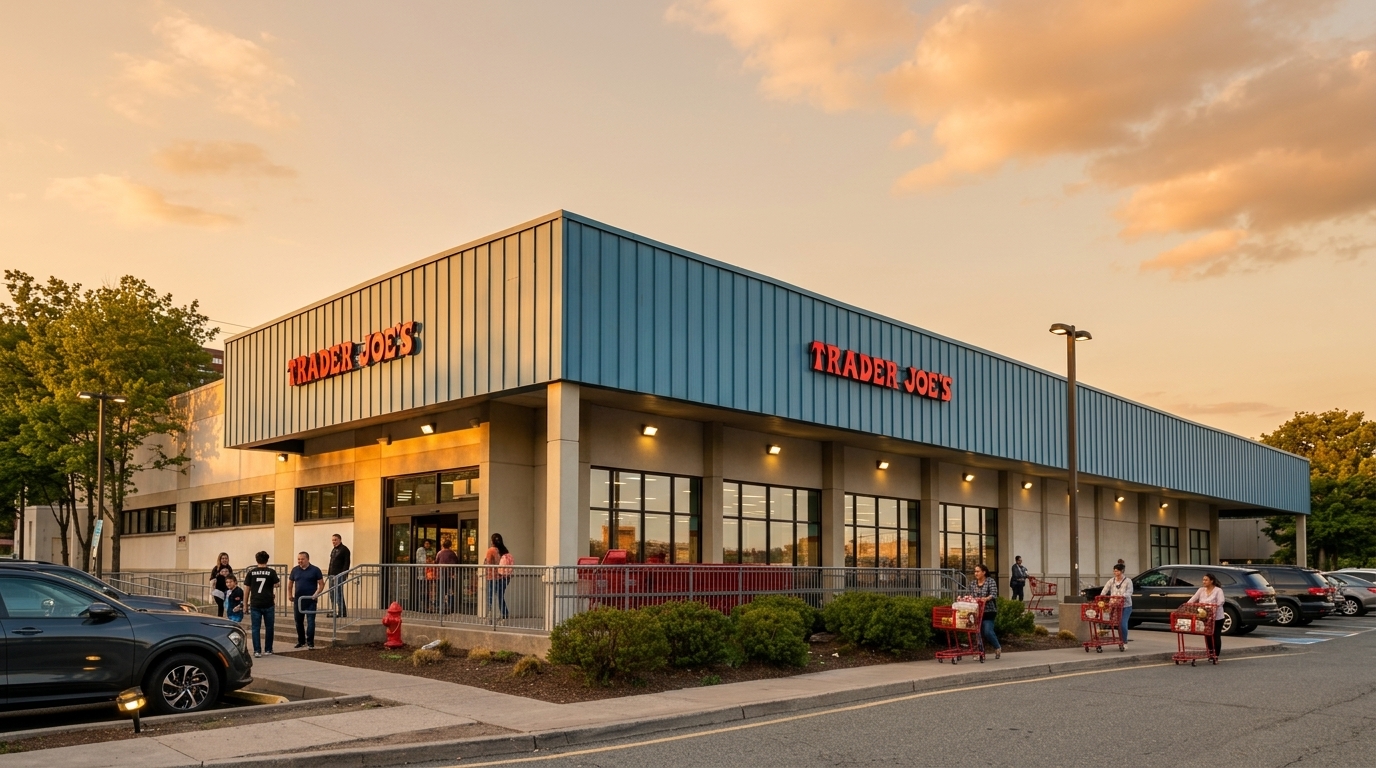
Trader Joe’s was founded in 1967 by Joe Coulombe in Pasadena, California, though the company began in 1958 as a chain of Pronto Market convenience stores in the Greater Los Angeles area, originally a subsidiary of Rexall. The company operates a curated assortment of specialty foods and groceries, emphasizing private-label products, value pricing, and a neighborhood-focused shopping experience. Trader Joe’s is owned by Aldi Nord, a sister company of Aldi Süd, with both controlled by the Albrecht family. The chain is headquartered in Monrovia, California, and serves customers primarily in the United States through a network of neighborhood-scaled stores that feature the company’s distinctive brand identity and service model.
Trader Joe’s differentiates itself through a focused approach to merchandising and customer experience. Rather than competing on store size or product breadth, the chain emphasizes careful curation, with about 4,000 carefully selected items compared to conventional supermarkets. Nearly 80% of Trader Joe’s inventory consists of private label products, allowing the company to maintain competitive pricing while building brand recognition and customer loyalty. Coulombe designed the chain to appeal to the small but growing number of well-educated, well-traveled consumers that mainstream supermarkets were ignoring. The stores feature a distinctive nautical aesthetic rooted in the brand’s origins, with employees historically referred to by maritime job titles and trained to create an engaging, informal shopping environment.
History
The company began in 1958 as a Greater Los Angeles area chain known as Pronto Market convenience stores, originally a subsidiary of Rexall unit Owl Drug. Rexall appointed Joe Coulombe to head up the new division when he was only 26 years old and had been with Rexall for only three years. During the late 1950s and early 1960s, Coulombe managed to build Pronto into a chain with a considerable presence in Orange County, California, though it experienced growing profit pressures by the mid-1960s as a result of increased competition.
The first Trader Joe’s store was opened in 1967 by founder Joe Coulombe in Pasadena, California. Coulombe decided to open a grocery chain to appeal to the small but growing number of well-educated, well-traveled consumers that mainstream supermarkets were ignoring. The Trader Joe’s name was a spoof on Trader Vic’s, the famous tiki-themed restaurant that had opened its first southern California location in the Beverly Hilton in 1955, and the original store in Pasadena provided an irreverent and more affordable offering of food and drink. The first Trader Joe’s boasted of having the world’s largest assortment of alcohol – 100 brands of Scotch, 50 brands of bourbon and gin and 14 types of tequila.
In 1977, Coulombe remade Trader Joe’s in response to the end of Fair Trade laws on alcohol in California and other price controls; the chain eliminated most household basics and cleaning essentials and focused on food, slashed the number of items it carried and moved to largely selling private-label items. In 1977, Trader Joe’s launched its first private label product — a granola.
Theo Albrecht, the co-founder of Aldi, bought the chain in 1979. Coulombe was succeeded as CEO by his Stanford roommate, John V. Shields, in 1987. Under his leadership, the company expanded into Arizona in 1993 and into the Pacific Northwest two years later. In 1996, the company opened its first stores on the East Coast in Brookline and Cambridge, both outside Boston. By mid-1995, Trader Joe’s was operating 72 outlets and was generating an estimated $1,000 per square foot.
In 2001, Shields retired and Dan Bane succeeded him as CEO. Trader Joe’s grew to about 65 outlets in 1994 and grossed about $600 million, representing average annual per-store sales growth of about 10 percent over the past five years. The chain continued its disciplined expansion strategy throughout the 2000s and 2010s, prioritizing profitable locations in population-dense urban and suburban areas.
In 2014, Trader Joe’s agreed to halt plans to open a store in a historically black neighborhood in Portland, Oregon, following protests led by the Portland African American Leadership Forum, which objected to the $2.4 million subsidy offered by the city to Trader Joe’s. This event highlighted tensions between the chain’s expansion and community concerns about gentrification and public resource allocation.
Operations & Footprint
Trader Joe’s operates neighborhood-scaled stores concentrated in major metropolitan areas and affluent suburban regions across the United States. The company maintains headquarters in Monrovia, California, with a secondary East Coast operations base in Boston, Massachusetts. Aldi Nord, the company’s parent, operates Trader Joe’s in the United States as a separate division, while Aldi Süd operates Aldi stores in the U.S. market. Aldi Nord owns the Trader Joe’s grocery chain in the United States, which operates separately from the group.
The chain operates stores primarily in well-educated, affluent neighborhoods and metropolitan regions. California is home to nearly 200 of the grocer’s locations, representing slightly more than one-third of the grocer’s entire U.S. store fleet. Recent expansion has accelerated, with the grocer debuting more than 30 new stores in 2024 — triple its additions the prior year. The company pursues a disciplined expansion strategy, focusing on markets where existing customer demographics align with its brand positioning.
Products, Services & Merchandising
Trader Joe’s product strategy emphasizes a carefully curated selection of items spanning grocery basics, specialty foods, organic and natural products, frozen foods, dairy, produce, and wine. The chain built its reputation partly on wine selection; Coulombe eventually found a loophole in California’s Fair Trade laws that allowed his shop to import high-end French wine and sell it for lower prices than competitors. The company discontinued its famous “Charles Shaw” wine, known as “Two-Buck Chuck,” in 2020.
Private-label products form the foundation of the merchandising strategy. While most retailers viewed private labels as merely cheaper alternatives to national brands, Trader Joe’s envisioned them as vehicles for creativity, quality, and customer connection. The company’s buyers travel extensively, visiting international food shows, local markets, and restaurants worldwide, discovering new flavors, ingredients, and food concepts that could be reimagined for the American market. Trader Joe’s maintains a “Product Hall of Fame” to recognize private label items that have achieved sustained commercial success and cultural significance.
The company maintains strict quality standards for private-label products. There are things Trader Joe’s does not allow in its products that are found in many other national brands, such as MSG and artificial flavors. Product discontinuation is common; if a product’s costs increase significantly or quality standards cannot be maintained at the desired price point, rather than compromising on quality or dramatically increasing prices, they simply discontinue the item, preserving customer trust in the brand’s value proposition.
Work Environment & Employment
Trader Joe’s has historically been viewed as a relatively progressive employer in the grocery sector, though this reputation has faced challenge in recent years. The first store paid its employees a living wage and featured a revolving door of products. Early worker satisfaction was notably higher than in traditional grocery retail, reflecting Coulombe’s original philosophy about treating employees as integral to the shopping experience.
Beginning in 2022, Trader Joe’s faced significant unionization efforts across multiple store locations. A store in Hadley, Massachusetts, became the first to unionize and created Trader Joe’s United, an independent union unaffiliated with national unions. A store in Louisville, Kentucky, voted to unionize with Trader Joe’s United in January 2023. A store in Oakland, California voted to unionize with Trader Joe’s United on April 20 2023.
The company’s management retained Littler Mendelson, a firm known for union avoidance, as their legal representation, and management has generally resisted staff unionization efforts. In 2016, an employee’s firing for insufficiently friendly greetings uncovered wider morale issues in some stores and led workers to ask the Retail, Wholesale and Department Store Union for assistance in organizing. In early 2021, workers protested restrictions on pronoun pins, which resulted in allowance for pins under an inch in diameter, but reignited talks of unionization.
In August, Trader Joe’s abruptly informed workers that it was closing its only wine shop in New York City, which workers had been planning to unionize. In the last decade Trader Joe’s shifted from a workplace with incredible pay, benefits, and a welcoming atmosphere to a company with increasing turnover, declining benefits, and stagnating wages, according to organizers.
Business Model & Financial History
Trader Joe’s operates on a narrow-margin, high-velocity retail model common to discount grocers. The company generates profitability through operational efficiency, limited product selection, direct supplier relationships, minimal advertising, and private-label sourcing rather than through promotional pricing or high-margin nationally branded goods. Trader Joe’s achieves lower prices through direct manufacturer relationships, limited selection, minimal marketing, and efficient operations.
In 1979, Theo Albrecht, the co-founder of Aldi, bought the chain, providing capital and operational resources for geographic expansion. The Albrecht family ownership structure has allowed Trader Joe’s to remain privately held, avoiding the pressure of quarterly earnings announcements and shareholder return expectations that constrain public grocery chains. This structure enabled the company to prioritize long-term market development and brand building over short-term profit maximization.
The company’s store economics depend on high inventory turnover, efficient labor productivity, and location selectivity. Trader Joe’s avoids competing on price in isolated product categories; instead, the entire shopping basket benefits from curated sourcing and direct relationships with manufacturers. The success of private-label products—which generate higher margin than equivalent national brands while maintaining competitive retail pricing—underpins the business model.
Competitive Landscape
Trader Joe’s competes against several distinct retail formats: traditional supermarkets (Kroger, Safeway), natural and organic grocers (Whole Foods), value-oriented chains (Aldi, Costco), and online/delivery services (Amazon Fresh). The chain occupies a unique market position distinct from each competitor. Unlike Whole Foods, Trader Joe’s maintains lower price points and avoids premium positioning; unlike Aldi, it emphasizes unique products and brand personality; unlike Costco, it operates smaller format stores and maintains item-level curation rather than bulk purchasing.
Trader Joe’s benefits from a positioning that is relatively rare in food retail: its prices are low, its brand is strong, and its product mix is genuinely differentiated from conventional supermarkets. This differentiation has historically insulated the chain from direct price competition and given it pricing power despite operating in a notoriously thin-margin industry.
Recent Developments & Outlook
In recent years, Trader Joe’s has pursued accelerated store expansion, particularly in underserved or higher-growth regions. The grocer debuted more than 30 new stores in 2024 and started the year with a store count of 579 locations stretching across 42 U.S. states and Washington, D.C. Trader Joe’s is expanding its footprint with 25 new locations across 14 states as of mid-2026.
The company has also faced accusations regarding its private-label development practices. Certain small food brands think that Trader Joe’s has replicated their products and pushed them out of making sales; Trader Joe’s has been observed expressing interest in certain small brands and requesting samples and additional information, but in some cases has allegedly then developed and launched similar products on its own.
Unionization remains an ongoing challenge. As of 2023, four of Trader Joe’s stores have unionized, though the company continues to contest union elections and has faced multiple National Labor Relations Board findings of unfair labor practices. The NLRB’s general counsel is calling for the grocery chain to negotiate with the union under a framework designed to address unfair labor practices at disputed locations. The outcome of ongoing legal proceedings may establish precedent for how union organizing campaigns are evaluated in the retail grocery sector.
Leave a Reply